
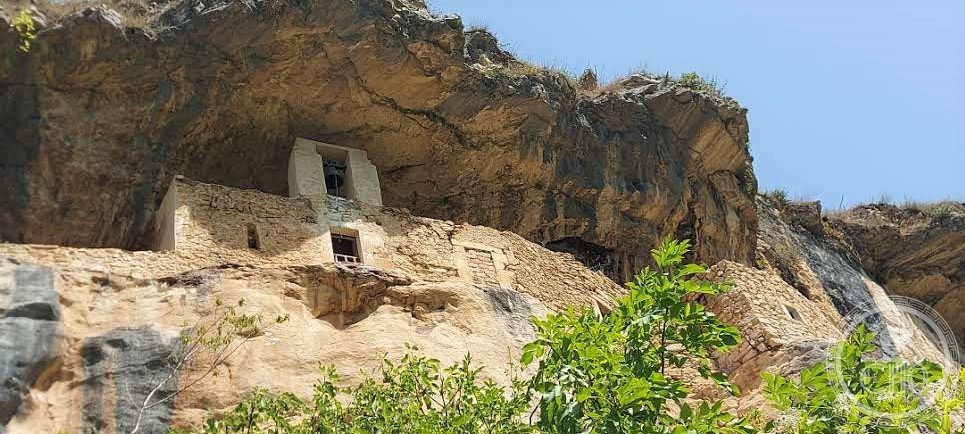
Set in a natural cavity overlooking the valley of the same name, at 700 metres on the Majella, the hermitage already existed before the eleventh century. It was Pietro da Morrone, back from the journey to Lyon where he had obtained from Pope Gregory X the recognition of his Celestine Congregation, who restored it and lived here for at least two years from 1274 — twenty years before being elected pope under the name of Celestine V.
About the Hermitage of San Bartolomeo in Legio
The Hermitage of San Bartolomeo in Legio, entirely built of stone within a natural rock cavity overlooking the valley of the same name in the municipality of Roccamorice, existed as a place of retreat before the 11th century, situated on a rocky outcrop rising some 50 metres at 700 metres of elevation on the Majella massif — the mountain range so closely associated with medieval hermit communities that it is sometimes called the “mother mountain” of Italian eremitism. The hermitage was restored and used by Pietro da Morrone around 1250, and he settled there again around 1274 for at least two years, immediately following his return from a journey to Lyon, where he had obtained from Pope Gregory X formal papal recognition of his own monastic congregation, the Celestines. Pietro would go on, two decades later in 1294, to be elected pope as Celestine V, making this modest rock-cut retreat one of several Majella hermitages directly linked to his pre-papal spiritual life, alongside the nearby Hermitage of Santo Spirito a Majella. The site preserves a rock-cut staircase, the so-called Scala Santa (Holy Stairway), carved directly into the stone, leading up to a small hermit’s cell where the saint is said to have lived in retreat, alongside a chapel and further rooms carved into the rock intended for the hermits who occupied the site. Each year on 25 August, the feast of Saint Bartholomew, the inhabitants of Roccamorice carry a wooden statue of the saint in procession from the hermitage down to the town’s church.
Key facts
- Before the 11th century: hermitage already in existence at the site.
- c. 1250: restored and used by Pietro da Morrone.
- 1274-c. 1276: Pietro settles at the hermitage following his return from Lyon.
- 1294: Pietro da Morrone elected pope as Celestine V.
- Location: a rock outcrop roughly 50 metres tall, at 700 metres elevation on the Majella.
- Structure: a rock-cut chapel, two hermit cells, and the Scala Santa staircase carved into the stone.
- 25 August: annual feast of Saint Bartholomew, with a statue procession from the hermitage to Roccamorice.
History
Pietro da Morrone’s specific choice to retreat to San Bartolomeo in Legio immediately after securing papal recognition for his Celestine congregation in Lyon situates this remote Majella hermitage at a pivotal, if quiet, moment in his own religious biography — a period of contemplative withdrawal directly following a major institutional achievement, two decades before the far more dramatic and reluctant acceptance of the papacy itself in 1294. The hermitage’s connection to Pietro places it within a small constellation of Majella rock-cut retreats — alongside Santo Spirito a Majella and others — that collectively trace the geography of a single medieval hermit’s spiritual formation before his unexpected elevation to the highest office in the Church.
The hermitage’s continued local devotional life, expressed through the annual 25 August procession carrying Saint Bartholomew’s statue from the rock-cut retreat down to the parish church in Roccamorice, demonstrates how a site originally built for solitary hermit contemplation has retained an active, communal religious function for the surrounding population across many centuries, well beyond its original ascetic purpose.
What you see
The hermitage’s rock-cut chapel and two hermit cells remain carved directly into the natural stone cavity, accessed via the Scala Santa staircase, itself hewn from the rock. Built entirely of stone within its natural cavity on the rocky outcrop, the hermitage offers striking views across the valley below, its remote and dramatic setting on the Majella massif largely unchanged since Pietro da Morrone’s own residence there in the 13th century.
Practical information
- Opening hours: accessible via a hiking trail; generally open daily; free admission (donations welcome).
- Address: SP64, 65023 Roccamorice, Italy.
Getting there
The hermitage is reachable on foot from Roccamorice (a short hiking trail) in the Majella National Park, province of Pescara, Abruzzo. GPS: 42.1817° N, 14.0390° E.
Nearby
- Hermitage of Santo Spirito a Majella — another Celestine hermitage, a short distance away.
- Roccamorice — the nearby village.
- Majella National Park — the surrounding protected mountain landscape.
Sources
- Majambiente — “Eremo di San Bartolomeo in Legio” (majambiente.it).
- Parco Majella — “Eremo di San Bartolomeo in Legio” (parcomajella.it).
- Info Point Regione Abruzzo — “Eremi in Abruzzo: Eremo di San Bartolomeo in Legio” (infopointabruzzo.it).
Find it on the map
See this place and what’s around it →📷 Become a Cultural Heritage Online photographer
Share your photos of places: they stay published under your name as the author. The more they're seen, the more you get noticed — and soon a contest will reward the most appreciated photos.
Log in or sign up free to add a photo