
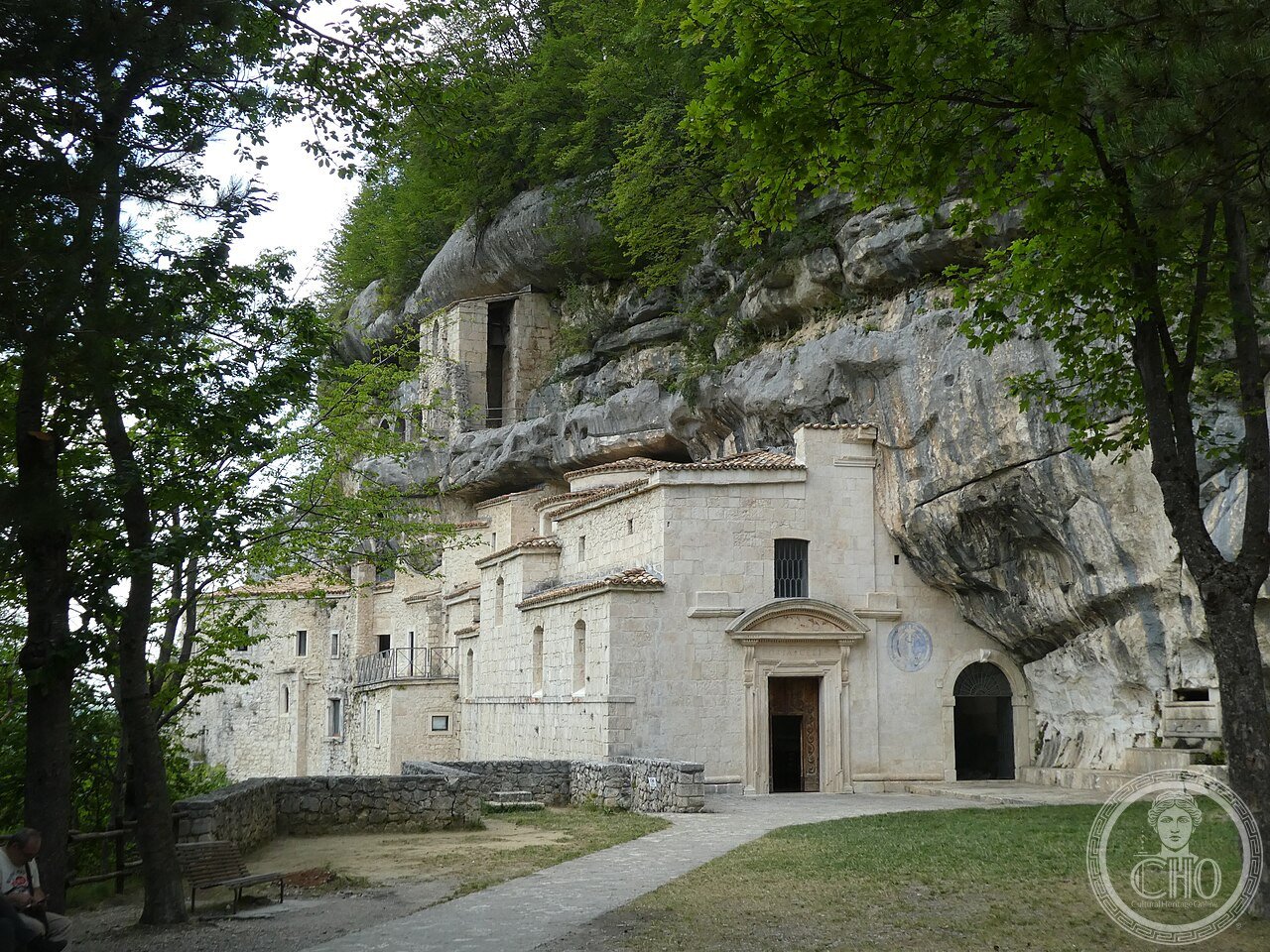
Nel 1055, il monaco Desiderio — futuro papa Vittore III, allora abate di Montecassino — costruì qui una chiesa. Quasi due secoli dopo, nel 1246, Pietro da Morrone giunse a restaurare l’eremo e vi costruì il primo oratorio e la prima cella: fu l’atto fondativo della congregazione che sarebbe diventata l’ordine dei Celestini. Un secolo più tardi, nel 1347, il tribuno romano Cola di Rienzo vi trovò rifugio in fuga da Roma.
About the Hermitage of Santo Spirito a Majella
The exact founding date of the Hermitage of Santo Spirito a Majella remains uncertain, though it is believed to predate the 11th century, established by Benedictine monks from the Abbey of Montecassino. The earliest historical record dates to 1055, when the monk Desiderio — the future Pope Victor III — built a church there. The site’s most consequential transformation came in 1246, when Pietro da Morrone arrived and substantially restructured the hermitage, building an oratory and a first cell, followed by a second oratory and further cells as the community grew — laying the practical foundation for what would become the Celestine order. On 1 June 1263, Pope Urban IV issued a letter instructing the Bishop of Chieti to incorporate the hermitage’s monks into the Order of Saint Benedict at Pietro’s own request, and in 1278 the hermitage was granted autonomy and the title of monastery, serving as the leading house of the order until 1293, when that role passed to another establishment. In 1347, the Roman tribune Cola di Rienzo took refuge at the hermitage while fleeing Rome. The community later fell into decline before recovering in 1586, when it received the title of Abbey. Following the suppression of religious orders in 1807, the monastery was definitively abandoned, its contents transferred to the nearby town of Roccamorice. Assigned to the Ministry of Cultural Heritage in 1998, the site has since undergone an ongoing restoration project, with its management entrusted since 2014 to the regional museum authority for Abruzzo.
Key facts
- Before the 11th century: founded by Benedictine monks from Montecassino
- 1055: the monk Desiderio, future Pope Victor III, builds a church at the site
- 1246: Pietro da Morrone restructures the hermitage, founding what becomes the Celestine order
- 1 June 1263: Pope Urban IV incorporates the monks into the Benedictine Order
- 1278: hermitage granted autonomy and monastery status, lead house of the order until 1293
- 1347: Cola di Rienzo takes refuge there while fleeing Rome
- 1586: the community receives the title of Abbey after a period of decline
- 1807: monastery suppressed and abandoned; restoration ongoing since 1998
History
The hermitage’s documented link to Desiderio in 1055 — a monk who would rise to become Abbot of Montecassino and, briefly, Pope Victor III — connects this remote Majella site to one of medieval Italy’s most powerful monastic institutions from its very earliest recorded history, well before Pietro da Morrone’s own arrival nearly two centuries later. Pietro’s 1246 restructuring of the hermitage, building its first oratory and cell as the nucleus of a growing community, represents the genuine institutional starting point of what would become the Celestine order — making Santo Spirito a Majella, rather than any of Pietro’s later, more famous retreats, the actual birthplace of the congregation he would lead until his brief and reluctant papacy in 1294.
Cola di Rienzo’s 1347 refuge at the hermitage, arriving as a fugitive from Rome following the collapse of his own populist revolutionary government there, situates this isolated Majella retreat within the wider political turbulence of 14th-century Italy, offering sanctuary to one of the period’s most dramatic and controversial political figures at the height of his personal crisis.
What you see
The hermitage complex, built into a narrow rocky gorge on the Majella massif, preserves the successive oratories and cells added from Pietro da Morrone’s 1246 restructuring onward, alongside later additions from the community’s 1586 elevation to Abbey status. Ongoing restoration since 1998 has worked to stabilise and recover the site’s historic fabric, which remains dramatically integrated into the surrounding rock formation.
Practical information
- Opening hours: open to visitors on a scheduled basis, seasonal variation; check current hours before visiting; admission fee may apply
- Address: Strada Comunale Santo Spirito 22, 65020 Roccamorice, Italy
Getting there
The Hermitage of Santo Spirito a Majella is reachable by car or on foot from Roccamorice, in the Majella National Park, province of Pescara, Abruzzo. GPS: 42.1709° N, 14.0882° E.
Nearby
- Hermitage of San Bartolomeo in Legio — another Celestine hermitage, a short distance away
- Roccamorice — the nearby village
- Majella National Park — the surrounding protected mountain landscape
Sources
- Wikipedia — “Eremo di Santo Spirito a Maiella” (it.wikipedia.org)
- Eremo Abbazia di Santo Spirito a Maiella — official site (santospiritomaiella.com)
- Ministero della Cultura — “Eremi celestiniani Parco Maiella” (cultura.gov.it)
Find it on the map
See this place and what’s around it →📷 Become a Cultural Heritage Online photographer
Share your photos of places: they stay published under your name as the author. The more they're seen, the more you get noticed — and soon a contest will reward the most appreciated photos.
Log in or sign up free to add a photo