
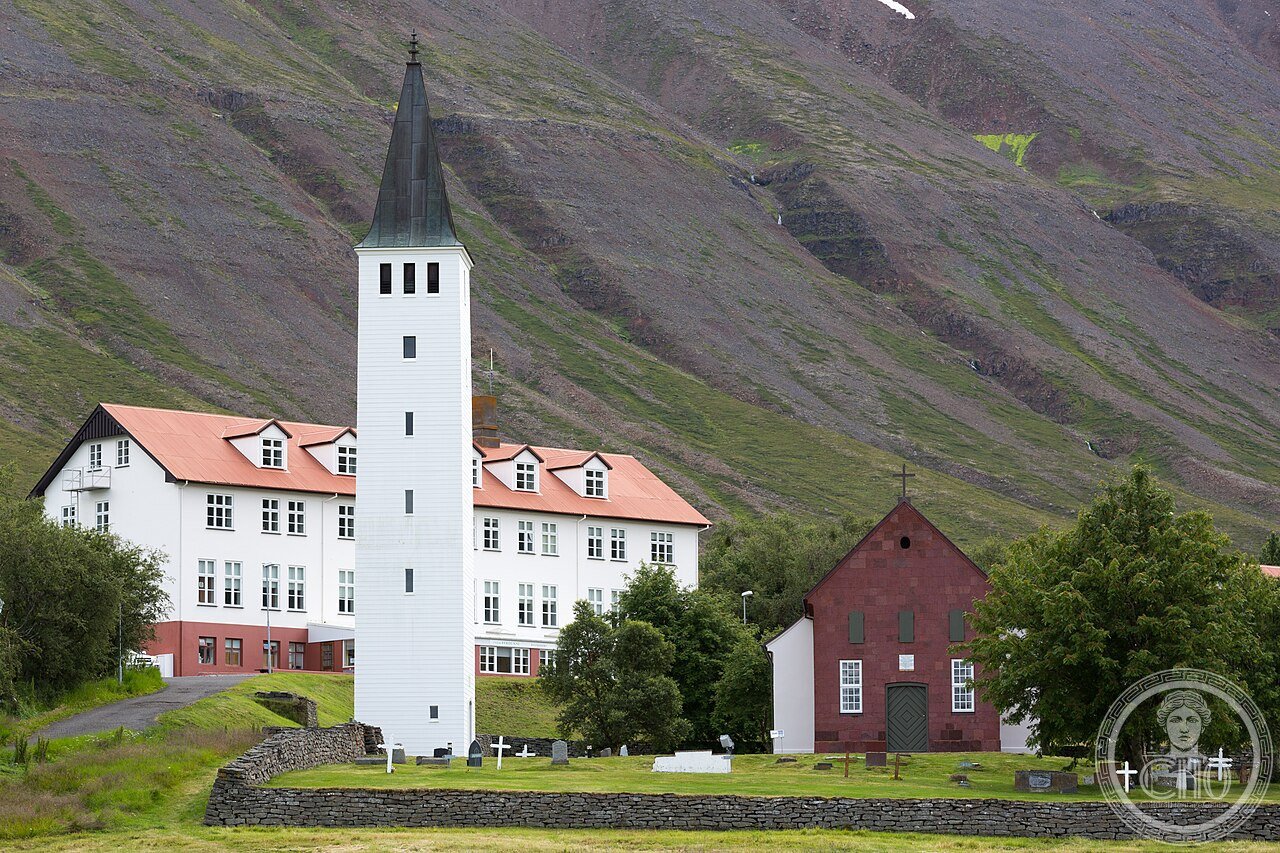
Nel 1530, il vescovo Jón Arason fece installare qui la prima tipografia della storia islandese, affidata allo stampatore Jón Matthíasson: nel 1534 uscì il primo libro mai stampato in Islanda, il Breviarium Nidrosiense. Vent’anni dopo, lo stesso vescovo sarebbe stato decapitato a Skálholt per essersi opposto alla Riforma luterana — l’ultimo vescovo cattolico che l’Islanda avrebbe conosciuto per quasi quattro secoli.
About Hólar Cathedral
The bishopric of Hólar was founded in 1106 to serve the northern half of Iceland, complementing the older southern see at Skálholt, with Jón Ögmundsson consecrated as its first bishop. A church had already stood at the site since the 11th century — the first, built in 1050 by Oxi Hjaltason, was followed by a second between 1050 and 1106, a third erected by Bishop Jón Ögmundsson himself after 1106, a fourth around 1300 under Bishop Jörundur Þorsteinsson, a fifth around 1394 under Bishop Pétur Nikulásson, and a sixth built around 1627 under Halldóra Guðbrandsdóttir — six successive churches before the present, seventh building. Hólar reached a particular high point under Bishop Jón Arason, consecrated in 1524, who in 1530 established Iceland’s first printing press at his episcopal seat, operated by the printer Jón Matthíasson; the only book known with certainty to have been printed there, the Breviarium Nidrosiense, appeared in 1534, before Matthíasson relocated the press with him to a new parish. Arason, the last Catholic bishop of Hólar, resisted the Danish crown’s imposition of Lutheranism for years after his southern counterpart at Skálholt was deported in 1541, until he and his two sons were beheaded at Skálholt on 7 November 1550, ending Catholic ecclesiastical resistance in Iceland for the better part of four centuries. The present cathedral at Hólar was built between 1757 and 1763 at the initiative of Bishop Gísli Magnússon, designed by the architect Laurids de Thurah and constructed from red sandstone quarried from the neighbouring mountain; it was consecrated on 20 November 1763. Hólar functioned as the northern episcopal see until 1801, when the diocese was abolished in favour of a single bishopric for all of Iceland, before being re-established as a suffragan see in 1909. Today, Hólar Cathedral is recognised as Iceland’s oldest surviving stone church.
Key facts
- 1106: bishopric of Hólar founded, with Jón Ögmundsson as first bishop
- Six earlier churches: built successively on the site between 1050 and 1627
- 1524: Jón Arason consecrated bishop of Hólar
- 1530-1534: Iceland’s first printing press established at Hólar; the Breviarium Nidrosiense printed in 1534
- 7 November 1550: Jón Arason and his two sons beheaded at Skálholt, ending Catholic resistance in Iceland
- 1757-1763: present red sandstone cathedral built by architect Laurids de Thurah, consecrated 20 November 1763
- 1801/1909: diocese abolished, then re-established as a suffragan see
- Today: Iceland’s oldest surviving stone church
History
Jón Arason’s 1530 establishment of Iceland’s first printing press at Hólar situates the northern diocese at the very origin of Icelandic print culture, a technological milestone he pursued specifically in service of Catholic liturgical and educational needs in the years immediately preceding the Reformation crisis that would ultimately cost him his life — the same bishop who brought printing to Iceland became, two decades later, its last Catholic martyr. The six successive churches that stood at Hólar between 1050 and 1627, each rebuilt in turn before the present red sandstone structure of 1757-1763, reflect a site of continuous religious significance across more than seven centuries, surviving fire, structural failure, and changing architectural fashion.
The construction of the present cathedral specifically from red sandstone quarried in the immediate vicinity gave 18th-century Hólar a building material and technique distinct from Iceland’s more common timber or turf church construction, contributing directly to its survival and its current status as the country’s oldest stone church — a durability that has preserved, in permanent material form, the site most closely associated with Iceland’s final Catholic bishop.
What you see
The cathedral, built of red sandstone quarried from the neighbouring mountain between 1757 and 1763 to designs by Laurids de Thurah, remains Iceland’s oldest surviving stone church. Its distinctive red-toned masonry sets it apart from the great majority of Iceland’s historic churches, most built in timber or turf. The site also preserves Auðunarstofa, a reconstructed medieval-style timber hall associated with the bishopric’s historic administrative functions.
Practical information
- Opening hours: generally open daily with seasonal variation; check current hours before visiting; free admission
- Address: Hólakirkja, Hólavegur, 551 Hólar, Skagafjörður, Iceland
Getting there
Hólar is reachable by car from Sauðárkrókur (approximately 30 minutes) in the Skagafjörður region, North Iceland. GPS: 65.7334° N, -19.1138° E.
Nearby
- Hólar University College — a modern institution continuing the site’s educational tradition
- Sauðárkrókur — approximately 30 minutes away; the largest town in the region
- Skagafjörður — the surrounding fjord and valley region
Sources
- Wikipedia — “Hólar Cathedral” and “Hólar” (en.wikipedia.org)
- Visit North Iceland — “Hólar Cathedral” (northiceland.is)
- Tiplr — “Hólar – Iceland’s ‘Other’ Vatican” (tiplr.com)
Find it on the map
See this place and what’s around it →📷 Become a Cultural Heritage Online photographer
Share your photos of places: they stay published under your name as the author. The more they're seen, the more you get noticed — and soon a contest will reward the most appreciated photos.
Log in or sign up free to add a photo