
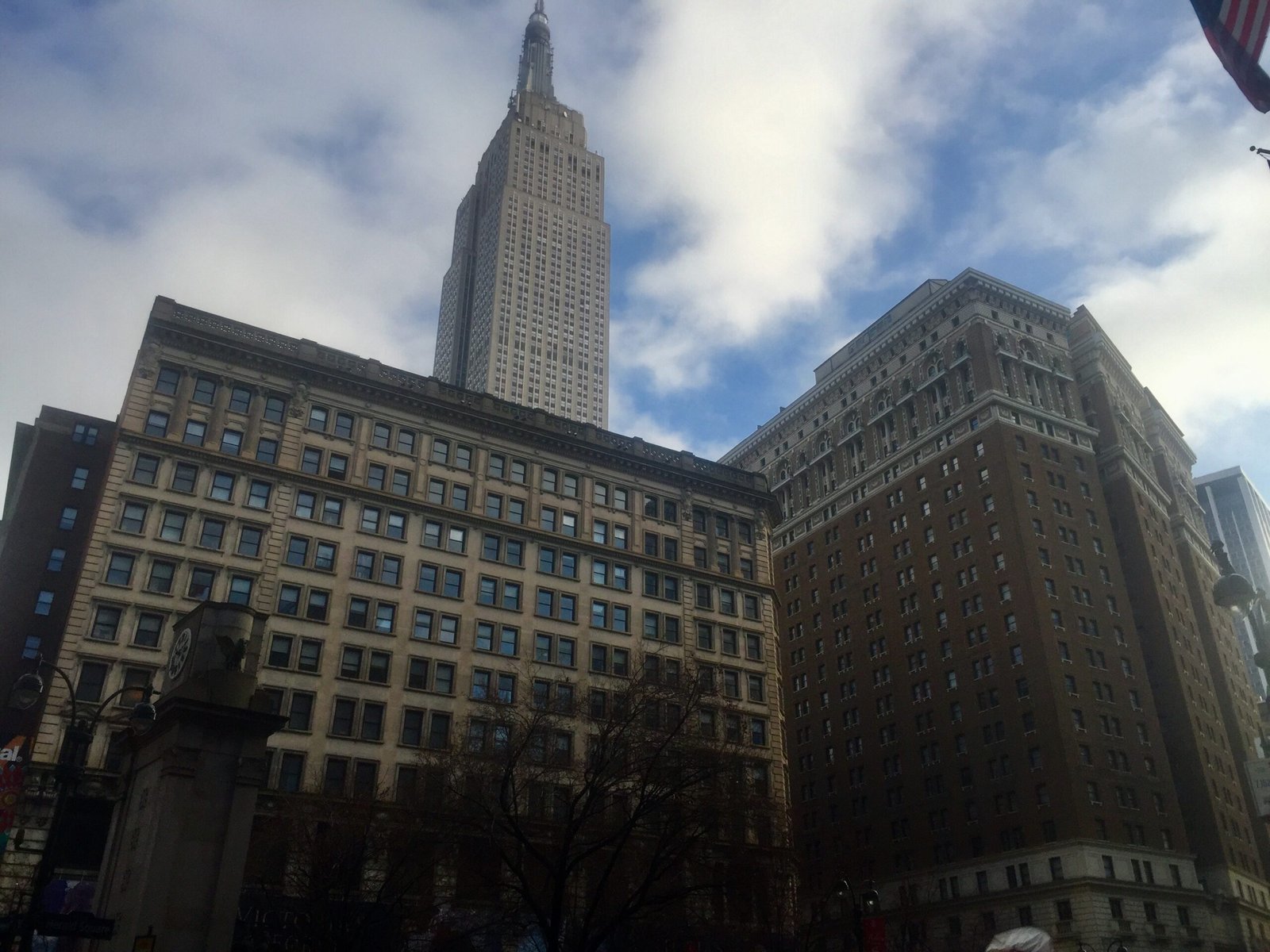
Completed on May 1, 1931 in just 410 days of construction, the Empire State Building at 350 Fifth Avenue held the title of world’s tallest structure for 39 years — its 102 floors and 1,250-foot limestone shaft embodying the ambition of Depression-era New York in a tower whose mast was designed, with characteristic optimism, as a mooring point for transatlantic dirigibles.
At a glance
The Empire State Building at 350 Fifth Avenue was the world’s tallest building from its opening on May 1, 1931 until the completion of the original World Trade Center in 1970 — a tenure of 39 years. Designed by William F. Lamb of Shreve, Lamb & Harmon and developed by a group led by John J. Raskob and former New York governor Al Smith, the 102-story tower rises 1,250 feet (381 metres) to the roof and 1,454 feet (443 metres) to the top of its antenna. Its Art Deco cladding of Indiana limestone and granite, with aluminum spandrels and windows, reflects the influence of the 1916 Zoning Law setback requirements and the commercial pressures of rapid construction: the building was designed in two weeks and erected at the rate of approximately four and a half floors per week. The 86th-floor observation deck, with views encompassing a 50-mile radius in clear conditions, remains one of the most visited attractions in the United States.
Key facts
- Completed: May 1, 1931 (construction began March 17, 1930)
- Architects: Shreve, Lamb & Harmon (William F. Lamb, principal designer)
- Developer: Empire State Inc. (John J. Raskob, Al Smith, Pierre S. du Pont)
- Style: Art Deco
- Address: 350 Fifth Ave at 34th St, New York, NY 10118
- Height: 1,250 ft (381 m) to roof / 1,454 ft (443 m) to antenna / 102 floors
- World’s tallest: 1931–1970 (39 years; surpassed by 1 World Trade Center)
- Designation: National Historic Landmark (1986); NYC Individual Landmark
History
The Empire State Building was conceived in the final euphoric months of the 1920s boom as a direct response to the Chrysler Building, which had stolen the world’s tallest title with its secret spire in 1930. John J. Raskob, the General Motors executive who had recently lost the Democratic presidential nomination to Herbert Hoover, and former New York governor Al Smith formed Empire State Inc. to develop the site of the old Waldorf-Astoria Hotel at 34th Street and Fifth Avenue. The project’s design brief was brisk: William F. Lamb of Shreve, Lamb & Harmon later recalled that Raskob placed a pencil on his desk and asked “How high can you make it so that it won’t fall down?” The pencil’s tapered form reportedly inspired the building’s massing.
The construction schedule was extraordinary even by the standards of a decade accustomed to ambitious building projects. Beginning on March 17, 1930, the construction teams — at peak employment approximately 3,400 workers per day — erected the steel frame at a rate of about four and a half floors per week, with the entire building — 365,000 tons of steel, limestone, granite, aluminum, and glass — completed in 410 working days. The project opened on schedule on May 1, 1931, although its commercial success was initially limited by the Depression: the building was nicknamed the “Empty State Building” during its early years of low occupancy. The mooring mast at the top, designed as a terminal for transatlantic dirigibles, was never used for that purpose: the updrafts around the building made safe mooring impossible, and public concern about the safety of hydrogen-filled airships over Midtown Manhattan precluded any serious attempt.
The building achieved its eventual cultural status not through commerce but through cinema: the 1933 film King Kong, in which the giant ape climbs the building’s mooring mast, established the image of the tower as a symbol of New York’s vertical ambition that has persisted through every subsequent decade. The 86th-floor observation deck became one of the city’s signature tourist destinations from the 1930s onward. The building was designated a National Historic Landmark in 1986 and continues to generate substantial revenue from its observation decks and broadcast antennae, whose signals reach approximately 26 million viewers in the greater New York metropolitan area.
What you see
The Empire State Building’s exterior is the canonical image of Art Deco skyscraper design: a limestone shaft rising from the Midtown street grid through a series of setbacks mandated by the 1916 Zoning Law, each setback stepping back to reduce the building’s floor plate as the tower rises, until the final floors narrow to the circular crown at the 102nd floor. The facade treatment is restrained compared to the Chrysler’s ornamental exuberance: Indiana limestone alternates with gray granite at the base, with aluminum spandrels and windows above, creating a vertical rhythm of ribbed piers that draws the eye upward without the heraldic imagery of the Chrysler’s eagles and hubcap friezes.
The building’s crown — the circular shaft of the mooring mast above the 86th floor — is illuminated at night in colours that change for holidays, seasons, and commemorations: red and green at Christmas, orange for Halloween, lavender and white for Pride, blue and white for New York Giants victories. The 86th-floor observation deck, open to the outdoor terrace, offers the city’s most celebrated 360-degree view: the Chrysler Building is visible to the north-east, the Hudson and East Rivers on either side, Central Park extending north, and on clear days the skylines of Brooklyn, New Jersey, and Connecticut on all horizons. The lobby, on the 34th Street side, retains its original Art Deco marble panels and bas-reliefs, including murals of the building itself and the state of New York.
Practical information
- Observation deck (86th floor): Open daily 8am–2am; paid; esbnycvisit.com; advance booking saves queue time
- Top deck (102nd floor): Additional charge; limited capacity; spectacular clear-day views
- Lobby access: Free; open weekdays during business hours; Art Deco lobby murals and panels
- Best time: Sunset for the transition from day to night views; weekday mornings for shorter queues
- Time needed: 1–2 hours with observation deck
- GPS: 40.7484° N, 73.9857° W
- Nearest transit: 34th St–Herald Sq (B/D/F/M/N/Q/R/W), 5 minutes; 34th St–Penn Station (1/2/3/A/C/E), 5 minutes
Getting there
The Empire State Building is at 350 Fifth Avenue at 34th Street in Midtown Manhattan. Multiple subway lines converge at 34th Street: Herald Square (B, D, F, M, N, Q, R, W lines) is 5 minutes west; Penn Station (1, 2, 3, A, C, E lines) is 5 minutes west. JFK Airport: approximately 50 minutes via AirTrain and subway. Newark Airport (EWR): approximately 35 minutes via NJ Transit to Penn Station.
Nearby
- Chrysler Building (1930) — William Van Alen; Art Deco; 405 Lexington Ave; 10 minutes north-east; CHO place card
- New York Public Library — Schwarzman Building (1911) — Carrère & Hastings; Beaux-Arts; 10 minutes north on Fifth Ave; already in CHO collection
- Madison Square Garden / Pennsylvania Station area — 5 minutes west; transport hub and Penn Station below (major Amtrak + NJ Transit terminal)
Sources
- National Park Service, NHL nomination form, Empire State Building — nps.gov
- Goldman, Jonathan. The Empire State Building Book. St. Martin’s Press, 1980. Construction history.
- Stern, Robert A. M., Gregory Gilmartin, and Thomas Mellins. New York 1930. Rizzoli, 1987.
- New York City Landmarks Preservation Commission, LP-0879 — nyc.gov/lpc
- Wikidata, Empire State Building — wikidata.org
Gallery
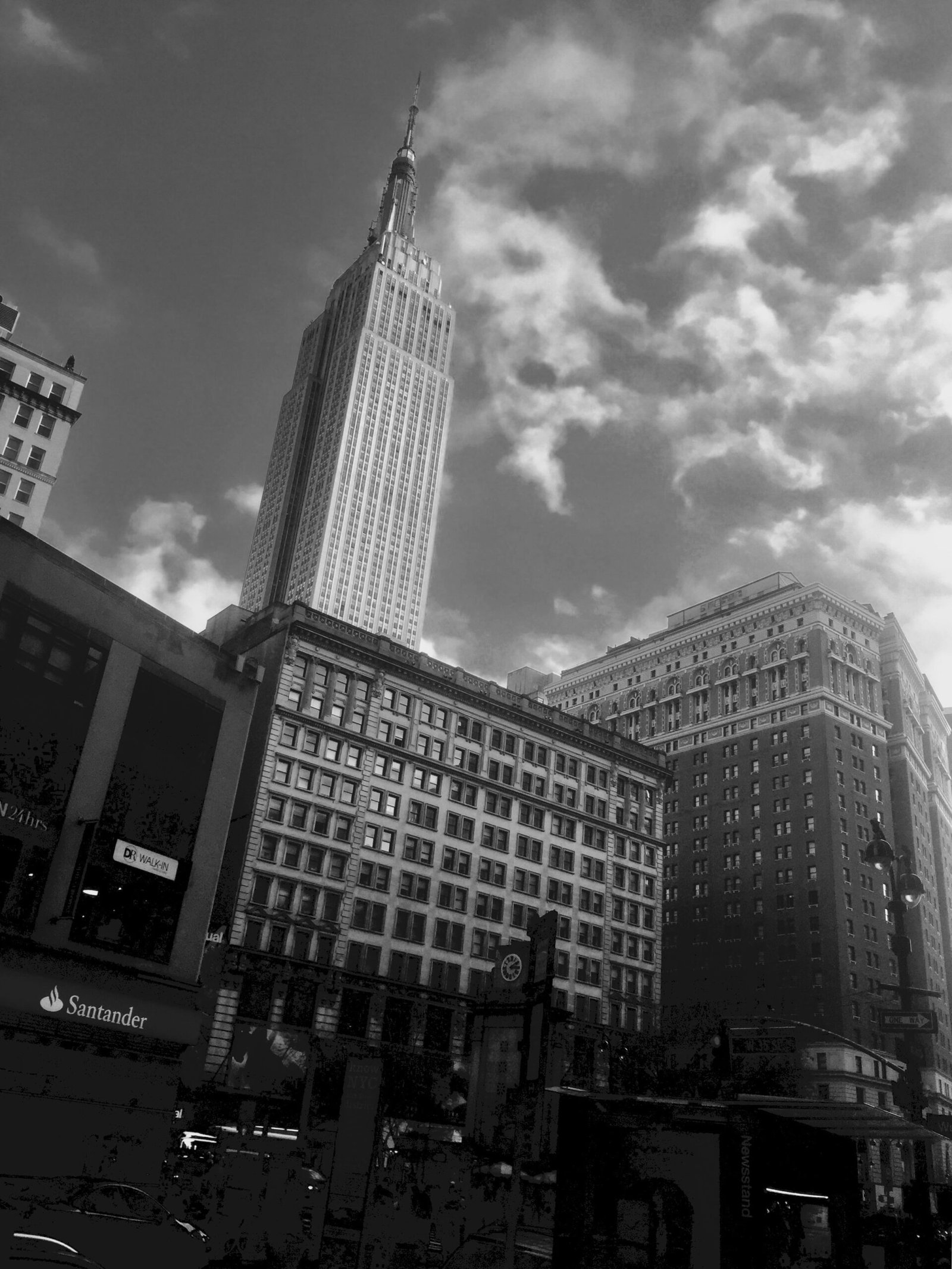
Midtown Manhattan, photographed by Luigi De Marchi.
Find it on the map
See this place and what’s around it →📷 Become a Cultural Heritage Online photographer
Share your photos of places: they stay published under your name as the author. The more they're seen, the more you get noticed — and soon a contest will reward the most appreciated photos.
Log in or sign up free to add a photoIs this page about you?
This page is read by travellers and heritage enthusiasts who find it on Google. Tell us how you are connected to this place and we will take it from there.