

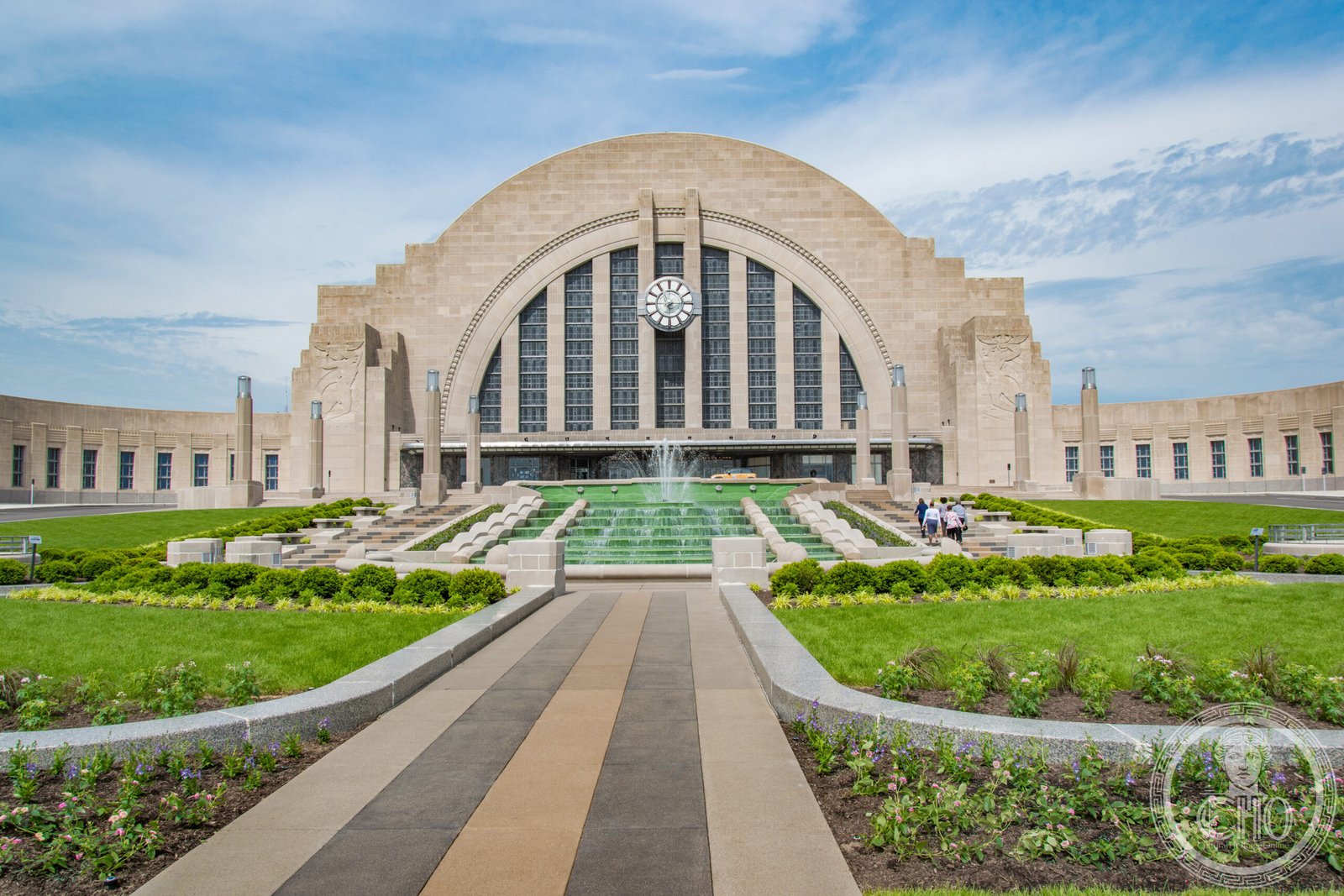

Completed in 1933 and today housing the Cincinnati Museum Center, Union Terminal is one of the finest surviving Art Deco buildings in the United States — its 180-foot half-dome facade a landmark of Depression-era civic architecture, its interior rotunda adorned with Winold Reiss’s monumental mosaic murals celebrating the history and industries of Cincinnati.
At a glance
Cincinnati Union Terminal, designed by Fellheimer & Wagner with Paul Philippe Cret as consulting architect and opened on March 31, 1933, is among the most architecturally ambitious railroad terminals built in the United States. Its defining element is the half-dome facade — a 180-foot-wide semicircular form that faces Ezzard Charles Drive — which functions simultaneously as the building’s structural crown, its main entrance canopy, and its most photographed exterior element. Inside, the main rotunda is one of the great Art Deco interior spaces in America: 145 feet in diameter, its curved walls covered with sixteen mosaic lunettes by Winold Reiss depicting the workers and industries of Cincinnati — steelworkers, glassblowers, soap-makers, riverboat builders — in a colour palette of terracotta, turquoise, and gold. The terminal closed as an active rail station in 1972 and reopened in 1990 as the Cincinnati Museum Center, now housing the Cincinnati History Museum, Cincinnati Museum of Natural History & Science, and the Duke Energy Children’s Museum. It is a National Historic Landmark.
Key facts
- Completed: 1933 (opened March 31, 1933)
- Architects: Fellheimer & Wagner (Alfred T. Fellheimer and Steward Wagner); consulting architect Paul Philippe Cret (1876–1945)
- Style: Art Deco
- Address: 1301 Western Ave, Cincinnati, OH 45203
- Half-dome: 180 ft (55 m) wide; dominant exterior element
- Murals: 16 mosaic lunettes by Winold Reiss (1888–1953) in main rotunda
- Current use: Cincinnati Museum Center (since 1990) — history, natural science, children’s museum, Omnimax theater
- Designation: National Historic Landmark (1977)
History
The construction of Cincinnati Union Terminal in the early 1930s was a remarkable act of civic ambition at the nadir of the Great Depression. Seven competing railroads serving Cincinnati — the Baltimore and Ohio, the Chesapeake and Ohio, the Louisville and Nashville, the Norfolk and Western, the New York Central, the Pennsylvania, and the Southern — agreed to consolidate their separate terminal facilities into a single shared station on a site in Mill Creek Valley west of downtown. The project required the relocation of the Mill Creek itself, the construction of extensive new rail infrastructure, and the design of a terminal building large enough to handle the traffic of all seven lines simultaneously.
Alfred T. Fellheimer of Fellheimer & Wagner had designed Grand Central Terminal’s improvements in New York and brought to Cincinnati a sophisticated understanding of the functional requirements of large rail terminals. Paul Philippe Cret, the Philadelphia Beaux-Arts architect who had also worked on federal buildings in Washington, contributed a design sensibility that balanced the functional demands of the program with an Art Deco visual language of exceptional clarity. The building’s plan is organized around the great rotunda, which serves as the main concourse — a 145-foot-diameter room from which all passenger facilities radiate — with the half-dome facade announcing this circular organisation to the city.
The terminal was one of the last great American railroad stations built before the long decline of passenger rail. Its active service life as a railroad terminal ended in 1972, when the last scheduled passenger trains departed. The building sat partially vacant for years before a referendum approved its conversion to a museum complex; the restoration and reopening in 1990 was one of the landmark American adaptive reuse projects of the era. A major renovation completed in 2018, following a $228 million campaign, restored the terminal’s principal spaces to their original splendour.
What you see
The half-dome facade is visible from the elevated approach road long before you reach the building, its pale limestone and brick surface rising above the surrounding landscape as an unmistakable Art Deco form. Unlike the vertical ambition of the New York towers, Union Terminal’s scale is horizontal: the building spreads across a vast site, its dome the punctuation mark of a composition that extends in both directions. The mosaic that covers the interior of the half-dome — a stylised sunburst of terracotta and turquoise — is the most photographed element of the building’s exterior.
Inside, the rotunda is the building’s supreme achievement. Winold Reiss’s sixteen lunette mosaics, each approximately 20 feet tall, ring the upper walls of the rotunda above the ticket windows and escalators: a continuous narrative of Cincinnati’s industrial and commercial history rendered in the vivid palette of Depression-era public art. The figures — workers in overalls, engineers, river pilots, glassblowers — are depicted with a formalist dignity that draws on both the Art Deco stylisation of the period and Reiss’s earlier work on mosaics for the Cincinnati train concourses. The floor of the rotunda, a circular field of terrazzo in geometric patterns, and the curved ticket windows in their limestone surrounds, complete one of the most intact Art Deco interiors anywhere in the United States.
Practical information
- Cincinnati Museum Center access: Open Tuesday–Sunday 10am–5pm; admission charged for individual museums; rotunda free to enter
- Omnimax Theater: Separate admission; schedule at cincymuseum.org
- Best time: Weekday mornings for uncrowded rotunda; school groups arrive mid-morning
- Time needed: 1 hour for architecture only; half-day for museum content
- GPS: 39.1097° N, 84.5390° W
- Nearest transit: Cincinnati Metro bus routes; approximately 2 miles (3 km) from downtown; free parking on site
Getting there
Cincinnati Union Terminal is at 1301 Western Avenue, approximately 2 miles north-west of downtown Cincinnati. No direct subway connection; Cincinnati Metro bus routes serve the site. By car, the building is directly accessible from I-75 north (exit 1C, Western Ave). Cincinnati/Northern Kentucky International Airport (CVG) is approximately 12 miles south; taxi or rideshare takes 20–25 minutes. Free parking is available on the terminal grounds.
Nearby
- Carew Tower (1930) — Ely Jacques Kahn; Art Deco; downtown Cincinnati; 2 miles east; CHO place card
- Eden Park — Cincinnati Art Museum (free permanent collection); Krohn Conservatory; 20 minutes by car from Union Terminal
- Ohio River waterfront — Roebling Suspension Bridge (1866, prototype for Brooklyn Bridge); 3 miles south-east
Sources
- National Park Service, NHL nomination form, Cincinnati Union Terminal — nps.gov
- Condit, Carl W. The Railroad and the City: A Technological and Urbanistic History of Cincinnati. Ohio State University Press, 1977.
- Cincinnati Museum Center, building history — cincymuseum.org
- Stern, Robert A. M. Pride of Place: Building the American Dream. Houghton Mifflin, 1986. Chapter on terminal architecture.
- Wikidata, Cincinnati Union Terminal — wikidata.org
Find it on the map
See this place and what’s around it →📷 Become a Cultural Heritage Online photographer
Share your photos of places: they stay published under your name as the author. The more they're seen, the more you get noticed — and soon a contest will reward the most appreciated photos.
Log in or sign up free to add a photoIs this page about you?
This page is read by travellers and heritage enthusiasts who find it on Google. Tell us how you are connected to this place and we will take it from there.