
.jpg)
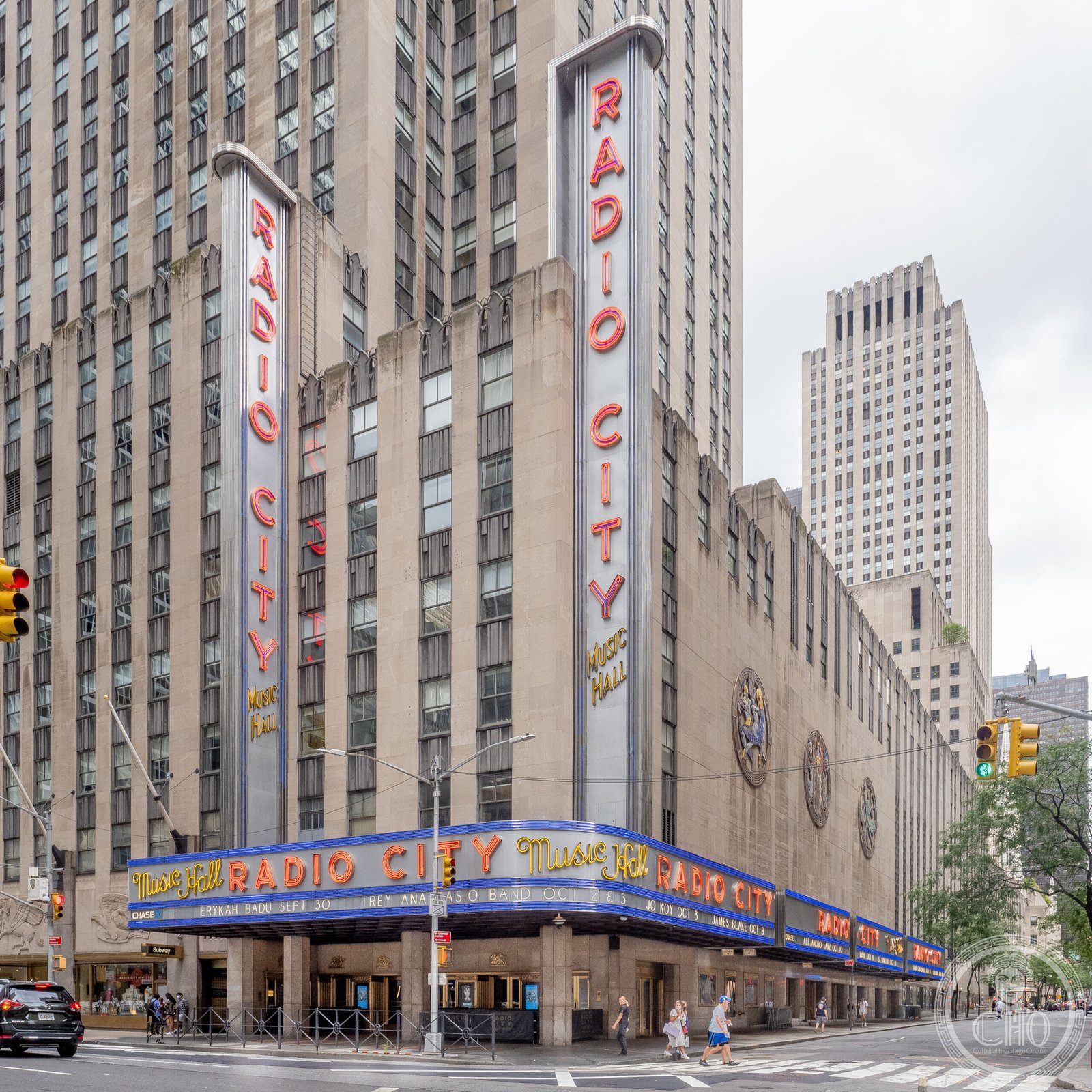
Completed in 1932 at the corner of Sixth Avenue and 50th Street as part of Rockefeller Center, Radio City Music Hall was the largest indoor theater in the world when it opened — its 6,015-seat auditorium enclosing one of the most complete and coherent Art Deco interiors ever created, with Donald Deskey’s design programme extending from the aluminium and velvet of the Grand Foyer to the great golden sunburst proscenium arch over the stage.
At a glance
Radio City Music Hall at 1260 Avenue of the Americas (Sixth Avenue) was designed as the prestige entertainment venue of Rockefeller Center — conceived by the theater impresario Samuel “Roxy” Rothafel as a “palace for the people” in which no seat would feel second-class. With 6,015 seats arranged across orchestra and three mezzanine levels, it was the world’s largest indoor theater at its opening in December 1932. The exterior, designed by the Associated Architects of Rockefeller Center (Reinhard & Hofmeister; Corbett, Harrison & MacMurray; Hood & Fouilhoux), is a dignified Art Deco composition of brick and limestone with stainless steel marquee. The interior, designed by Donald Deskey following a competition, is the building’s principal achievement: a unified Art Deco environment of extraordinary ambition, in which murals, textiles, furniture, metalwork, and lighting were all designed as an integrated whole. Radio City has been a New York City Landmark since 1978.
Key facts
- Opened: December 27, 1932
- Architects (exterior): Associated Architects of Rockefeller Center: Reinhard & Hofmeister; Corbett, Harrison & MacMurray; Hood & Fouilhoux
- Interior designer: Donald Deskey (1894–1989)
- Style: Art Deco
- Address: 1260 Avenue of the Americas (Sixth Ave at 50th St), New York, NY 10020
- Seating: 6,015 (orchestra + 3 mezzanines)
- Designation: NYC Individual Landmark (1978)
- Notable: Annual Christmas Spectacular; Rockettes; Wurlitzer organ; “Rising Sun” proscenium arch; Ezra Winter ceiling mural “Fountain of Youth”
History
Samuel “Roxy” Rothafel had built his reputation as the creator of the great movie palaces of the 1920s — the Capitol, the Roxy — and brought to Radio City the conviction that a great theater should overwhelm its audience with beauty from the moment they entered the lobby. When John D. Rockefeller Jr. offered him the anchor entertainment venue in Rockefeller Center, Rothafel proposed something larger than a movie palace: a theater designed for vaudeville, live performance, and film, scaled to match the grandeur of the surrounding development. The name “Radio City” referenced the radio broadcast facilities planned for the complex (NBC would occupy 30 Rock) and the cultural fantasy of a new kind of urban entertainment district.
The interior design competition was won by Donald Deskey, an American industrial designer who had been working with modernist principles drawn from European precedents — the Bauhaus, De Stijl, the Vienna Workshops — but translated into an American idiom of optimism, machine aesthetics, and luxury materials. Deskey’s programme for Radio City was comprehensive: he designed the furniture, the textiles, the metalwork, the light fixtures, and the decorative programme of the major spaces, commissioning murals from Stuart Davis, Yasuo Kuniyoshi, and Ezra Winter, among others. The grand foyer’s gold-leaf ceiling, the aluminium staircase balustrades, the leather and velvet of the main auditorium — all Deskey, all conceived as parts of a single environment rather than as individual decorative elements.
The theater’s programming history has been as eventful as its architecture. After a shaky opening as a vaudeville house in December 1932, it was quickly reprogrammed as a first-run movie palace, a role it filled with enormous success for nearly forty years. By the 1970s, the shift to multiplex cinema had made the 6,000-seat format commercially unviable, and demolition was proposed in 1978. A public campaign led by the Municipal Art Society reversed the decision; Radio City was designated a New York City Landmark that year and has operated ever since as a concert venue and home of the annual Christmas Spectacular, the Rockettes’ holiday show that typically plays to over a million people each season.
What you see
The exterior on Sixth Avenue is deceptively restrained: a facade of brick and limestone with a stainless steel marquee extending to the sidewalk, its curved corners and horizontal banding marking it as of its decade without the explicit ornamental programme of the Chrysler or the Empire State. The impact of Radio City is reserved entirely for what lies behind the entrance doors. The Grand Foyer — 140 feet long, with a gold-leaf ceiling that catches and diffuses the light from concealed sources, and Ezra Winter’s mural “Fountain of Youth” covering the entire curved end wall — is one of the great theatrical entry sequences in any American building. The Deskey materials — aluminium, Bakelite, cork, mirrored glass — are combined with the discipline of a stage designer who understands that every surface will be seen under artificial light rather than daylight.
The auditorium itself is the defining space: 6,015 seats arranged to face the stage in a single sweep of mezzanines, the proscenium arch shaped as a great radiating sunburst of gold, the ceiling above the orchestra a sequence of concentric gilded arches that amplify the sightlines toward the stage. The Wurlitzer organ — one of the largest in the world — rises on hydraulic lifts from below the stage. Stage tours (available most mornings) include the Deskey interiors, the rehearsal studios where the Rockettes practise, and the orchestra pit with the Wurlitzer visible. The theater is best experienced during a live performance, when Deskey’s lighting programme — dimming and shifting through the show — fully demonstrates the building’s original theatrical purpose.
Practical information
- Interior tours: “The Iconic Tour” available most mornings; paid; booking at rockefellercenter.com or radiocity.com
- Performances: Concerts, award shows, Christmas Spectacular (October–January); check msg.com/radio-city
- Best time: Tour mornings; Christmas Spectacular for the full seasonal experience
- Time needed: 1 hour tour; 2–3 hours for a performance
- GPS: 40.7599° N, 73.9801° W
- Nearest transit: 47th–50th Sts–Rockefeller Ctr (B/D/F/M), 1 minute; 49th St (N/W/R), 3 minutes
Getting there
Radio City Music Hall is at 1260 Avenue of the Americas (Sixth Avenue) at 50th Street, at the west side of Rockefeller Center. Rockefeller Center subway station (B, D, F, M lines) is immediately east on 50th Street. 30 Rockefeller Plaza is directly across the block to the east. JFK Airport: approximately 50 minutes via AirTrain and subway. Times Square is 10 minutes south on Sixth Avenue.
Nearby
- 30 Rockefeller Plaza (1933) — Associated Architects; Art Deco anchor tower of Rockefeller Center; Top of the Rock observation deck; directly east; CHO place card
- Channel Gardens and Sunken Plaza — Rockefeller Center’s outdoor axis; ice rink in winter; free; between 49th and 50th on 5th Avenue
- Museum of Modern Art (MoMA) — 11 West 53rd Street; world-class modern and contemporary art collection; 5 minutes north
Sources
- New York City Landmarks Preservation Commission, Radio City Music Hall designation report, LP-0924 (1978) — nyc.gov/lpc
- Albrecht, Donald, ed. Donald Deskey: Decorative Designs and Interiors. E. P. Dutton, 1987.
- Okrent, Daniel. Great Fortune: The Epic of Rockefeller Center. Viking, 2003.
- Deskey, Donald. Interior design documentation, Cooper Hewitt, Smithsonian Design Museum — collection.cooperhewitt.org
- Wikidata, Radio City Music Hall — wikidata.org
Find it on the map
See this place and what’s around it →📷 Become a Cultural Heritage Online photographer
Share your photos of places: they stay published under your name as the author. The more they're seen, the more you get noticed — and soon a contest will reward the most appreciated photos.
Log in or sign up free to add a photoIs this page about you?
This page is read by travellers and heritage enthusiasts who find it on Google. Tell us how you are connected to this place and we will take it from there.