
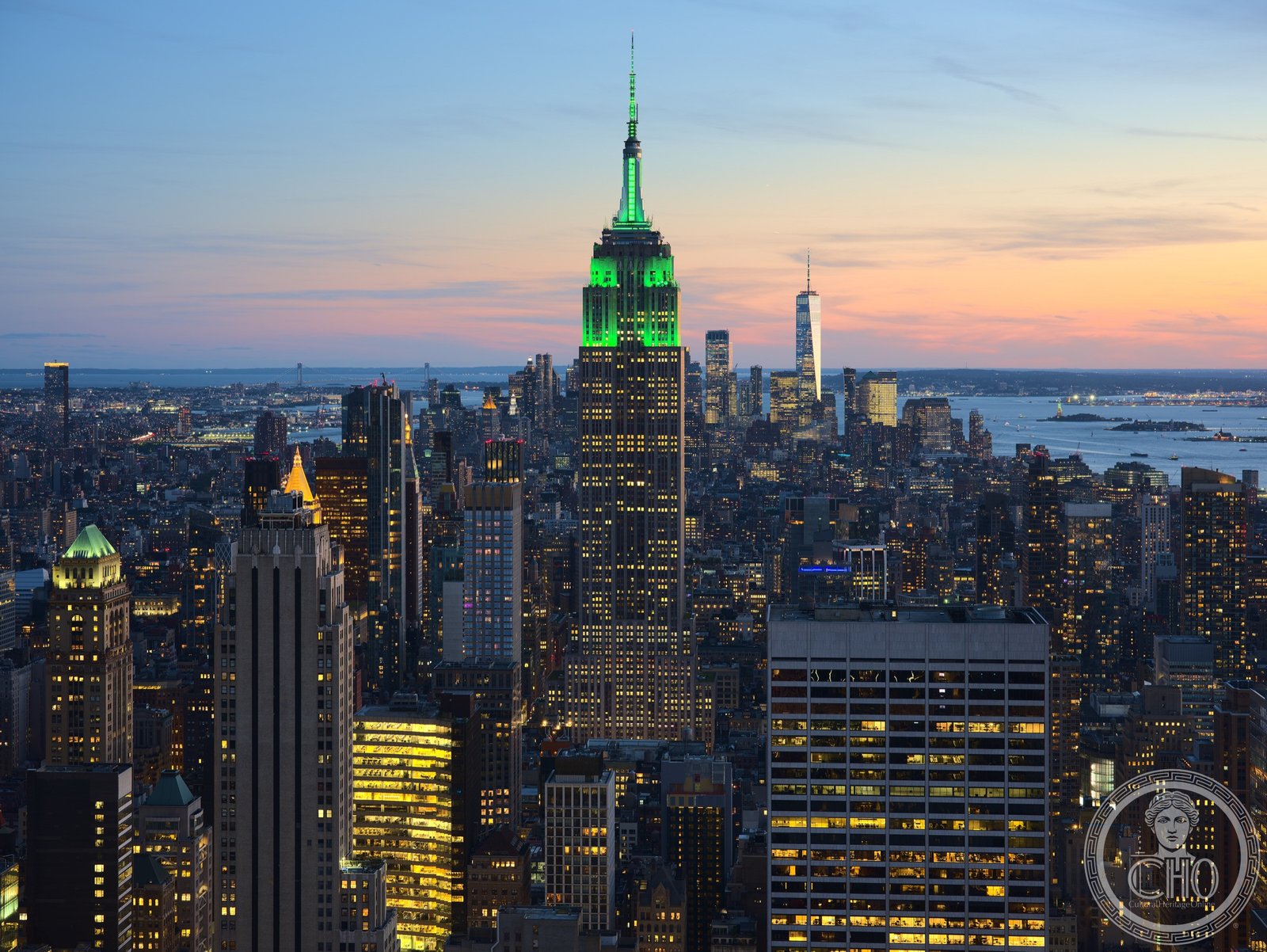

The world’s tallest building for forty years, and still the most legible proof that the Art Deco skyscraper was not an engineering achievement to which style was applied, but a style that engineering made possible.
At a glance
The Empire State Building at 350 Fifth Avenue in Midtown Manhattan is the most famous skyscraper in the world. Designed by the firm Shreve, Lamb & Harmon and completed in 1931 after an extraordinary construction period of fourteen months, it stands 1,454 feet to the top of its broadcast antenna and held the title of the world’s tallest structure from its completion until the World Trade Center surpassed it in 1970. Its limestone and granite exterior, arranged in the stepped setback profile prescribed by New York City’s 1916 zoning code, is the defining example of the Art Deco tower formula — geometry as civic statement, height as metropolitan identity. The building is a National Historic Landmark and the most visited paid attraction in New York City.
Key facts
- Address: 350 Fifth Avenue, Midtown Manhattan, New York City
- Completed: April 11, 1931
- Architects: Shreve, Lamb & Harmon
- Developer: John J. Raskob and Pierre S. du Pont
- Height: 1,454 feet to antenna tip; 1,250 feet to roof
- Floors: 102
- Style: Art Deco
- Designation: National Historic Landmark
- GPS: 40.7484°N, 73.9857°W
History
The Empire State Building was conceived in the late 1920s by John J. Raskob, a financier associated with General Motors and the Democratic Party, who wanted to surpass the Chrysler Building — then under construction at Lexington and 42nd Street — as the world’s tallest building. The site at Fifth Avenue and 34th Street, previously occupied by the first Waldorf-Astoria Hotel, was acquired in 1929, and construction began in March 1930. The building’s structural steel was raised at a pace of approximately four and a half floors per week, and the building was completed in just 410 days — an achievement in industrial coordination that has not been matched at comparable scale.
The building opened on May 1, 1931 — just as the Great Depression deepened into its worst phase. The failure to fill its office floors with paying tenants during the 1930s led New Yorkers to call it the “Empty State Building,” and it did not turn a profit until 1950. Its economic difficulties during the Depression were offset, in terms of cultural standing, by its immediate adoption as a symbol of New York City and American ambition: it appeared in the 1933 film King Kong within two years of its opening, and has been reproduced, photographed, and referenced so frequently in the decades since that it has become genuinely ubiquitous as a sign for modernity, cities, and vertical aspiration.
The World Trade Center surpassed it as the world’s tallest building in 1970, but the Empire State Building remained the centerpiece of the Manhattan skyline in public consciousness, and its observation decks have attracted more than 130 million visitors since opening. The building’s National Historic Landmark designation reflects not only the quality of Shreve, Lamb & Harmon’s design but the building’s significance as a monument of American industrial and cultural history.
What you see
The building’s exterior is a lesson in the Art Deco setback formula at its most refined. The lower floors occupy the full Fifth Avenue block; as the tower rises, a series of rectilinear setbacks reduce its footprint at each stage, creating the characteristic stepped profile that the New York zoning code had mandated to ensure light reached the streets below. The cladding alternates Indiana limestone and stainless steel monel spandrels, with the vertical lines of the setbacks emphasized by chrome and nickel alloy ornamental bands that catch the light at different times of day. The overall effect — especially from a distance, or from an elevated vantage point such as the Rockefeller Center observation deck — is of a building that appears to taper into the sky rather than simply end at a given height.
The lobby, entered from the Fifth Avenue entrance, is the building’s finest interior space: a three-story volume of marble, aluminum, and chromium, with a floor mosaic depicting the building in the context of the eight wonders of the world and ceiling murals celebrating transportation and industry. The aluminum relief panels and the ceiling ornament bring the machine-age vocabulary of Art Deco into a residential-scale encounter — unlike the exterior, which operates at the scale of the city, the lobby operates at the scale of the human body. Both scales are necessary for a building that was designed to be experienced from far away and from directly inside.
Practical information
- 86th Floor Observatory: Open daily, 9 AM–midnight; advance tickets recommended at esbnyc.com
- 102nd Floor Top Deck: Limited capacity; panoramic glass-enclosed observation
- Lobby: Free to enter during building hours; Art Deco interior visible to all visitors
- Time needed: 1.5–2 hours for observatory visit; 20 minutes for lobby only
Getting there
The Empire State Building stands at 350 Fifth Avenue at 34th Street in Midtown Manhattan. By subway, the B, D, F, M, N, Q, R, and W trains stop at 34th Street–Herald Square (one block west on Sixth Avenue); the 1, 2, and 3 trains stop at 34th Street–Penn Station (two blocks west). Penn Station and Madison Square Garden are two blocks west; Grand Central Terminal is ten blocks north. The building is accessible on foot from most Midtown hotels and is a natural anchor for a tour of Midtown Manhattan that includes the Chrysler Building (ten blocks northeast), the New York Public Library (five blocks north), and Rockefeller Center (fifteen blocks north).
Nearby
- Chrysler Building (1930) — ten blocks northeast at Lexington and 42nd; Art Deco peer
- New York Public Library (1911) — five blocks north at 42nd and Fifth; Carrère and Hastings Beaux-Arts
- Penn Station / Madison Square Garden — two blocks west on 33rd Street
- Flatiron Building (1902) — six blocks south at Broadway and Fifth; Fuller Building, Beaux-Arts
Sources
- National Historic Landmark nomination form, Empire State Building (National Park Service)
- New York City Landmarks Preservation Commission — designation report, Empire State Building
- Carol Willis, Form Follows Finance: Skyscrapers and Skylines in New York and Chicago — context of the building’s design and construction
- Empire State Building Associates / Empire State Realty Trust — official building history (esbnyc.com)
- New York Times, coverage of the building opening, May 1, 1931 (ProQuest Historical Newspapers)
Find it on the map
See this place and what’s around it →📷 Become a Cultural Heritage Online photographer
Share your photos of places: they stay published under your name as the author. The more they're seen, the more you get noticed — and soon a contest will reward the most appreciated photos.
Log in or sign up free to add a photoIs this page about you?
This page is read by travellers and heritage enthusiasts who find it on Google. Tell us how you are connected to this place and we will take it from there.