
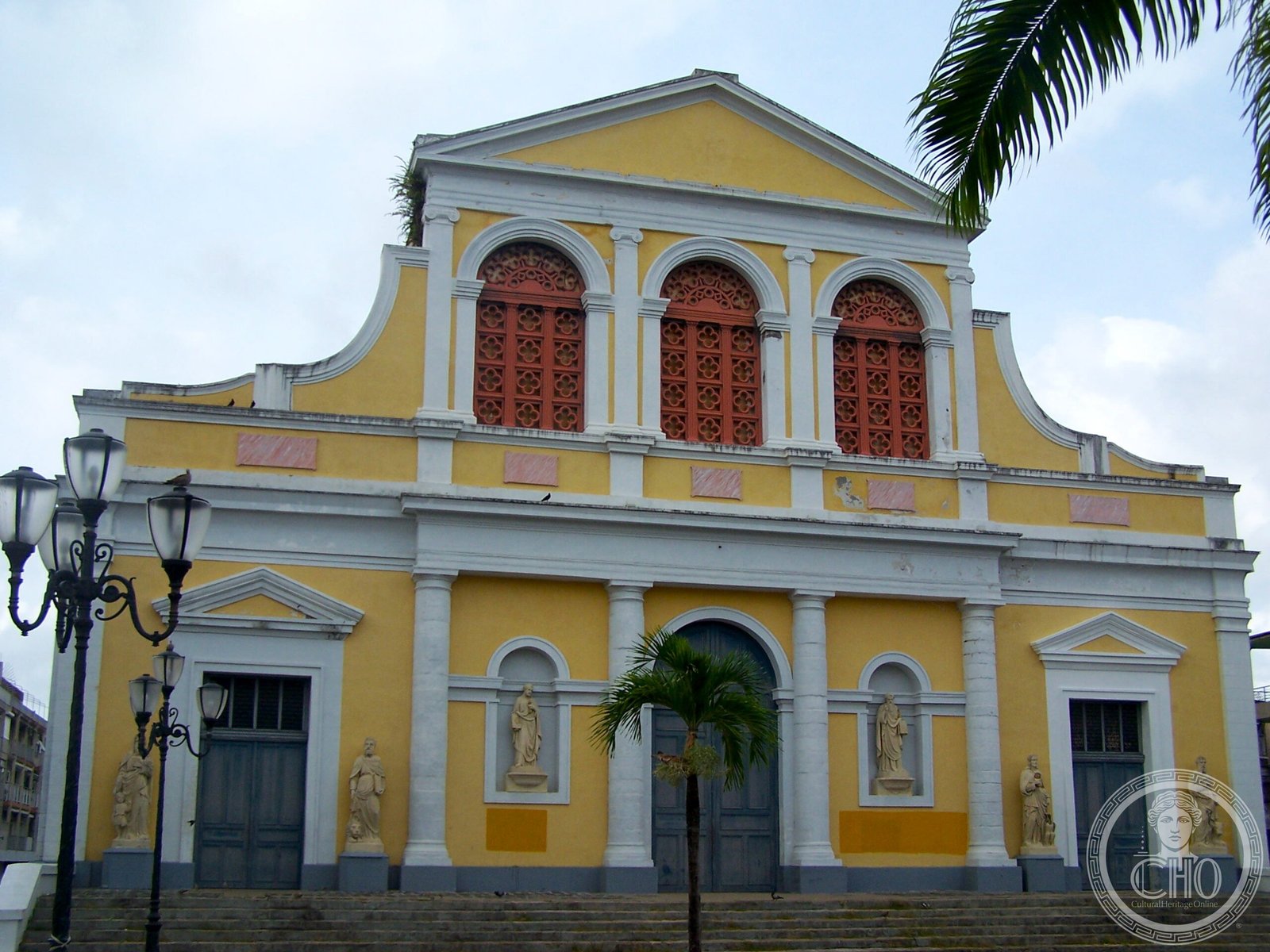
In Pointe-à-Pitre, Guadeloupe, a first church on the present site was begun on 22 September 1807. Work was interrupted in 1810 by the British occupation of the island and resumed in 1814 on plans revised by the architect Nassau, and the church was completed on 1 December 1817. The building was destroyed or severely damaged by the earthquake of 8 February 1843, which killed about 3,000 people on an island of only 22,000 inhabitants, and was followed by a devastating fire in the town. The rebuilding, carried out between 1847 and 1853 by the architect Alexandre Petit, sent from mainland France, with the public works inspector Auguste de Prémonville, returned the building to worship in 1853. Because of persistent trouble with the roof, around 1865 it was decided to remake the structure entirely in metal, to a design by the architect Charles Trouillé and built by the Joly firm of Argenteuil, run by the engineer César Jolly. It was not, as is often wrongly told, the work of the workshops of Gustave Eiffel, a popular attribution contradicted by the scholarly literature on the building. The work ended, depending on the source, between 1872 and 1876, with a metal bell tower about 35 metres high, holding three bells, added between 1875 and 1877. It was Governor Gourbeyre who first proposed, after the earthquake of 1843, the idea of a «great iron vessel». The style is neoclassical, with a façade of Doric columns on the ground floor and Ionic ones above, the work of the architect Petit, showing Saints Peter and Paul and the four evangelists. The plan is basilican, with a central nave of ten bays, side aisles and a choir with ambulatory. The structure combines stone and brick masonry with a cast-iron skeleton left entirely in view, cast-iron columns along the nave with capitals in Gothic Revival style and curved metal trusses, chosen for their resistance to earthquakes and fire and for climatic ventilation through louvred openings. A marble altar from the workshops of Vincent Bonomi, of the 19th century, has a separate monumental listing. The church, with an estimated capacity of about 3,000 faithful, is described as the largest and most important religious building in Pointe-à-Pitre, although the original stained glass and decorative paintings have all disappeared over time. Academic studies describe it as a forerunner in the use of iron for religious buildings in the French colonies, ahead of similar experiments in mainland France. The diocese of Guadeloupe and Basse-Terre was erected on 27 September 1850 by Pope Pius IX. A distinct diocese of Pointe-à-Pitre, which had existed separately, was suppressed and merged with that of Basse-Terre on 19 July 1951, when the diocese took its present name of Basse-Terre and Pointe-à-Pitre and the church became a co-cathedral. It is not entirely clear from the sources whether it keeps an active canonical status as co-cathedral today or only an honorary one. Besides the earthquake of 1843, the building has been through the earthquake of 1897 and the cyclones of 1928, which destroyed the Cavaillé-Coll organ of 1856, of 1956, of 1966 and of 1989, Hurricane Hugo, with the metal skeleton described as a key factor in the survival of the building through these events, although no specific detail on the damage caused by Hugo has been found. A municipal safety commission recommended closing it in 2019 for fire-safety non-compliance. Work on the roof and the electrical system, financed with 600,000 euros from the state and the region, allowed it to reopen in August 2020. In April 2021 the church was chosen as the emblematic monument of Guadeloupe for the Mission Bern and the Loto du Patrimoine, the heritage lottery, raising 570,285 euros for the restoration of the roof and of the metal structures, still needed because of ongoing corrosion, cracked plaster and water infiltration. The building has been listed as a French historic monument by decree of 28 December 1978.
About Église Saint-Pierre-et-Saint-Paul
In Pointe-à-Pitre, Guadeloupe, a first church on the current site was begun on 22 September 1807, its construction interrupted in 1810 by the British occupation of the island and resumed in 1814 on revised plans by architect Nassau, completed on 1 December 1817. The building was destroyed or severely damaged by the earthquake of 8 February 1843, which killed roughly 3,000 people on an island of only 22,000, followed by a devastating fire in the town. Reconstruction, carried out between 1847 and 1853 by architect Alexandre Petit, sent from mainland France, with public-works inspector Auguste de Prémonville, returned the building to worship in 1853.
Key facts
- 8 February 1843: a devastating earthquake destroys the earlier church, killing roughly 3,000 people islandwide.
- 1847-1853: the church rebuilt under architect Alexandre Petit.
- ~1865-1876: a full metal-frame restructuring by architect Charles Trouillé, built by the Joly firm of Argenteuil.
- 1875-1877: a roughly 35-metre metal bell tower added.
- 19 July 1951: becomes co-cathedral with the creation of the Diocese of Basse-Terre et Pointe-à-Pitre.
- 28 December 1978: classified a French historic monument.
History
Rebuilt after an earthquake that killed roughly one in seven islanders, then re-engineered decades later with an entirely exposed cast-iron skeleton to withstand the next one, Église Saint-Pierre-et-Saint-Paul stands as a genuine precursor of iron religious architecture in the French colonies — a claim to significance that owes nothing to Gustave Eiffel, despite the popular but unsupported local nickname crediting his workshops. Selected as Guadeloupe’s flagship monument for the 2021 national heritage lottery, its ongoing restoration continues a nearly two-century pattern of rebuilding after earthquakes and hurricanes that the iron frame was specifically designed to survive.
What you see
A neoclassical façade of Doric columns below and Ionic above, depicting Saints Peter and Paul and the four evangelists, fronts a basilical nave of ten bays whose entirely exposed cast-iron columns and curved metal roof trusses were chosen specifically for earthquake and fire resistance. A marble altar by the workshops of Vincent Bonomi and a roughly 35-metre metal bell tower, added in the 1870s, complete a building whose original stained glass and decorative paintings have since disappeared.
Practical information
- Opening hours: generally open daily outside services; check current hours given ongoing restoration work.
- Address: Place Gourbeyre, 97110 Pointe-à-Pitre, Guadeloupe.
Getting there
The church stands on Place Gourbeyre in central Pointe-à-Pitre, easily reached on foot from the city’s historic core. GPS: 16°14′20″N, 61°32′04″W.
Nearby
- Place Gourbeyre — the central square adjoining the church.
Sources
- French Wikipedia — “Église Saint-Pierre-et-Saint-Paul de Pointe-à-Pitre” and “Diocèse de Basse-Terre et Pointe-à-Pitre”
- Base Mérimée — French Ministry of Culture heritage database, reference IA97100213.
- In Situ (Ministère de la Culture journal) — “Les prémices de l’architecture métallique en Guadeloupe”
- Fondation du Patrimoine — restoration project page.
Find it on the map
See this place and what’s around it →📷 Become a Cultural Heritage Online photographer
Share your photos of places: they stay published under your name as the author. The more they're seen, the more you get noticed — and soon a contest will reward the most appreciated photos.
Log in or sign up free to add a photo