
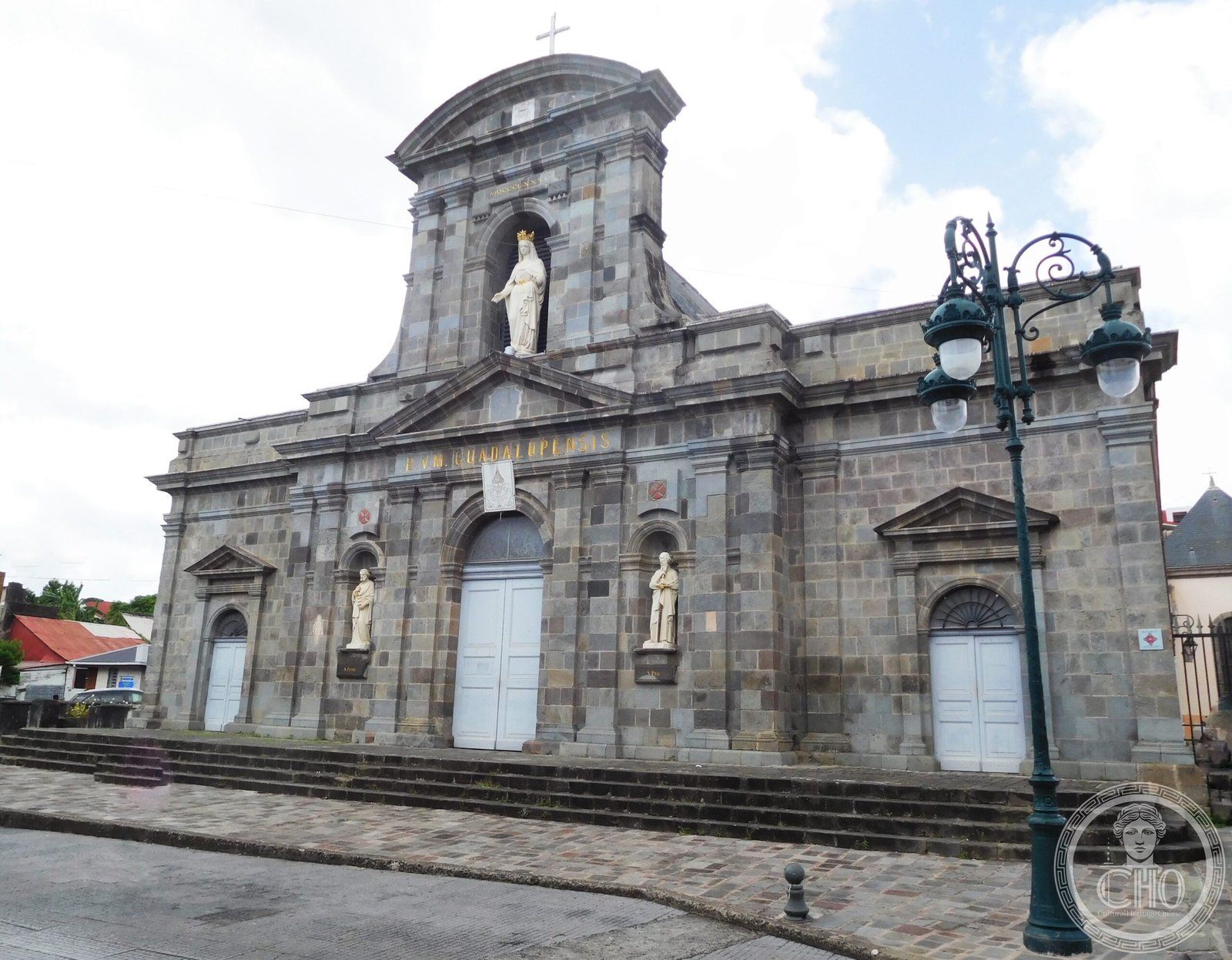
In Basse-Terre, Guadeloupe, the first structure on the site was a wooden chapel-convent dedicated to St. Francis. Capuchin friars built it on land donated by Governor Du Lion on 30 November 1673. Between 1674 and 1679 a further land grant allowed a masonry church and a cemetery to be built. A fire destroyed the building in 1703. The reconstruction, led by Father Bonaventure, was nearly complete when he left on 11 June 1734; one general source instead cites 1736 as the completion date, an unresolved two-year discrepancy. The present façade is traditionally attributed to this phase. An English attack caused further damage in 1759. The chapel became an official parish in 1713. Worship was suspended during the Revolution in 1792, and the church was restored and reopened in 1802. New side aisles were added in 1844. Between 1874 and 1877 the choir was enlarged with an apse and an ambulatory under the capitular vicar Blanger. No source documents a specific architect for the original seventeenth- and eighteenth-century phases, which are attributed to the Capuchins as both patrons and builders. In the “Jesuit” Baroque style, typical of the buildings spread by the Society of Jesus from the 17th century, the cathedral is built of volcanic stone with partial plastering. Its western façade, in dressed stone, has three bays of classical proportions. Inside, a central nave with two side aisles is extended by an ambulatory, under a barrel vault clad in wood, with Doric capitals. Three terracotta statues of the Virgin, St. Peter and St. Paul were commissioned in 1874 from the Virebent manufactory in Launaguet, Haute-Garonne. The bell tower was built as a freestanding structure, separate from the main body, precisely for seismic reasons. It was erected in 1820 or in 1837, sources disagree, and enlarged between 1875 and 1889 after the damage of the 1825 cyclone. The Code Noir of 1685 recognised Catholicism as the only religion allowed in the French colonies. Through its missionary orders the Church openly supported colonisation and slavery in the Antilles, and remained complicit in the colonial order even after abolition; yet the parishes also offered enslaved people spaces of community, through confraternities. The dioceses of Guadeloupe and Martinique were created in 1850, two years after the abolition of slavery in 1848. On 27 September of that year Pope Pius IX established the diocese of Basse-Terre, covering Guadeloupe, Saint-Barthélemy and Saint-Martin, and the church of Saint-François was consecrated as its cathedral, dedicated to Notre-Dame de Guadeloupe. A suffragan of the archdiocese of Bordeaux until 1905, the diocese was renamed Basse-Terre and Pointe-à-Pitre on 19 July 1951, and since 30 September 1967 it has been a suffragan of the archdiocese of Saint-Pierre and Fort-de-France. On 12 December 1877 Bishop Benjamin-Joseph Blanger raised the cathedral to the rank of minor basilica. A cyclone in 1825 “completely overturned” the building, which was rebuilt in the second half of 1826. The earthquake of 8 February 1843, with an estimated magnitude of 8.5 and around 3,000 victims in Guadeloupe, brought down several gables and houses in the town, but no specific direct damage to the cathedral is confirmed; the church of Pointe-à-Pitre was hit harder. Hurricane Cléo, a category 4 storm, destroyed the roof on 22 August 1964. No specific damage from the devastating Hurricane Hugo of September 1989 is documented, although a major restoration programme for roofs and façades, completed in 2010, began in that very year. In December 2018 a new organ with 1,856 pipes was installed, built in Corrèze by the organ builder Bertrand Cattiaux. Five bishops are buried in the cathedral’s crypt. No papal visit is documented. The present bishop is Monsignor Philippe Guiougou, a native of Guadeloupe, appointed by Pope Francis on 3 April 2023 and ordained bishop on 9 July of the same year. The cathedral has been a classified French historic monument since 17 June 1975, with the bell tower classified separately on 19 May 2006.
About Cathédrale Notre-Dame-de-Guadeloupe
In Basse-Terre, Guadeloupe, the first structure on the site was a wooden chapel-convent dedicated to St. Francis, built by Capuchin friars on land donated by Governor Du Lion on 30 November 1673; between 1674 and 1679 a further land grant allowed a masonry church and cemetery to be built. A fire destroyed the building in 1703; reconstruction, led by Father Bonaventure, was nearly complete by his departure on 11 June 1734 — one general source instead cites 1736 as the completion date, an unresolved two-year discrepancy — and the present façade is traditionally attributed to this phase, with an English attack causing further damage in 1759.
Key facts
- 1673: the first Capuchin chapel built on the site.
- 1703 and 1759: destroyed by fire, then damaged by an English attack.
- 27 September 1850: the Diocese of Basse-Terre created, the church elevated to cathedral.
- 1825 and 1843: a cyclone overturns the building, an 8.5-magnitude earthquake devastates the region.
- 1964: Hurricane Cléo destroys the roof.
- 12 December 1877: elevated to minor basilica status.
History
Rebuilt after fire in 1703, damage from an English attack in 1759, a cyclone in 1825, and Hurricane Cléo’s roof destruction in 1964, Cathédrale Notre-Dame-de-Guadeloupe’s builders responded to this repeated destruction with a deliberately engineered solution: a bell tower built as a freestanding structure, separate from the main body, specifically to reduce earthquake risk. Its 1850 elevation to cathedral status, two years after the abolition of slavery in the French Antilles, reflects a broader post-abolition strengthening of Catholic institutional presence across Guadeloupe and Martinique.
What you see
A Baroque “Jesuit-style” façade in volcanic stone with partial plaster fronts a nave and two side aisles extended by an ambulatory, its barrel vault clad in wood above Doric-capital pillars. Three terracotta statues of the Virgin, St. Peter and St. Paul, commissioned in 1874 from the Virebent manufactory in southern France, stand inside a building whose freestanding bell tower — engineered separately from the main structure for seismic safety — was rebuilt and enlarged after 19th-century cyclone damage.
Practical information
- Opening hours: generally open daily outside services; check current hours before visiting.
- Address: Place Bébian, 97100 Basse-Terre, Guadeloupe.
Getting there
The cathedral stands on Place Bébian in central Basse-Terre, easily reached on foot from the town’s historic core. GPS: 15°59′45″N, 61°43′47″W.
Nearby
- Place Bébian — the central square adjoining the cathedral.
Sources
- French Wikipedia — “Cathédrale Notre-Dame-de-Guadeloupe de Basse-Terre” and “Diocèse de Basse-Terre et Pointe-à-Pitre”
- Base Mérimée — French Ministry of Culture heritage database, references PA00105849 and IA97100917.
- Persée — “Église et esclavage” (research on the Catholic Church and slavery in the French Antilles).
Find it on the map
See this place and what’s around it →📷 Become a Cultural Heritage Online photographer
Share your photos of places: they stay published under your name as the author. The more they're seen, the more you get noticed — and soon a contest will reward the most appreciated photos.
Log in or sign up free to add a photo