
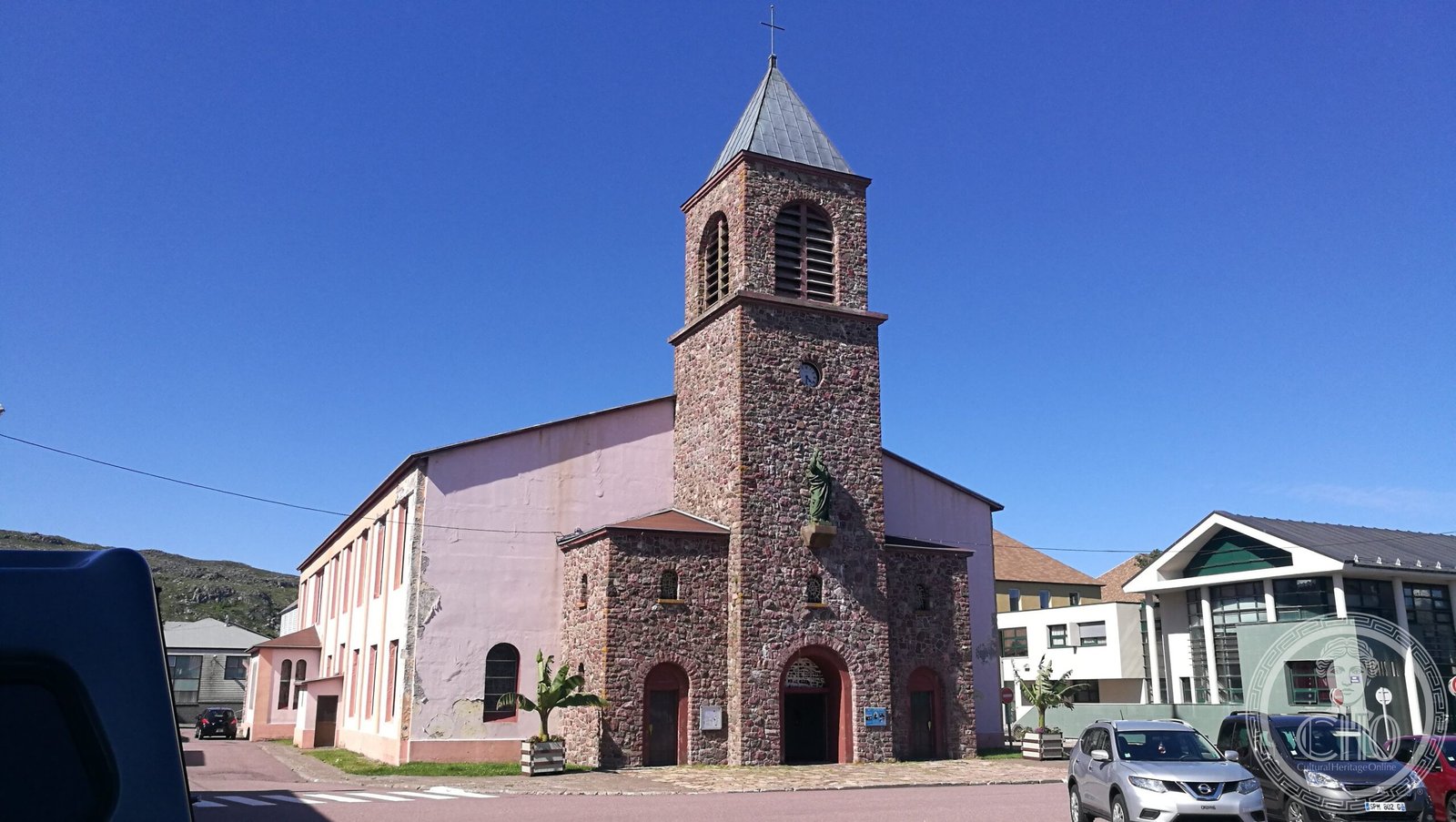
At Saint-Pierre, chief town of the small French archipelago of Saint-Pierre-et-Miquelon, off Newfoundland in Canada, the French settlers who arrived from 1668 brought Catholic worship with them. A first wooden church was completed in 1690. Damaged in 1846 by the explosion of a gunpowder store, it was replaced in 1852 by a new parish church on the same site, itself destroyed by the great fire of 2 November 1902, which according to the sources started in the church itself. The present building was built between 1905 and 1907 and inaugurated on 1 December of that year. No source identifies the architect responsible for this rebuilding, while only Joseph Muller, of Colmar, is documented, the author of the later rebuilding of the bell tower in 1975. In a style described as «Basque church», joining European and local elements, with an upper inner gallery fitted with wooden benches, the cathedral was rebuilt in 1907 in concrete, an innovative choice for the time meant to resist fire, which proved ill-suited in the long run to the harsh climate of the North Atlantic. The bell tower, made anew in 1975, uses Alsatian sandstone and local pink granite instead. The stained glass of the early twentieth century shows French saints such as Margaret Mary Alacoque and Bernadette Soubirous, while a second group of modern windows was given by General Charles de Gaulle after his visit of 1967, with gospel scenes that include sea imagery and references to Pope John XXIII and the Second Vatican Council. The cathedral served the apostolic vicariate of the islands of Saint-Pierre-et-Miquelon, not technically a diocese in the canonical sense, as is sometimes wrongly reported, erected as an apostolic prefecture in 1765, two years after the cession of New France to Great Britain, and raised to an apostolic vicariate on 16 November 1970 by Pope Paul VI. The vicariate was suppressed on 1 March 2018 and joined as a deanery to the diocese of La Rochelle and Saintes, in metropolitan France, counting at the time of the suppression two parishes and about 6,300 Catholics. Today the cathedral is an active parish church of that diocese, an unusual administrative arrangement for an overseas territory. The present parish priest is Father Antoine Sagna, while the bishop with full authority over the diocese, since 19 August 2025, is Monsignor Pierre-Antoine Bozo, who succeeded as coadjutor Monsignor Georges Colomb, withdrawn from service since 2023 following accusations. The bell tower rebuilt in 1907 in concrete decayed to the point of needing a complete rebuilding in 1975, a concrete example of the challenges the North Atlantic climate poses to the conservation of the buildings of the archipelago. The cathedral has been classified a French historic monument since 18 February 2020.
About Cathédrale Saint-Pierre
In Saint-Pierre, the main town of the small French archipelago of Saint-Pierre-et-Miquelon off the coast of Newfoundland, Canada, French settlers arriving from 1668 onward brought Catholic worship with them; a first wooden church was completed in 1690. Damaged in 1846 by the explosion of a gunpowder magazine, it was replaced in 1852 by a new parish church on the same site, itself destroyed by the great fire of 2 November 1902, which sources say originated in the church itself. The present building was constructed between 1905 and 1907 and inaugurated on 1 December 1907; no source identifies the architect responsible for this reconstruction, though Joseph Muller of Colmar is documented as the architect of the later 1975 bell tower rebuild.
Key facts
- 1690: the first wooden church completed on the site.
- 2 November 1902: the previous church destroyed by a major fire.
- 1905-1907: the current cathedral built in reinforced concrete.
- 1967: Charles de Gaulle donates stained-glass windows following his visit.
- 1975: the deteriorated concrete bell tower entirely rebuilt.
- 18 February 2020: classified a French historic monument.
History
Rebuilt in concrete specifically to resist fire after an 1902 blaze destroyed its predecessor, Cathédrale Saint-Pierre instead ran into a different adversary: the harsh North Atlantic climate, which so badly deteriorated its 1907 bell tower that it required a complete rebuild by 1975. Serving what was, until its 2018 suppression, the ecclesiastical territory covering France’s last foothold in North America, the cathedral today functions as an ordinary parish church of a mainland French diocese — an unusual administrative arrangement for one of France’s most remote overseas territories.
What you see
Built in a “Basque church” style blending European and local features, with an upper interior gallery fitted with wooden benches, the cathedral’s 1907 reinforced-concrete construction was an innovative fire-resistant choice that proved poorly suited to the North Atlantic climate over time. Its rebuilt bell tower uses Alsatian sandstone and local pink granite, while stained glass inside ranges from early-20th-century depictions of French saints to modern windows donated by Charles de Gaulle after his 1967 visit, blending Gospel scenes with maritime imagery.
Practical information
- Opening hours: generally open daily outside services; check current hours before visiting.
- Address: Rue Jacques Cartier, Saint-Pierre, Saint-Pierre-et-Miquelon.
Getting there
The cathedral stands on Rue Jacques Cartier in the town of Saint-Pierre, easily reached on foot from the town center. GPS: 46°46′52″N, 56°10′20″W.
Nearby
- Central Saint-Pierre — the town’s main harbor and commercial district.
Sources
- Wikipedia — “St. Pierre Cathedral, Saint-Pierre” (en.wikipedia.org).
- French Wikipedia — “Cathédrale Saint-Pierre de Saint-Pierre-et-Miquelon” and “Vicariat apostolique de Saint-Pierre et Miquelon”
- France Info (la1ère) — “La cathédrale de Saint-Pierre classée aux monuments historiques”
- Diocese of La Rochelle — official parish page (catholiques17.fr).
Find it on the map
See this place and what’s around it →📷 Become a Cultural Heritage Online photographer
Share your photos of places: they stay published under your name as the author. The more they're seen, the more you get noticed — and soon a contest will reward the most appreciated photos.
Log in or sign up free to add a photo