
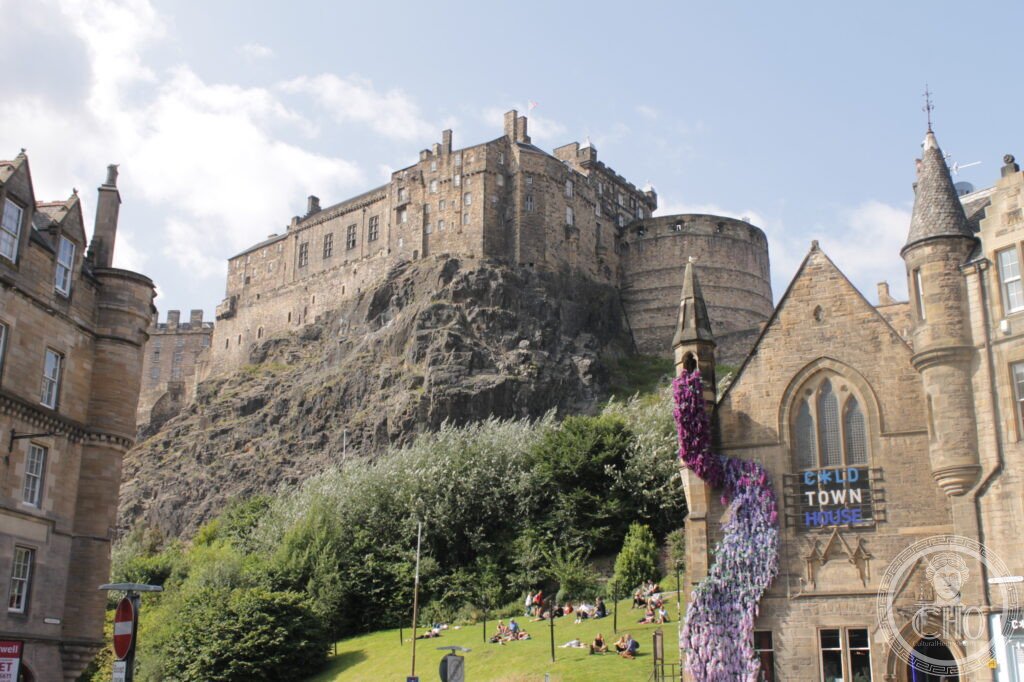
A fortress on an extinct volcanic plug 130 metres above the city that has been the symbolic heart of Scotland since at least the 7th century — the site of royal births, sieges, and executions; the keeper of the Scottish Crown Jewels (the oldest in the British Isles); and the stage each August for the Edinburgh Military Tattoo, one of the most watched live events on earth.
At a glance
Edinburgh Castle is a historic fortress on Castle Rock — a volcanic plug of basalt rising 130 metres above the surrounding city — at the west end of the Royal Mile in Edinburgh, the capital of Scotland. Occupation of the rock dates from at least the 2nd century AD; the first documentary reference to a castle is in the 12th century, under King David I (r. 1124–1153). The castle has been the site of major events in Scottish history: the birth of James VI (1566), 26 sieges, the storage of the Scottish Crown Jewels (lost 1651, rediscovered 1818 by Walter Scott), and the imprisonment of Mary, Queen of Scots. Today it is the most visited paid attraction in Scotland, housing several museums, the Scottish National War Memorial, and the Honours of Scotland (the Scottish Crown Jewels, the oldest royal regalia in the British Isles, continuously held since 1540). The One O’Clock Gun has been fired every weekday (except Good Friday, Christmas Day, and Sundays) since 1861.
Key facts
- Castle Rock: a plug of basalt formed by a volcanic eruption approximately 340 million years ago, subsequently shaped by glaciation into a steep-sided rock with a gentle slope to the east (the Royal Mile); the geological formation is called a “crag and tail” and explains why both Edinburgh’s castle and its main street have the orientation they do
- Honours of Scotland: the Scottish Crown Jewels — the crown, the sceptre, and the sword of state — are the oldest royal regalia in the British Isles; the crown dates to 1540 (earlier elements may incorporate medieval material); they were hidden in 1707 after the Acts of Union with England, locked in a chest in the castle, and rediscovered by Walter Scott in 1818; they are displayed in the Crown Room
- St Margaret’s Chapel: the oldest building in Edinburgh and the oldest surviving building in Scotland; built by King David I c. 1130 as a private chapel for the royal family and dedicated to his mother, Margaret of Scotland (later canonised); a small Romanesque structure seating approximately 20 people; still used for baptisms and small weddings
- Mons Meg: a giant medieval bombard (cannon) forged in 1449 at Mons in present-day Belgium; presented to James II of Scotland in 1457; it could fire a stone cannon ball of 330 pounds (150 kg) over 3 km; too heavy to transport on campaigns (3 tonnes), it was used for ceremonial salutes until it burst in 1681; restored and on display in the castle vaults
- The One O’Clock Gun: a 105mm field gun (replaced over the years; the current gun entered service in 2001) is fired every weekday at exactly 1:00 pm; the tradition began in 1861 as a time signal for ships in the Firth of Forth to set their chronometers; it remains the most precise public time signal in Scotland
- Sieges: Edinburgh Castle has been besieged 26 times, more than any other castle in Britain; the most significant were the Lang Siege (1571–1573, when it was held for Mary Queen of Scots against the Scottish regent) and the Jacobite siege of 1745
- GPS: 55.9486° N, 3.1999° W
History
The rock was a defended site in the Iron Age; the earliest documentary evidence of a castle is in the reign of King David I (r. 1124–1153), who is credited with founding the castle chapel now known as St Margaret’s Chapel. For the next 500 years, Edinburgh Castle alternated between Scottish and English control more than any other fortification in Britain. The Wars of Scottish Independence (1296–1357) saw the castle change hands five times; Robert the Bruce captured it from the English in 1314 and demolished the defences to prevent it being reused as an English garrison post. The Stewart (Stuart) dynasty rebuilt the castle from the late 14th century as a royal residence, and it was here that Mary, Queen of Scots, gave birth to the future James VI (later James I of England) in June 1566.
The castle’s military function was gradually supplanted by its administrative and ceremonial functions from the 17th century: it became a garrison, a prison (for French prisoners of war in the 18th century, and later for American prisoners during the War of Independence), and a treasury. The Scottish Crown Jewels — the Honours of Scotland — were used at the coronation of Charles II in 1651 but were then hidden to prevent their capture by Cromwell’s forces; they were so thoroughly concealed that they were forgotten, and it required Walter Scott’s persistent campaigning and a royal warrant to open the sealed chest in which they had been locked in 1707.
The Edinburgh Military Tattoo — the annual performance of massed pipe bands, military displays, and international performers on the castle esplanade — was first held in 1950; it now attracts 220,000 ticket-holders over three weeks in August and is broadcast to an estimated 100 million viewers in 30 countries. The castle esplanade, where the Tattoo is held, was also historically the site of the “witches’ executions”: a plaque near the gate marks the spot where approximately 300 women were burned or strangled as witches between 1479 and 1722.
What you see
Entry through the gatehouse and portcullis gate leads up the slope to the main castle complex; the views from the upper level over Edinburgh and the Firth of Forth are the best from any point in the city. St Margaret’s Chapel (the oldest building) is a small Romanesque structure whose simplicity is arresting after the military complexity of the surrounding fortifications. The Great Hall (completed 1511 under James IV) has one of the finest original medieval hammerbeam roofs in Scotland.
The Crown Room houses the Honours of Scotland in a purpose-built display with context on the 1818 rediscovery; the Stone of Destiny (the coronation stone on which Scottish kings were crowned until its removal to Westminster in 1296 and its return in 1996) is displayed in an adjacent case. Mons Meg and the vaults below the great hall (converted to a prison in the 18th century) complete the main circuit; the Scottish National War Memorial (1927, designed by Robert Lorimer) at the summit is architecturally impressive and unusually solemn in its commemoration of the Scottish dead of both World Wars.
Practical information
- Admission: £22.50 adult (Historic Environment Scotland members free); book online in advance, especially in summer; the castle is one of the most visited attractions in Britain and can have 2-hour queues at the entrance in peak season
- Military Tattoo (August): tickets sell out months in advance; all seats are on temporary grandstands on the esplanade; the show runs nightly except Sundays; grandstand heating is available but bring warm layers
- One O’Clock Gun: fired every weekday at 1:00 pm from Mills Mount Battery on the north side of the castle; the best viewing positions fill up 10 minutes before; admission to the castle is required
- Getting there: walk up the Royal Mile from Edinburgh Waverley station (15 minutes); Lothian Buses 23, 27, 41, 42 stop on the Royal Mile; taxis to the esplanade are possible
Getting there
Edinburgh Waverley station (15 minutes on foot via the Royal Mile) has direct trains from London King’s Cross (4.5 hours) and Glasgow Queen Street (50 minutes). Edinburgh Airport (EDI) is 8 km west; trams run directly to the city centre (30 minutes). GPS: 55.9486, -3.1999.
Nearby
- Palace of Holyroodhouse — the official Scottish residence of the British monarch, at the foot of the Royal Mile opposite the Scottish Parliament; the ruins of Holyrood Abbey (12th century) adjoin the palace; the chambers of Mary Queen of Scots are open to visitors; 15 minutes walk east of the castle
- National Museum of Scotland — the largest museum in Scotland; wide-ranging collections from prehistoric Scotland to the 20th century; the Dolly the sheep (first cloned mammal) is here; free entry; 5 minutes walk from the Royal Mile
- Stirling Castle — the other great Scottish royal fortress, on a similar volcanic rock; the seat of the Stuart monarchs before Edinburgh became pre-eminent; the Great Hall (1503) is the finest secular building in Scotland; 1 hour west of Edinburgh by train or car; Historic Environment Scotland
Sources
- Wikipedia, Edinburgh Castle, accessed June 2026
- Historic Environment Scotland, Edinburgh Castle official information, accessed June 2026
- Peter Yeoman, Edinburgh Castle, Historic Scotland, 2007 — the standard archaeological and historical summary by the former site archaeologist
Find it on the map
See this place and what’s around it →📷 Become a Cultural Heritage Online photographer
Share your photos of places: they stay published under your name as the author. The more they're seen, the more you get noticed — and soon a contest will reward the most appreciated photos.
Log in or sign up free to add a photoIs this page about you?
This page is read by travellers and heritage enthusiasts who find it on Google. Tell us how you are connected to this place and we will take it from there.