
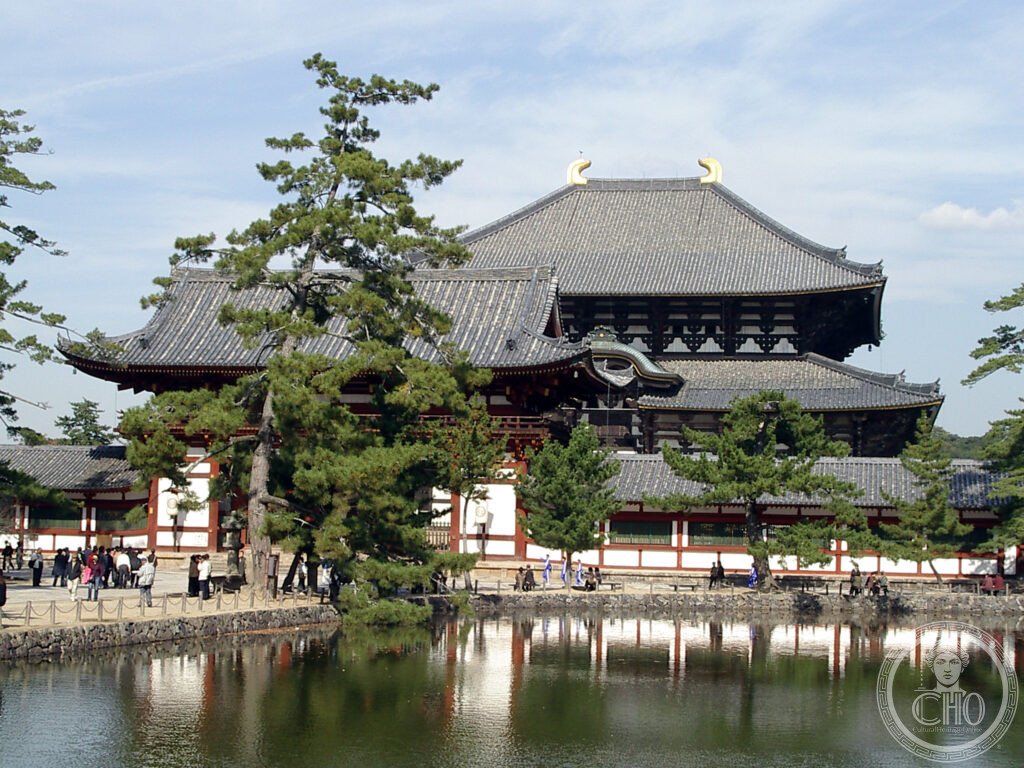
A wooden hall in Nara that is the largest of its kind in the world, housing a 15-metre bronze Buddha cast in 752 AD by a workforce of 370,000 labourers and 2,180,000 daily workers — a project so vast that it consumed a significant portion of Japan’s total bronze production for years, and whose inauguration ceremony was attended by 10,000 Buddhist monks from across Asia.
At a glance
Tōdai-ji (東大寺, “Great Eastern Temple”) is a Buddhist temple complex in Nara, Japan, the former imperial capital (710–784 AD). The temple was commissioned by Emperor Shōmu and completed in 752 AD as the head temple of all provincial Buddhist temples in Japan and as a symbol of state Buddhism at the height of the Nara period. The complex’s central building, the Daibutsuden (Great Buddha Hall), was rebuilt in 1709 after fires destroyed the original and the first rebuilding; the current structure, despite being only two-thirds the size of the original, remains the largest wooden building in the world (57 metres wide, 50 metres deep, 48 metres tall). Inside stands the Vairocana Buddha (Daibutsu), a bronze figure 15 metres tall cast in 752 AD and one of the largest bronze statues in the world. The temple, the Daibutsu, and the surrounding Nara Park with its free-roaming deer (considered sacred messengers of the gods) together form one of the most complete religious landscapes in East Asia. Tōdai-ji is part of the UNESCO World Heritage Site “Historic Monuments of Ancient Nara,” inscribed 1998.
Key facts
- The Daibutsuden: the Great Buddha Hall is the largest wooden building in the world, a fact that has been true since its 1709 rebuilding; it is 57 metres wide, 50 metres deep, 48 metres tall; the original 8th-century building was larger; the current structure was rebuilt at two-thirds the original scale due to limited resources after the Taira clan burned it in 1180.
- The Daibutsu: the Great Buddha (Birushana-butsu, the Vairocana Buddha) is 15 metres tall seated; the face alone is 5 metres; the total bronze weight is approximately 500 tonnes; it was cast in 752 AD using a technique of segment-by-segment casting in eight stages; the gilded hands and lotus throne are later replacements; the original face was also replaced after fire damage.
- The Nandaimon (Great South Gate): the monumental gate at the entrance to the temple complex; rebuilt 1203; its two guardian figures (Niô, the Kongo Rikishi) are 8.4 metres tall, carved in 1203 by the sculptors Unkei and Kaikei in the newly confident Kamakura-period style — the most dynamic Buddhist sculpture in Japan.
- Nara Park deer: approximately 1,200 sika deer roam freely in Nara Park around the temple; they were considered sacred messengers of the gods of Kasuga Taisha (the Shinto shrine adjoining the Buddhist Tōdai-ji complex); they approach visitors for the special deer crackers (shika senbei) sold throughout the park; they are a National Natural Monument.
- Fires and rebuildings: the original 752 Daibutsuden was burned in 1180 (Genpei War, Taira clan); the first rebuilding (1185–1195) was burned in 1567 (Sengoku period warfare); the current structure dates from 1709, a rebuilding under the monk Kokei with a donation from the merchant city of Osaka.
- Heritage: UNESCO World Heritage Site, Historic Monuments of Ancient Nara, inscribed 1998.
- GPS: 34.6884° N, 135.8399° E.
History
Emperor Shōmu (r. 724–749 AD) ordered the construction of Tōdai-ji in 745 AD during a period of smallpox epidemic, famine, and political instability. The project was explicitly conceived as a national prayer: the casting of the giant Buddha would secure divine protection for the Japanese state. The scale of the undertaking was unprecedented in Japanese history: the monk Gyōki organised the collection of donations from across the country; the metalworker Kuninaka no Kimimaro oversaw the casting, which used 437 tonnes of bronze, 130 kg of gold, and 75 kg of mercury (for the gilding). The Daibutsu-den inauguration ceremony in 752 AD was attended by over 10,000 monks, including Bodhisena from India who performed the eye-opening ceremony (kaigen kuyo) that animated the statue.
Tōdai-ji’s position as the administrative head of the provincial temple system (kokubunji) gave it enormous institutional power in the Nara and early Heian periods. The monks of Tōdai-ji were major political actors; the monk Dōkyō (who became the Emperor Shōtoku’s favourite and was accused of aiming at the imperial throne) was based here. The temple controlled vast estates and exercised quasi-governmental authority over much of the Kinai region. This power made it a target: the burning of the Daibutsuden in 1180 by Taira no Shigehira on orders of Taira no Kiyomori was one of the defining atrocities of the Genpei War and a major factor in the Taira clan’s subsequent loss of popular support.
The Kamakura-period rebuilding (1185–1195) introduced the “Indian style” (Tenjikuyô) architecture imported by the monk Chôgen, who had travelled to China and returned with new architectural techniques; the Nandaimon gate survives from this rebuilding. The second burning in 1567 left only the Buddha and its lotus throne standing in the open air for 130 years; the current Daibutsuden was completed in 1709, sheltering the Daibutsu again for the first time in over a century.
What you see
The approach from Nara station through the park is gradual: the deer begin immediately (they are everywhere throughout the park, not confined to specific areas), then the Nandaimon Gate (rebuilt 1203) becomes visible — the two Niô guardian figures fill the twin bays of the gate at 8.4 metres each, their expressions of violent energy contrasting with the frozen calm of the Daibutsu inside. The Daibutsuden itself only reveals its full scale from the second courtyard: 57 metres wide, the hall dwarfs the surrounding cedars and manages to look simultaneously massive and light, its upturned roof edges lifting the horizontal mass.
Inside, the Daibutsu occupies the full height of the hall: 15 metres of bronze seated Buddha, the face at the same height as the second gallery above ground level. The scale is comprehensible only from very close (the feet are at eye level); from the standard approach across the hall floor, the figure seems moderately large. The detail of the surviving original bronze — the lotus throne, the secondary figures on the throne petals — is extraordinary when seen close. Behind the main altar, a wooden pillar has a hole at the base said to be the size of the Daibutsu’s nostril; passing through it is traditionally said to bring enlightenment in the next life, and there is usually a queue.
Practical information
- Admission: ¥600 adult; includes entry to the Daibutsuden and the surrounding precincts; the Nandaimon gate and Nara Park are free.
- Hours: 8 am–4:30 pm (winter); 7:30 am–5 pm (spring/summer/autumn).
- Getting there: from Kyoto, Kintetsu Nara Line direct to Kintetsu Nara station (35 minutes, ¥760); from Osaka (Kintetsu Namba) direct to Kintetsu Nara (35–45 minutes); from Tokyo, Shinkansen to Kyoto then local train; the Daibutsuden is 20 minutes walk north-east from Kintetsu Nara station through the park.
- Deer crackers: shika senbei (deer crackers, ¥200 for a bundle of 10) are sold throughout the park; the deer know exactly what they are and will actively pursue people who appear to be holding them.
Getting there
Kintetsu Nara station (20 minutes walk from the temple) is the most convenient; direct Kintetsu express trains from Kyoto (35 minutes) and Osaka Namba (35–45 minutes). JR Nara station (30 minutes walk from the temple) is on the JR Yamatoji Line from Osaka. Nara has no direct Shinkansen connection but is 35 minutes from Kyoto. GPS: 34.6884, 135.8399.
Nearby
- Kasuga Taisha Shrine — the tutelary Shinto shrine of the Fujiwara clan; thousands of bronze lanterns line its covered approach; founded 768 AD, the current vermilion structures are modern rebuildings of the original (Shinto shrines are traditionally rebuilt every 20 years); 15 minutes walk east of Tōdai-ji through the park; UNESCO WHS (as part of Ancient Nara).
- Kofuku-ji — the Fujiwara family temple, immediately south of the deer park; the five-storey pagoda (1426, the second-tallest in Japan) and the three-storey East Golden Hall (1415) are the major surviving structures; the Kokuhôkan Museum has an extraordinary collection of Nara-period Buddhist sculpture; UNESCO WHS.
- Horyu-ji — 15 km south-west of Nara; the oldest surviving wooden buildings in Japan (c. 607 AD), older than Tōdai-ji by 150 years; the Western Precinct has the five-storey pagoda and the Kondô (Golden Hall), both from the late 7th century; UNESCO WHS inscribed 1993.
Sources
- Wikipedia, Tōdai-ji, accessed June 2026.
- UNESCO, Historic Monuments of Ancient Nara, WHS reference 870, inscribed 1998.
- Mimi Hall Yiengpruksawan, Hiraizumi: Buddhist Art and Regional Politics in Twelfth-Century Japan, Harvard East Asian Monographs, 1998.
- Donald McCallum, The Four Great Temples: Buddhist Archaeology, Architecture, and Icons of Seventh-Century Japan, University of Hawaii Press, 2009.
Find it on the map
See this place and what’s around it →Events here — now on & upcoming
- Death of Shōmu (756) — Tōdai-ji04 Jun 2027See the event →
- Death of Rōben (774) — Tōdai-ji10 Jan 2027See the event →
Historical events at this place (2)
📷 Become a Cultural Heritage Online photographer
Share your photos of places: they stay published under your name as the author. The more they're seen, the more you get noticed — and soon a contest will reward the most appreciated photos.
Log in or sign up free to add a photoIs this page about you?
This page is read by travellers and heritage enthusiasts who find it on Google. Tell us how you are connected to this place and we will take it from there.