
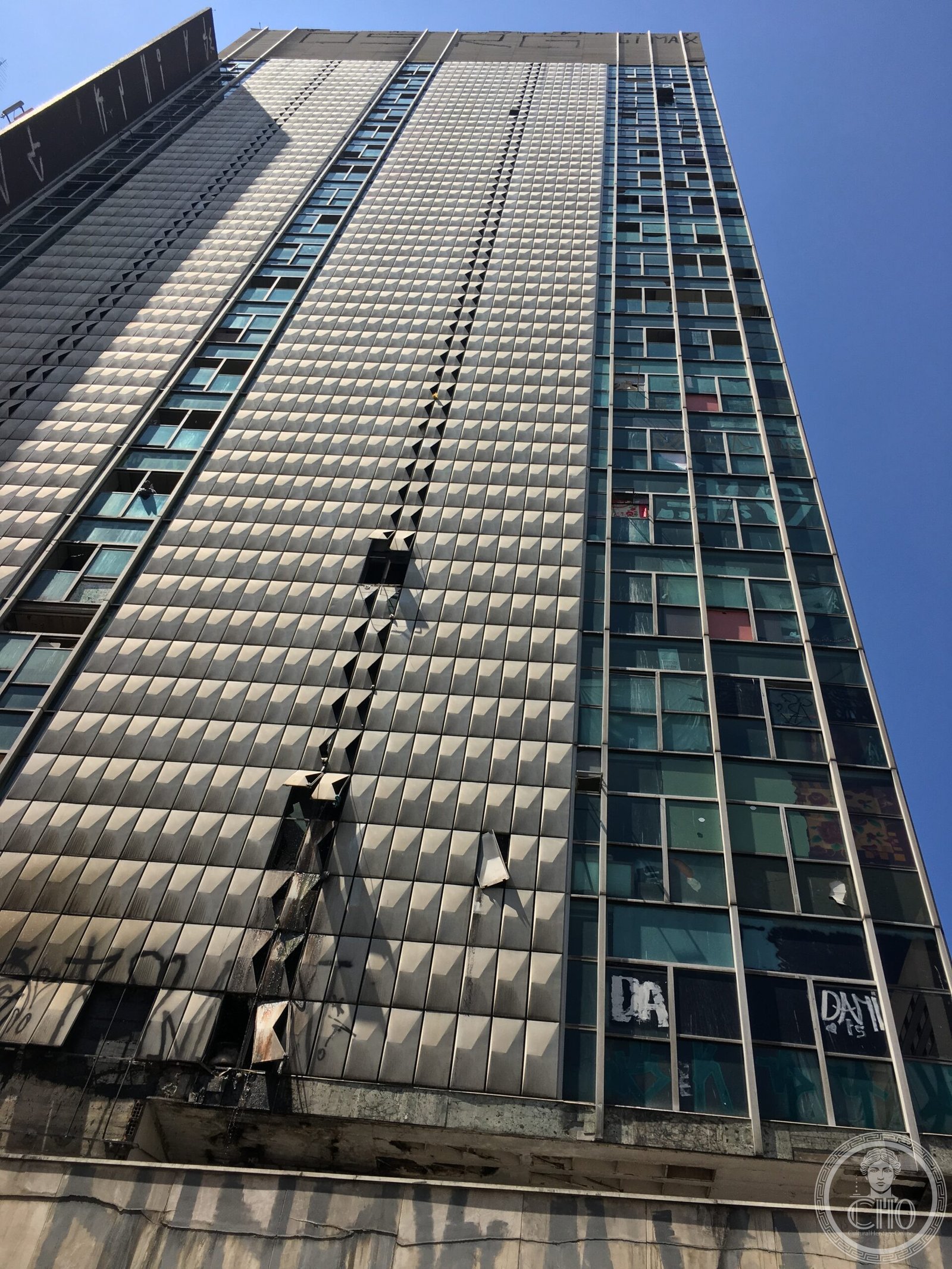
The Edifício Wilton Paes de Almeida was a landmark modernist skyscraper in central São Paulo, celebrated as one of Brazil’s pioneering glass-curtain-wall towers. Designed by architect Roger Zmekhol and completed in 1968, the 26-storey building stood on Rua Antônio de Godói in the República district and earned the nickname “Skin of Glass” for its innovative aluminum-framed glass façade — a technological rarity in Brazil at the time of its construction. Listed as a historic property in 1992, it served for decades as the Federal Police headquarters in São Paulo before falling into abandonment and occupation by low-income squatters. On 1 May 2018, a fire broke out in the early hours and the structure collapsed completely, killing seven people. The building remains a powerful symbol of São Paulo’s unresolved social and urban tensions.
At a glance
- Type
- Modernist office skyscraper (destroyed 2018)
- Period
- 1961–1968 (construction)
- Style
- Brazilian Modernism with glazed curtain wall
- Location
- 23 Rua Antônio de Godói, Largo do Paiçandu, República, São Paulo, Brazil
- Coordinates
- 23.5422° S, 46.6379° W
- Architect(s)
- Roger Zmekhol
Overview
The Wilton Paes de Almeida Building rose 26 floors above Largo do Paiçandu in São Paulo’s República district, forming a bold vertical accent within the densely populated city centre. Completed in 1968 to a design by Roger Zmekhol, the tower was notable as one of the first buildings in São Paulo to deploy a fully glazed aluminum-framed curtain wall — earning its popular nickname “Pele de Vidro” (Skin of Glass). Built-in air conditioning, then a luxury, was integrated from the outset. The address placed it at the confluence of São Paulo’s immigrant-era urban fabric and its post-war modernist ambitions, making the structure a visible marker of mid-century civic optimism in Brazil’s largest city.
History
Construction commenced in 1961 and the building was inaugurated in 1968. Through the 1980s and into 2003 it served as the headquarters of the Federal Police for the state of São Paulo, lending it institutional gravity during a turbulent period in Brazilian history. The property was placed on the municipal heritage list in 1992, acknowledging its architectural pioneering. After the Federal Police relocated, the building passed through various states of neglect. By the 2010s it had been occupied by hundreds of homeless families affiliated with a housing movement. On the night of 1 May 2018 a fire ignited on the fifth floor, traced to an overloaded power strip, and spread rapidly through the building; the structure collapsed, killing seven people and leaving two missing weeks afterward.
Architecture & Design
Roger Zmekhol’s design was audacious for its era in Brazil: a slender 26-storey tower clad entirely in floor-to-ceiling glass panels held in aluminum frames, achieving a uniformly reflective skin that distinguished it from the heavier concrete masses typical of contemporary São Paulo construction. The building integrated mechanical air conditioning throughout — a system almost unheard of in Brazilian commercial architecture of the 1960s — and employed a structural grid that minimised interior columns to maximise open-plan office floors. This combination of transparency, lightness, and technological ambition placed it in dialogue with contemporary American curtain-wall towers of the same decade, yet the building was entirely locally conceived and executed.
Cultural significance
The Wilton Paes de Almeida Building occupies a charged place in São Paulo’s cultural memory. Its 1992 heritage listing confirmed its status as a milestone of Brazilian architectural modernity. Its later history — Federal Police headquarters, then squatter occupation, then catastrophic fire — mirrors the arc of São Paulo’s post-industrial centre: civic ambition, institutional abandonment, and the housing crisis. The 2018 collapse became an international news story and a symbol of the human cost of urban neglect. Though the structure no longer exists, it endures in scholarship, photography, and public debate about heritage preservation, social housing, and the responsibilities of the state toward listed buildings.
Visiting today
The building no longer stands. The site at Largo do Paiçandu in the República district remains a significant urban location in central São Paulo, surrounded by other modernist-era buildings and public space. Visitors interested in the building’s story can explore documentation at the São Paulo Museum of Art archives or consult the Instituto do Patrimônio Histórico e Artístico Nacional records. The tragedy of 2018 has been extensively documented by local and international media, and the site itself continues to be a focal point for discussions about urban housing policy in Brazil.
Getting there
The former site lies in the República district of central São Paulo. The nearest Metro station is República, served by Lines 3-Red and 4-Yellow, a short walk from Largo do Paiçandu. Numerous bus lines serve the area along Avenida Ipiranga and adjacent streets. The district is a major interchange hub and easily reached from any part of the city. The surrounding area contains several notable modernist buildings and public squares that reward exploration on foot.
Sources & resources
Find it on the map
See this place and what’s around it →Record researched and written by Luigi De Marchi for Cultural Heritage Online, 2026.
📷 Become a Cultural Heritage Online photographer
Share your photos of places: they stay published under your name as the author. The more they're seen, the more you get noticed — and soon a contest will reward the most appreciated photos.
Log in or sign up free to add a photoIs this page about you?
This page is read by travellers and heritage enthusiasts who find it on Google. Tell us how you are connected to this place and we will take it from there.