

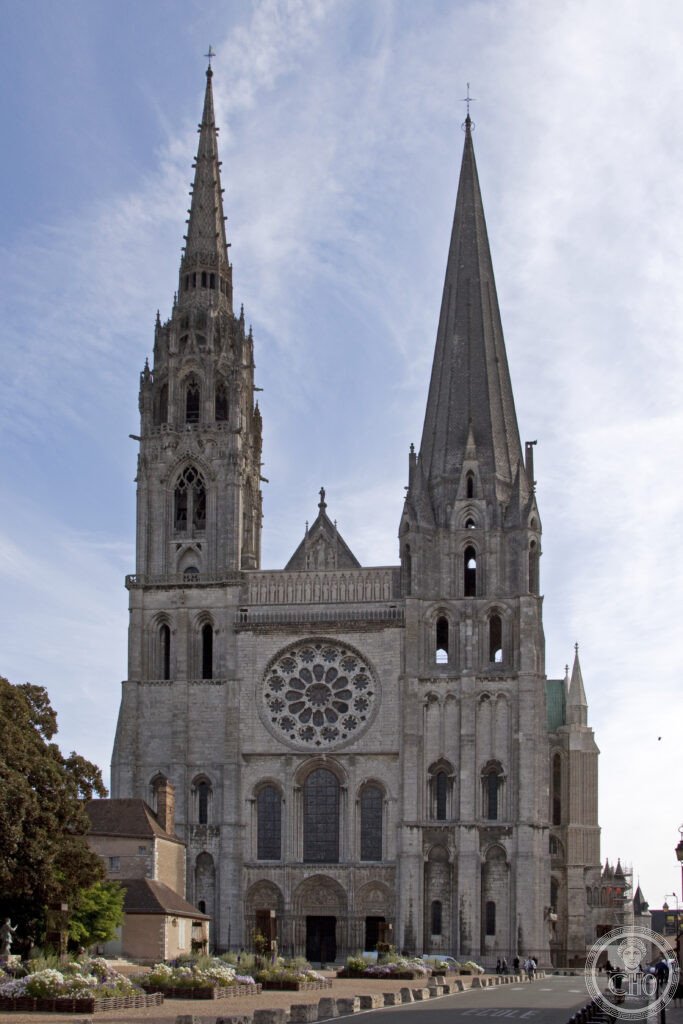
The cathedral that defined High Gothic architecture — built in 26 years (1194–1220) with a speed and consistency that no other Gothic building achieved, its 176 windows of intact medieval stained glass (the largest surviving collection in the world) turning the interior into a sustained meditation in coloured light that Rodin called “the French Acropolis.”
At a glance
Notre-Dame de Chartres (Chartres Cathedral) stands above the flat agricultural plain of the Beauce in the town of Chartres, 90 km south-west of Paris, its two asymmetrical towers visible for 30 km in every direction. The present building was constructed with extraordinary rapidity after a fire in 1194 destroyed the previous Romanesque cathedral (except for the west facade and the crypt); the building was substantially complete by 1220. Chartres is regarded by architectural historians as the first fully developed example of High Gothic architecture — the building that synthesised the innovations of the preceding 50 years (flying buttresses, pointed arches, ribbed vaults, large windows) into a coherent and influential whole. Its 176 medieval stained glass windows, covering approximately 2,600 square metres and ranging in date from the 12th century to the early 13th century, are the largest surviving collection of medieval stained glass in situ in the world. Chartres Cathedral was inscribed as a UNESCO World Heritage Site in 1979.
Key facts
- Construction: present building begun 1194 after fire; nave, choir, and transepts structurally complete by c. 1220; the building was built with exceptional consistency of design and materials over 26 years, suggesting continuous construction rather than the multiple campaigns typical of Gothic cathedrals
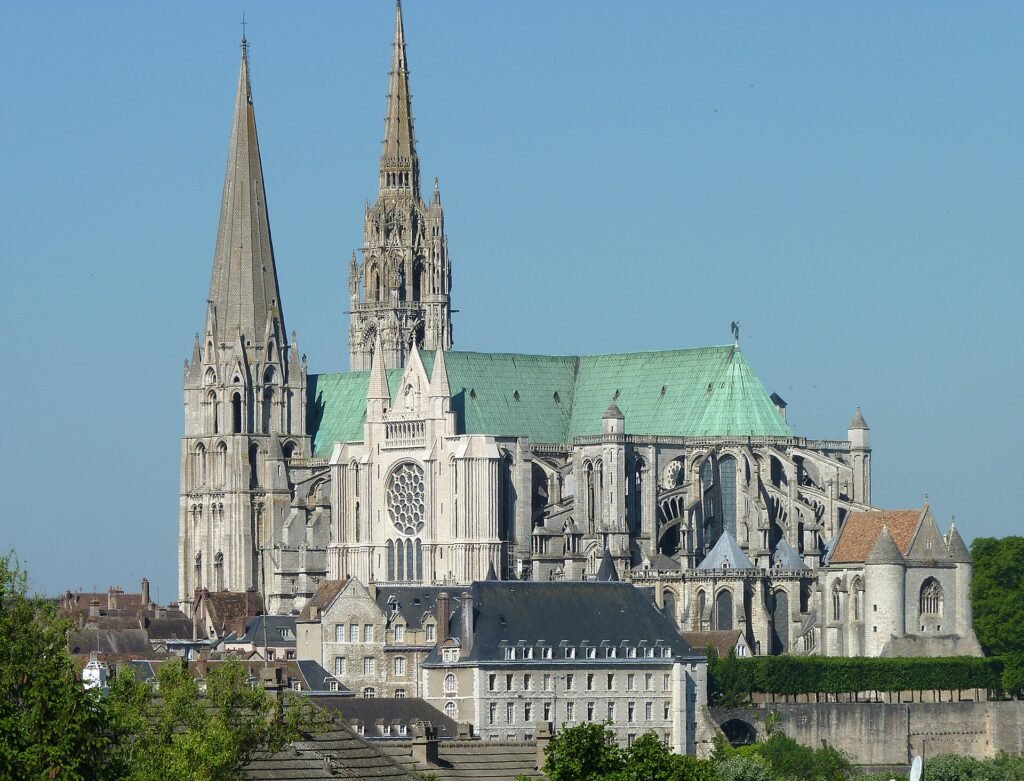
- Dimensions: total length 130 metres; nave width 16.4 metres; nave height 36.55 metres; south tower (Clocher Vieux, Old Tower) 105 metres with a Romanesque spire; north tower (Clocher Neuf, New Tower) 113 metres with a Renaissance spire added 1507–1513
- Stained glass: 176 windows; approximately 2,600 square metres; ranges from the Blue Virgin (12th century, pre-fire, the earliest surviving window in Chartres) to the north transept rose window (1230, donated by Blanche of Castile) and south transept rose window (1221–1230, donated by Pierre de Dreux); the glass is characterised by the distinctive “Chartres blue,” an intense cobalt blue produced by a technique not fully replicated since the medieval period
- Three portals: the Royal Portal on the west facade (c. 1150, pre-fire, the finest ensemble of Romanesque sculpture in France); the north transept portal (c. 1210–1220, dedicated to the Virgin Mary); the south transept portal (c. 1215–1220, dedicated to the martyrs and confessors)
- Sancta Camisia: the cathedral’s principal relic — the tunic of the Virgin Mary, said to have been worn at the Annunciation and Christ’s birth — donated by Charlemagne in 876; the fire of 1194 was thought to have destroyed it, but its miraculous survival in the crypt was taken as a sign that the Virgin herself wanted a grander cathedral built
- Heritage: UNESCO World Heritage Site, inscribed 1979
- GPS: 48.4473° N, 1.4877° E
History
A church on the Chartres hilltop is documented from at least the 4th century; it became an important Marian pilgrimage site in the 9th century after the donation of the Sancta Camisia relic by Charles the Bald (grandson of Charlemagne) in 876. Several earlier buildings were destroyed by fire; the Romanesque cathedral of Bishop Fulbert (begun 1020) was one of the largest in France and set the ground plan that the Gothic building follows. The fire of 10 June 1194 destroyed the nave and choir of Fulbert’s building; the west facade and crypt survived. The bishop, the chapter, and the king launched an immediate fundraising campaign across France; the response was extraordinary — accounts describe wealthy and poor alike bringing building materials to Chartres in carts, an event known as the “cult of the carts.”
The building that arose between 1194 and 1220 was designed by an unknown master builder — the architect of Chartres is completely anonymous, one of the few major Gothic buildings without a documented architect — who achieved a level of consistency and completeness unprecedented in Gothic construction. The nave, choir, and transepts share the same vault height, the same width proportions, and the same window system; there are almost no visible changes of plan or rebuilding. The speed of construction was made possible by the availability of funds, the pre-existing crypt and west facade that fixed the ground plan, and a clear architectural vision that was not interrupted by financial crises or changes of patron.
Chartres escaped the religious wars of the 16th century and the Revolution relatively intact: Protestants sacked the treasury in 1568 but did not destroy the glass; the Revolutionary government stripped the metalwork and sold the treasury contents but did not damage the fabric. In 1836, lightning struck the north spire and the fire destroyed the wooden roof over the choir; the choir vault (stone) survived. The 2009 initiative to clean and study the cathedral’s interior led to the discovery of extensive polychromy — the cathedral’s columns and walls were originally painted in white and ochre to simulate stone, not the bare grey limestone visible today; the cleaning of selected bays has restored this original effect and changed scholarly understanding of Gothic interior space.
What you see
The approach to Chartres from the train station (Parvis Notre-Dame square) presents the cathedral’s west facade at close range: the Royal Portal in the centre flanked by the two towers — the Romanesque south tower and the later Renaissance north tower. The Portal’s tympana carry Christ in Majesty (central), the Ascension (left), and the Nativity and Presentation in the Temple (right); the column figures below (the “column statues”) are the first life-size figures in monumental Gothic sculpture, their stiff frontality and elongated proportions quite different from the naturalism that followed.
The interior strikes at the crossing: the 36-metre nave vault, the choir beyond, and the rose windows of both transepts illuminating the crossing with coloured light. The north rose window (1230) is the most perfect composition: a central medallion with the Virgin surrounded by prophets and the ancestors of Christ in a radiating design that resolves the abstract geometry of the Gothic window into a figural programme of extraordinary complexity. The effect of walking the nave — the gradual revelation of the window programme, the changing quality of light as the sun moves, the way the cobalt blue of the windows deepens the interior shadows — is what drew Rodin back year after year and what makes Chartres unique among Gothic cathedrals.
Practical information
- Address: 16 Cloître Notre-Dame, 28000 Chartres
- Hours: daily 8:30 am–7:30 pm; later on certain evenings (Son et Lumière programme in summer)
- Admission: cathedral free; north tower ascent EUR 9 (350 steps, worth it for the close view of the flying buttresses and the roof); crypt tour EUR 3 (only with guided tour, approximately 40 minutes, in French and English)
- Malcolm Miller tours: the English-speaking art historian Malcolm Miller conducted legendary tours of the cathedral for 60 years; daily tours in English at noon and 2:45 pm (check availability); the most informative introduction to the iconographic programme of the windows
- Light at dusk: the west facade in the late afternoon light, when the setting sun enters through the west windows and the interior fills with ochre and gold, is the definitive experience of Chartres
Getting there
From Paris Montparnasse: 1 hour by direct SNCF train (frequent departures; EUR 15–20); the cathedral is 10 minutes on foot from Chartres station. By car from Paris: 90 km south-west on the A11/A10 (1 hour 20 minutes). GPS: 48.4473, 1.4877.
Nearby
- Chartres Old Town — the medieval quarter below the cathedral; the Maison Picassiette (a house decorated entirely in broken ceramics by a Chartres road sweeper, 1938–1964; now a museum); the Eure River valley walkways
- Cathédrale Saint-Étienne, Bourges — the other great High Gothic cathedral of the Loire region; the west facade has five (not three) portals; the stained glass programme is complementary to Chartres; 2.5 hours south by train; UNESCO WHS
- Versailles — 55 km north-east of Chartres; 30 minutes by direct train; the Palace of Versailles combines easily with Chartres as a full-day excursion from Paris
More photographs
Sources
- Wikipedia, Chartres Cathedral, accessed June 2026
- UNESCO, Chartres Cathedral, WHS reference 81, inscribed 1979
- Malcolm Miller, Chartres Cathedral, Pitkin Guides, 2010 — the standard compact guide to the iconography
- Jean Villette, L’Énigme du labyrinthe de la cathédrale de Chartres, 1995 — on the famous labyrinth in the nave
Find it on the map
See this place and what’s around it →📷 Become a Cultural Heritage Online photographer
Share your photos of places: they stay published under your name as the author. The more they're seen, the more you get noticed — and soon a contest will reward the most appreciated photos.
Log in or sign up free to add a photoIs this page about you?
This page is read by travellers and heritage enthusiasts who find it on Google. Tell us how you are connected to this place and we will take it from there.