

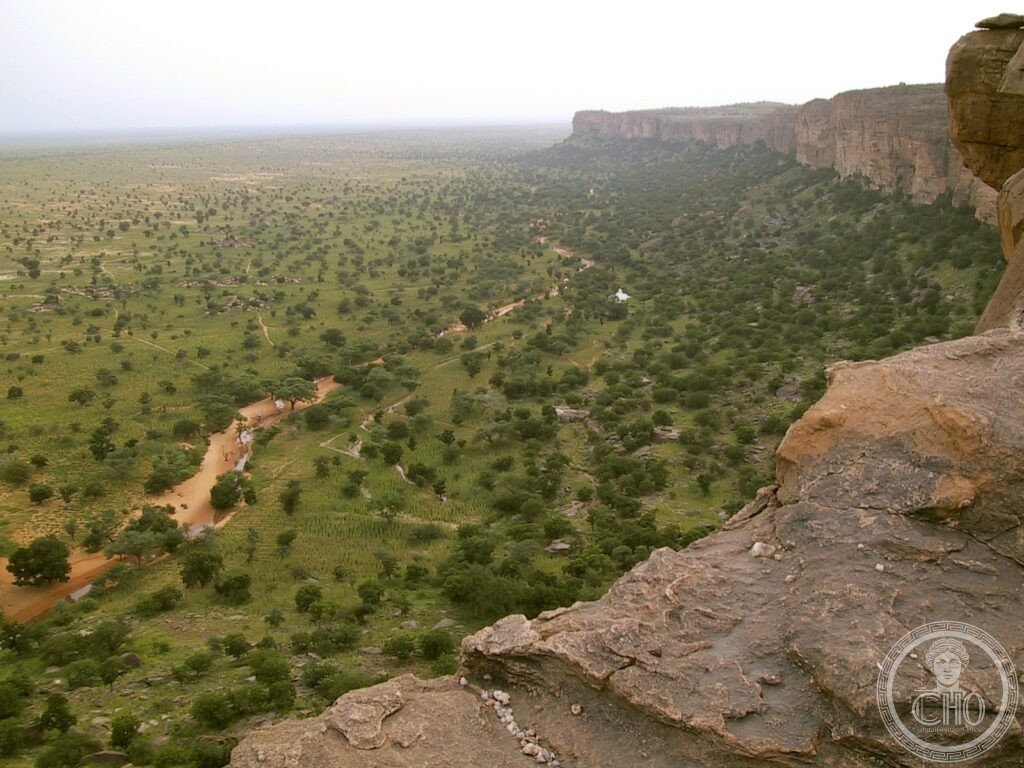
The Bandiagara Escarpment in central Mali rises above the Seno-Gondo plains as a wall of sandstone, its cliffs holding villages built directly into the rock by the Dogon people since the fourteenth century. Above them lie the burial caves of the earlier Tellem people. Below runs a living tradition of mask, ceremony and carved wood.
At a glance
The Bandiagara Escarpment is a sandstone cliff running for some 150 kilometres, rising around 500 metres above the Seno-Gondo plains in the Mopti Region of Mali. Dogon villages are built directly into the rock face at several levels: conical granaries are tucked into overhangs at mid-cliff, flat-roofed houses sit in the lower villages, and the burial caves of the earlier Tellem people lie higher still, in positions that seem almost unreachable.
The Dogon are believed to have settled the escarpment from around 1300–1400 CE, and their numbers today are estimated in the hundreds of thousands, though the exact figure is debated. Their cosmology, recorded in depth by the French anthropologist Marcel Griaule through his work with the Dogon elder Ogotemmêli, includes knowledge of a companion star to Sirius that European astronomers only confirmed telescopically in 1862 — a detail that has long puzzled scholars and never been fully explained.
Key facts
- Sigi ceremony: the most important Dogon rite, held once every sixty years in a cycle said to correspond to the orbital period of Sirius B; the last was held in 1967–1973, with the next expected around 2027–2033. It involves the carving of new masks, a procession through the villages and the passing on of secret ceremonial knowledge.
- Masks: the Dogon use 78 known types of ritual mask in the Dama funeral ceremony and the Sigi. The Kanaga, shaped like a cross, and the Sirige, a tall house mask standing several metres high, are the best known.
- Tellem caves: burial caves set high in the cliff face contain mummified remains and funerary objects of the Tellem people, who predate the Dogon and are thought to date from roughly the 11th to 15th century. How their bodies were carried to such positions remains unexplained, though one theory holds that the cliff was still wooded at the time.
- Location: Bandiagara District, Mopti Region, Mali; approximate coordinates 14.35° N, 3.55° W.
History
The ancestors of the Dogon are thought to have fled to the Bandiagara Escarpment in the 14th or 15th century to escape forced conversion under the expanding Mali Empire. The escarpment’s inaccessibility allowed them to preserve a traditional religious system built around a large pantheon of spirits and a distinct creation narrative; today a substantial share of the Dogon practise Islam alongside these older ceremonies.
In the twentieth century the French anthropologist Marcel Griaule spent extended periods studying Dogon cosmology, working closely with the Dogon elder Ogotemmêli. Their collaboration produced the book published in English as Conversations with Ogotemmêli, a work that became one of the most influential texts in the history of anthropology and brought the Dogon to wider attention.
What you see
Along the escarpment, villages such as Banani, Tireli and Begnimato show the Dogon’s architecture at close range: the ginna, the house of the hogon or spiritual leader, and the toguna, a low-roofed meeting house built deliberately too low for men to stand, so that discussions stay calm. Banani sits among large boulder fields with granaries visible in the cliff above it; Tireli and Begnimato lie further along the escarpment and are reached partly on foot or by donkey.
The granaries themselves are among the most distinctive structures on the cliff, their pointed roofs and flat roofs said to reflect a cosmological pairing of sky and earth. Built into the rock at mid-cliff level, they are among each family’s most valued possessions, and their carved wooden doors, decorated with figures of ancestors and water spirits known as Nommo, rank among the finest wood carving produced in sub-Saharan Africa.
Practical information
- Guides: a local Dogon guide is required to trek the escarpment; arrangements are best made in Bandiagara town, and current rates should be confirmed locally.
- Itineraries: guided treks typically run over several days and take in a number of villages along the cliff.
- Security: the security situation in the Mopti Region has been unsettled since 2012; travellers should check current advisories from their own government, such as the UK FCDO, US State Department or French MEAE, before planning a visit.
Getting there
The usual route is to fly into Bamako, then continue to Mopti by air or overland, and from there travel by 4WD to Bandiagara town. The escarpment villages themselves are reached by a combination of vehicle and walking, with guided multi-day treks the normal way to see several villages along the cliff.
Nearby
- Djenné — around 130 km northwest of Bandiagara; home to the Great Mosque of Djenné, the largest mud-brick building in the world, whose current structure dates from 1907 on a site used for mosques since 1240, and known for its annual community replastering festival and lively Monday market.
- Mopti — around 70 km west of Bandiagara; a river port at the confluence of the Niger and Bani, sometimes called the Venice of Mali, with the Komoguel Mosque of 1935 and a working waterfront of dugout canoes.
Sources
- Wikipedia, Bandiagara Escarpment
- Wikipedia, Dogon people
- Wikipedia, Marcel Griaule
- UNESCO, Cliff of Bandiagara (Land of the Dogons), WHS reference 516
Find it on the map
See this place and what’s around it →📷 Become a Cultural Heritage Online photographer
Share your photos of places: they stay published under your name as the author. The more they're seen, the more you get noticed — and soon a contest will reward the most appreciated photos.
Log in or sign up free to add a photo