

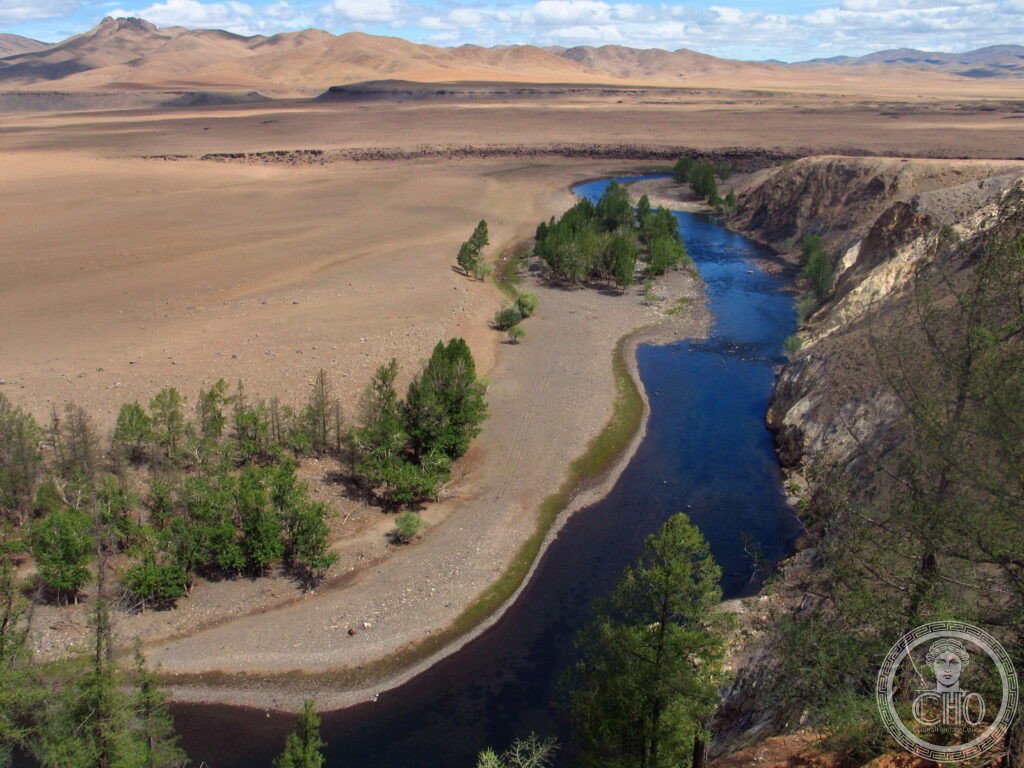
A river valley on the Mongolian steppe served as the political heart of Central Asia for two thousand years, from the Xiongnu to the Türks, the Uyghurs and finally the Mongols of Genghis Khan. Beneath and around the Buddhist monastery of Erdene Zuu lie the ruins of Karakorum, once capital of the largest land empire in history.
At a glance
The Orkhon Valley is considered the most fertile river valley of the Mongolian steppe, and for two millennia it was the chosen seat of successive nomadic empires: the Xiongnu from the 1st century BCE, the Türk Khaganate from 552 CE, the Uyghurs from 744 CE, and finally the Mongols. Genghis Khan founded his capital, Karakorum, here in 1220, and his successors expanded it into a city that received ambassadors from Europe, China, Persia and the Caliphate before it was abandoned once Kublai Khan moved the Mongol capital to Beijing in 1264.
Today the site is dominated by Erdene Zuu, founded in 1586 as the first Buddhist monastery in Mongolia and built in part from stone taken from the ruined palaces of Karakorum. Its outer wall, roughly 400 metres square, is lined with 108 white stupas, 108 being a sacred number in Buddhism.
Key facts
- Location: Övörkhangai Province, central Mongolia, along the Orkhon River.
- Karakorum: founded by Genghis Khan in 1220, capital of the Mongol Empire until 1264, described by the Franciscan friar William of Rubruck after his visit in 1254.
- Erdene Zuu monastery: founded in 1586 by the Khalkha ruler Abtai Sain Khan, the first Buddhist monastery in Mongolia, built using stones from the demolished palaces of Karakorum.
- Orkhon Inscriptions: the Köl Tigin and Bilge Kagan stelae, carved around 735 CE, the oldest known substantial texts in any Turkic language, deciphered by the Danish linguist Vilhelm Thomsen in 1893.
- Status: inscribed as a UNESCO World Heritage Site in 2004.
History
The valley became the political centre of the steppe in the 1st century BCE, when the Xiongnu Empire, whose raids prompted the construction of the Chinese defensive walls that preceded the Great Wall, established their capital here. The Türk Khaganate followed from 552 CE, leaving behind the Orkhon Inscriptions, and the Uyghurs held the valley from 744 to 840 CE before the Mongols made it their own.
Genghis Khan founded Karakorum in 1220, and under his successor Ögedei Khan it grew into a true city, with pagan temples, mosques and a Christian church standing alongside quarters for merchants and craftsmen from across Asia and Europe. William of Rubruck, sent by King Louis IX of France, reached the city in 1254 and left the most detailed Western eyewitness account of the Mongol capital, describing it as smaller than a Paris suburb despite its cosmopolitan population. Karakorum’s political importance ended in 1264 when Kublai Khan relocated the Mongol capital to Beijing.
Erdene Zuu monastery, founded in 1586 on the ruins of the old capital, grew at its height to house dozens of temples and a large monastic community. The Stalinist purges of 1937–1938 devastated Mongolian Buddhism nationwide, and Erdene Zuu lost the great majority of its temples; only three survive today, preserved as a museum from 1947.
What you see
The remains of Karakorum spread beneath and around Erdene Zuu as foundation stones, earthen mounds and scattered fragments, among them a large granite tortoise, one of four that once marked the corners of the imperial city, the turtle being a symbol of eternity in Mongolian culture. Joint German-Mongolian archaeological work carried out since 2000 has traced the grid of streets, workshop areas for ceramics and metalworking, and palace foundations across the site.
The Kharkhorin Museum, in the adjoining town, displays the finest objects recovered from Karakorum, including Chinese porcelain and celadon that attest to the extent of trade with China, Persian glass, and Mongolian bronzework, alongside a model reconstruction of the imperial city at its height.
Within Erdene Zuu itself, the three surviving temples and the long wall of white stupas remain the principal monuments, set within the wider archaeological landscape of the old capital.
Practical information
- Best season: the steppe is at its best from June to August, with wildflowers and frequent sightings of eagles and vultures.
- What to bring: warm layers are advisable even in summer, as temperatures on the open steppe fall sharply after sunset.
- Local stays: nomadic ger camps in the surrounding steppe often offer tea, fermented mare’s milk and accommodation.
- Entry and hours: current admission arrangements for Erdene Zuu and the Kharkhorin Museum should be checked with the relevant Mongolian tourism or heritage authority before travelling.
Getting there
Karakorum and the town of Kharkhorin lie about 360 kilometres southwest of Ulaanbaatar, reached by paved road along Highway 24 or by shared minivan from the capital’s bus station. Many organised tours from Ulaanbaatar combine the Orkhon Valley with Khustai Nuruu National Park as part of a multi-day circuit; current schedules and fares are best confirmed directly with transport operators or tour providers.
Nearby
- Orkhon Waterfall (Ulaan Tsutgalan) — around 60 km south of Kharkhorin, reached by four-wheel drive over unpaved tracks; the largest waterfall in Mongolia, formed by a basalt lava dam roughly 20,000 years ago, set in a green valley amid open steppe.
- Tövkhön Monastery — around 50 km south of Kharkhorin, reached by four-wheel drive followed by a walk through pine forest; a hermitage built on a granite cliff by Zanabazar, the first Jebtsundamba Khutuktu and Mongolia’s foremost religious sculptor.
Sources
- Wikipedia, Orkhon Valley Cultural Landscape
- Wikipedia, Karakorum
- Wikipedia, Erdene Zuu
- UNESCO, Orkhon Valley Cultural Landscape
Find it on the map
See this place and what’s around it →📷 Become a Cultural Heritage Online photographer
Share your photos of places: they stay published under your name as the author. The more they're seen, the more you get noticed — and soon a contest will reward the most appreciated photos.
Log in or sign up free to add a photo