

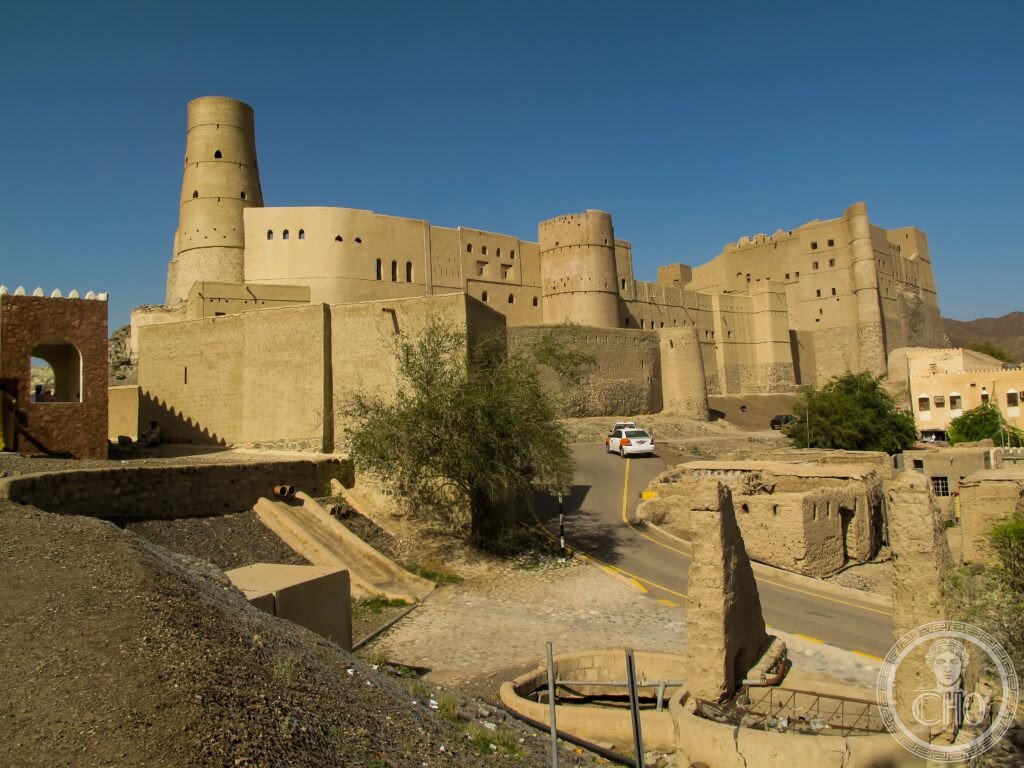
Rising from an oasis at the foot of the Hajar Mountains, Bahla Fort is the largest fortification in Oman, its twelve-kilometre outer wall enclosing an entire historic town of mosques, souks and irrigation channels once ruled by the Banu Nebhan dynasty and still spoken of, locally, as the city of jinn.
At a glance
Bahla is a historic oasis town in interior Oman, continuously inhabited since pre-Islamic times. Its position at the foot of the Jebel Akhdar, the highest range in the country, once gave it control of the trade route linking the coast to the interior, and under the Banu Nebhan dynasty it became the most powerful city of inner Oman. The fort and its long outer wall date largely from this period.
Bahla carries a lasting reputation in Omani folklore as a place of jinn and witchcraft, a reputation that locals still refer to today. Some accounts link it to the town’s long association with the Ibadi sect, which outsiders from other schools of Islam sometimes viewed with suspicion.
Key facts
- Recognition: inscribed as a UNESCO World Heritage Site in 1987, the first Omani site to receive this status.
- Endangered listing: placed on the UNESCO List of World Heritage in Danger in 1988 owing to the fragile state of its mud-brick construction; removed from the list in 2004 after restoration by Omani teams working with ICCROM.
- Scale: the outer defensive wall runs for roughly twelve kilometres around the old town, among the longest such walls in Arabia.
- Water system: the oasis is fed by ancient falaj channels, some said to be over two thousand years old; Oman’s aflaj irrigation systems received a separate UNESCO inscription in 2006.
- Craft tradition: Bahla has been Oman’s principal centre of pottery-making for some six hundred years, a craft now recognised as intangible cultural heritage.
History
The fort and its walls took their present form largely under the Banu Nebhan, an Ibadi dynasty that ruled the town between the twelfth and fifteenth centuries. Ibadi Islam, distinct from both Sunni and Shia traditions, remained the dominant school in Oman’s interior, and under the Banu Nebhan Bahla controlled the trade routes running from the Arabian Sea coast into the interior, becoming the wealthiest city in the region. The dynasty declined in the fifteenth century and was succeeded by the Yaruba Imamate.
When the Portuguese seized Muscat and the Omani coast in the sixteenth and seventeenth centuries, the interior, including Bahla, was never brought under their control. It was the Yaruba Imamate that eventually united Oman and drove the Portuguese from Muscat in the mid-seventeenth century.
What you see
The complex divides into an inner citadel, largely seventeenth-century in date and showing gun towers with Portuguese-influenced design, and an older outer curtain wall of mud-brick construction, standing several metres thick and high in its best-preserved sections. The historic gate, Bab al-Bahla, marks the traditional entrance to the fortified town.
Within the walls the old town survives largely intact: a covered souk considered among the most authentic in interior Oman, the whitewashed minaret of the Great Mosque, falaj channels still running through residential quarters, and date palm groves that continue to make Bahla one of the country’s notable date-producing areas.
Practical information
- Entry: the fort is open to visitors for a modest admission charge; current hours and fees are best checked with Oman’s tourism authority before travelling.
- Suggested time: allow enough time to see the fort itself and to walk the adjoining souk and pottery workshops.
- Combine with: Bahla is usually visited as part of a wider circuit with Nizwa and Jabrin Palace.
Getting there
Bahla lies around 200 kilometres southwest of Muscat, reached via the highway through Nizwa. The drive crosses the Hajar Mountains and is regarded as one of the more scenic routes in the region.
Nearby
- Nizwa Fort and Souk — around 40 kilometres northeast; the historic capital of interior Oman, with its large round tower built in the mid-seventeenth century, a traditional livestock market and a noted silver and date souk.
- Jabrin Palace — around 30 kilometres southwest; an early eighteenth-century palace known for its painted wooden ceilings, Quranic inscriptions and rooftop astronomical observatory.
Sources
- Wikipedia, Bahla Fort
- UNESCO, Bahla Fort, WHS reference 433, inscribed 1987
- Aflaj Irrigation Systems of Oman
Find it on the map
See this place and what’s around it →📷 Become a Cultural Heritage Online photographer
Share your photos of places: they stay published under your name as the author. The more they're seen, the more you get noticed — and soon a contest will reward the most appreciated photos.
Log in or sign up free to add a photoIs this page about you?
This page is read by travellers and heritage enthusiasts who find it on Google. Tell us how you are connected to this place and we will take it from there.