
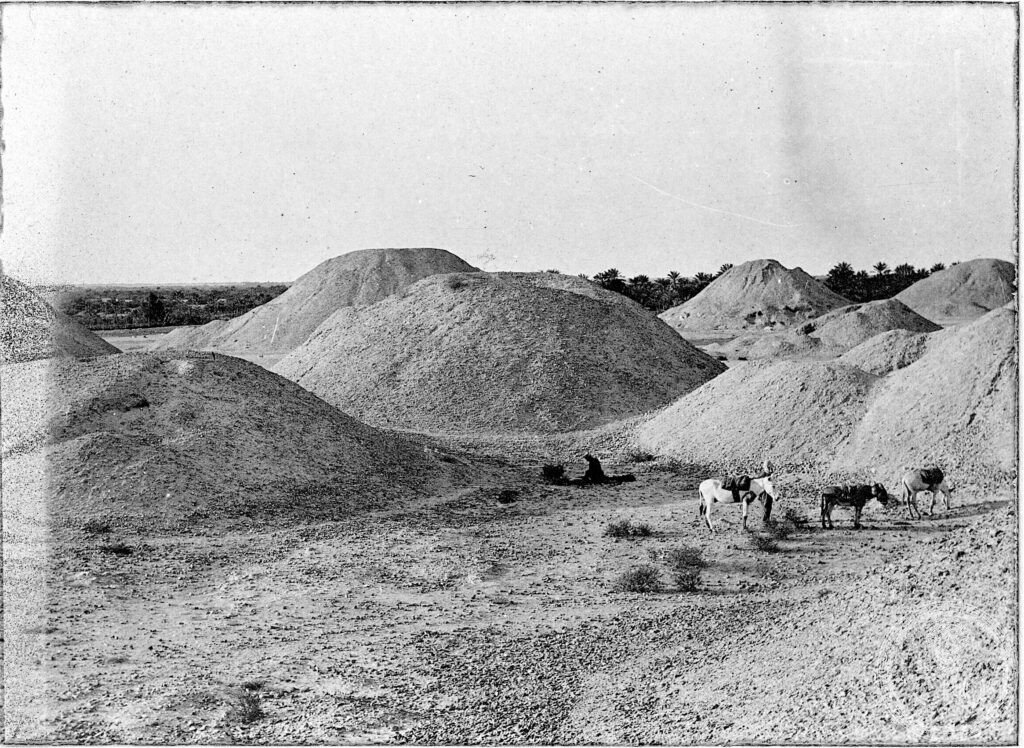
Across central Bahrain, tens of thousands of earthen mounds still rise from the desert, the burial ground of the Dilmun civilisation that once controlled Gulf trade between Mesopotamia and the Indus Valley. Nowhere else in the ancient world did an entire population receive individual burial on this scale.
At a glance
The Dilmun Burial Mounds form what is thought to be the largest prehistoric burial ground in the world. An estimated 350,000 mounds once covered Bahrain Island; roughly 170,000 survive today, much of the rest lost to modern building since the 1950s. They were raised over about three centuries, between 2050 and 1750 BCE, at the height of the Dilmun civilisation, and range from three to fifteen metres in height and five to twenty metres across.
What sets the site apart is not only its scale but its social logic: almost every adult in Dilmun society appears to have been given an individual mound, a practice with no real parallel elsewhere in the ancient world and one that implies a strong belief in an individual afterlife. The largest and most elaborate mounds, the Royal Mounds at A’ali, are associated with Dilmun’s rulers or high priests.
Key facts
- Extent: a group of 17 archaeological sites across Bahrain Island and Al-Muharraq Island, inscribed by UNESCO in 2019.
- Scale: around 170,000 surviving mounds, from an original total estimated at 350,000.
- Date range: built over roughly three centuries, c.2050–1750 BCE.
- Royal Mounds: at A’ali, six large mounds reaching 12–15 metres, the tallest in Bahrain.
- Grave goods: pottery, bronze weapons, carnelian and agate beads from the Indus Valley, alabaster vessels from southern Arabia, and Mesopotamian cylinder seals, now held mainly at the Bahrain National Museum.
History
Dilmun appears in Sumerian and Akkadian cuneiform texts from around 3000 BCE, described by the Sumerians as a paradise land where the sun rises, and as the place to which the flood hero Ziusudra was sent after the deluge. Its merchants moved copper from Oman and tin from Afghanistan through to Mesopotamia, and appear in the trade tablets of Ur as the “merchants of Dilmun”.
The modern rediscovery of this history began with the Jutland Archaeological Society’s Danish expedition, which started work in 1954 under P.V. Glob and Geoffrey Bibby. Over some fifteen years the team excavated more than 2,000 mounds, establishing the stratigraphy and chronology of the burial tradition. Bibby’s popular account of the dig, Looking for Dilmun, published in 1969, brought the site to a wide readership and first established Bahrain’s status as the seat of an ancient civilisation. Finds from the excavations are now divided between the Jutland Archaeological Society in Aarhus and the Bahrain National Museum.
What you see
The A’ali Royal Mounds, in the north-east of the island, are the most visually striking element of the site: six mounds standing twelve to fifteen metres high, set in open ground without formal fencing or a visitor park, their bulk startling against Bahrain’s flat terrain. To the south, the Salmabad mound field spreads across a wide stretch of desert visible from the main highway, its horizon filled edge to edge with smaller burial mounds packed close together, a density that satellite images capture particularly well.
For context and detail, the Bahrain National Museum in Manama displays burial goods recovered from dozens of excavated mounds, with interpretation that sets the objects against the wider Gulf trade network they came from.
Practical information
- Access: the mounds sit in open, unfenced ground; there is no ticketed site management at A’ali or Salmabad.
- Visas: GCC nationals do not require a visa; most Western nationals can obtain one on arrival or through Bahrain’s eVisa system, subject to current rules published by the relevant authority.
- Museum visit: the Bahrain National Museum should be checked directly for current opening arrangements and entry terms.
- Combine visits: pairing the mounds with Qal’at al-Bahrain and the National Museum gives the fullest picture of Dilmun civilisation.
Getting there
Bahrain International Airport is well connected within the Gulf region and to a number of international hubs. The mound sites are spread across the island and are best explored by car or taxi, since there is no public transport network serving them directly.
Nearby
- Qal’at al-Bahrain (Bahrain Fort) — a multi-period site on the northern coast, from the Dilmun Bronze Age through to Portuguese occupation, with its own archaeology museum; inscribed as a UNESCO World Heritage Site in 2005.
- Al-Khamis Mosque — one of the oldest mosques in Bahrain, dating from the 11th century, with twin minarets and archaeological remains of the original foundation beneath the present structure.
Sources
- Wikipedia, Dilmun Burial Mounds
- Wikipedia, Dilmun
- Geoffrey Bibby
- UNESCO, Dilmun Burial Mounds, WHS reference 1507
Find it on the map
See this place and what’s around it →📷 Become a Cultural Heritage Online photographer
Share your photos of places: they stay published under your name as the author. The more they're seen, the more you get noticed — and soon a contest will reward the most appreciated photos.
Log in or sign up free to add a photo