
Three small islands in Havannah Harbour hold the story of Roi Mata, the chief credited with ending generations of clan warfare in central Vanuatu. His burial site, found in 1967 exactly where oral tradition said it would be, remains one of the Pacific’s most striking confirmations of spoken history.
At a glance
Chief Roi Mata’s Domain is a cultural landscape spread across three coral limestone islands in Havannah Harbour, northwest of Port Vila: Lelepa, Artok and Fels. It preserves the settlement where the 17th-century paramount chief Roi Mata is said to have lived, the cave where he is believed to have died, and the site on Artok where he was buried alongside roughly fifty of his followers. The kastom traditions connected to his story are still maintained by the communities of Efate, Lelepa and Artok.
Key facts
- Location: Havannah Harbour, central Vanuatu, spanning Lelepa, Artok and Fels islands
- Central figure: Roi Mata, a paramount chief of the 17th century CE credited with uniting the region’s warring clans
- Burial discovery: excavated in 1967 by archaeologist José Garanger, guided entirely by local oral tradition
- Status: inscribed as a UNESCO World Heritage Site in 2008, the only one in Vanuatu
- Living heritage: the kastom traditions surrounding Roi Mata have been maintained by descendant communities for around four centuries
History
The Mangaasi site on Lelepa, where Roi Mata is said to have lived, contains an archaeological sequence going back some 3,000 years to the Lapita people, the first settlers of Vanuatu and ancestors of later Polynesian and Melanesian populations. Layers of decorated Lapita pottery give way to later local ceramic traditions, and finally to material contemporary with Roi Mata himself in the 17th century.
Oral tradition holds that before Roi Mata, the islands of central Vanuatu were locked in continual clan warfare. He is credited with introducing the tambu system, a set of land-use rules and sacred alliances that made conflict impractical by binding clans into mutual obligation, and with institutionalising cross-clan marriage to cement peace between former enemies. His achievement is described in the tradition as comparable in scale to that of Sundiata Keita in the Mali Empire: a single leader who ended fragmentation through alliance rather than conquest.
In 1967 the French archaeologist José Garanger, working with ORSTOM, excavated the burial site on Artok Island. He was led there entirely by the account given by Ni-Vanuatu elders, who described Roi Mata as buried with many followers who had died alongside him. Garanger found the chief’s skeleton at the centre of a mass grave, surrounded by some 47 other skeletons in concentric arrangement, many still dressed in ceremonial tapa cloth, shell ornaments and pig tusks. The physical evidence matched the oral account in precise detail, a correspondence that reshaped how Pacific oral tradition has since been regarded as a historical source.
What you see
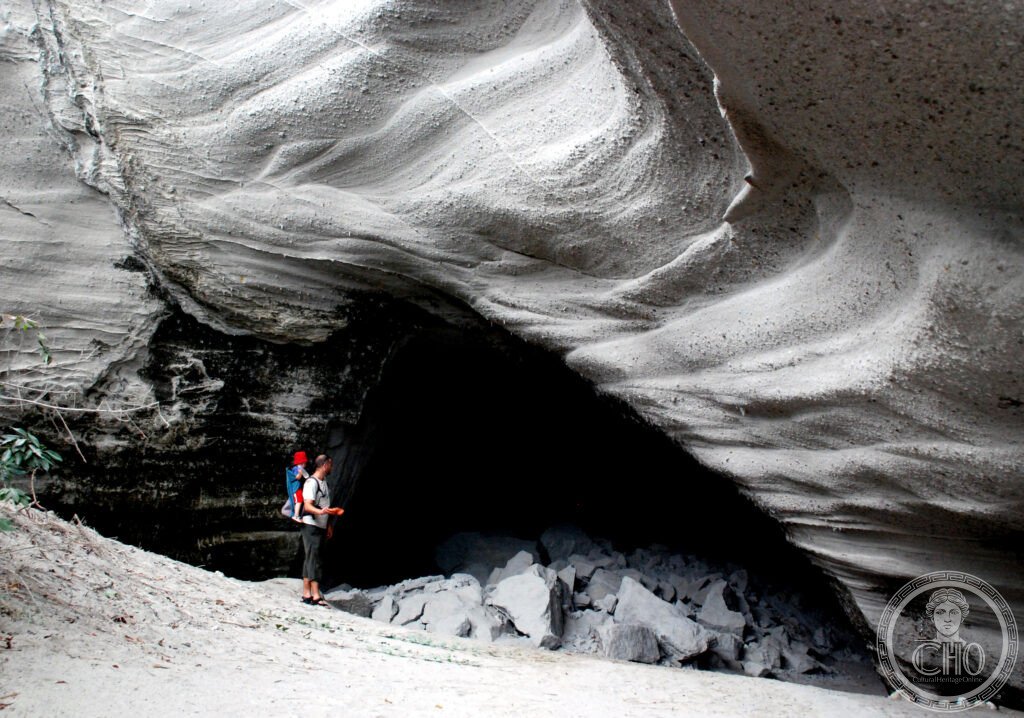
Visits take in all three islands. Lelepa holds the Mangaasi village and archaeological site, where visitors are typically received with a traditional welcome. Fels Island holds the limestone cave where Roi Mata is believed to have spent his final days, a small but atmospheric space reached on foot from the shore. Artok Island holds the burial site itself, where the excavation pits are protected under roofing; photography at the actual burial spots is not permitted, and guides explain both the oral tradition and the Garanger excavation on the spot.
Practical information
- Access: the Domain can only be reached by boat, as part of community-run tours organised by local kastom communities with support from the Vanuatu Cultural Centre
- Booking: tours are arranged in Port Vila through the Vanuatu Cultural Centre or accredited operators on Lelepa Island; check current arrangements and any fees directly with them
- Best season: the dry months from May to October bring calmer seas and steadier winds
- Cyclone risk: the wider region is subject to cyclones between November and April
Getting there
Port Vila International Airport on Efate Island is the main gateway to Vanuatu, with direct connections from several Pacific cities including Auckland, Brisbane, Sydney, Nadi and Noumea. Most Western nationalities do not require a visa for short stays. From Port Vila, the boat tour to the Domain is arranged locally rather than booked in advance from abroad.
Nearby
- Port Vila — around 25 km southeast, Vanuatu’s capital, with the Vanuatu National Museum holding an ethnographic collection that includes material related to Roi Mata
- Mele Cascades — a short distance from Port Vila, a waterfall often combined with a Domain visit to make a full day outside the capital
- Tanna Island — around 200 km south, home to Mount Yasur, an accessible active volcano with a walkable crater rim, and the John Frum village associated with the still-active cargo cult movement
Sources
- Wikipedia
- UNESCO
Find it on the map
See this place and what’s around it →📷 Become a Cultural Heritage Online photographer
Share your photos of places: they stay published under your name as the author. The more they're seen, the more you get noticed — and soon a contest will reward the most appreciated photos.
Log in or sign up free to add a photo