
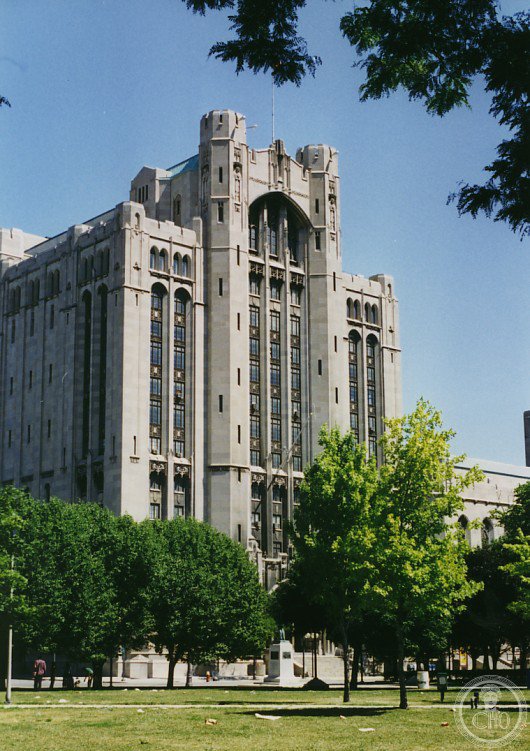
The Detroit Masonic Temple is the largest Masonic temple in the world, a vast Gothic Revival structure completed in 1926 in Detroit Cass Corridor neighbourhood. Designed by architect George D. Mason, it encompasses 16 floors, 1,037 rooms, three theatres, three ballrooms, and one of the largest stages in North America — a monumental civic landmark that has hosted everyone from Masonic lodges to rock concerts for nearly a century.
At a glance
- Type
- Masonic temple / cultural centre
- Period
- 1920–1926
- Style
- Gothic Revival with Art Deco interior elements
- Location
- Detroit, Michigan, USA
- Coordinates
- 42.3414° N, 83.0603° W
- Architect(s)
- George D. Mason
Overview
Standing 210 feet tall at 500 Temple Street in Detroit Cass Corridor, the Detroit Masonic Temple has held the distinction of world largest Masonic temple since 1939, when Chicago competing structure was demolished. The building belongs to the Masonic Temple Association and serves simultaneously as an active lodge facility and a busy public venue. Its sheer scale — 14 acres of floor space, 1,037 rooms, and a stage measuring 55 by 100 feet — makes it one of the most complex single buildings in the American Midwest. Alongside its Masonic functions, the temple hosts Broadway touring productions, concerts, boxing matches, professional wrestling events, and private galas throughout the year.
History
The Masonic Temple Association was incorporated in 1894, and after outgrowing an earlier premises the organisation commissioned George D. Mason to design a purpose-built temple of unprecedented scale. Groundbreaking took place on Thanksgiving Day, 1920; the cornerstone was ceremonially laid on 19 September 1922 with a trowel said to be the same used by George Washington to lay the cornerstone of the US Capitol. The building was dedicated on Thanksgiving Day 1926. Financial difficulties in the early 2010s brought the temple close to foreclosure; in 2013 Detroit-born musician Jack White paid $142,000 in back taxes to help save it, prompting the Association to rename its Scottish Rite cathedral the Jack White Theater in his honour.
Architecture & Design
George D. Mason chose Indiana limestone for the exterior, executing a Gothic Revival design characterised by pointed arches, crenellated parapets, and vertical towers that give the building a medieval fortress quality unusual in early-twentieth-century American civic architecture. The Art Deco influence appears most strongly in the interior public spaces: streamlined bronze fixtures, geometric tile floors, and stylised ornamental panels reflect the transitional moment between the two movements. The seven lodge rooms are each decorated in a distinct historical style — Egyptian, Doric, Ionic, Corinthian, Italian Renaissance, Byzantine, Gothic, and Romanesque — with artistic direction provided by Italian craftsmen. The 160-by-100-foot drill hall, one of the largest clear-span interior spaces in Michigan, is remarkable for its structural engineering as well as its restrained elegance.
Cultural significance
The Detroit Masonic Temple is a monument to the ambitions of early-twentieth-century fraternal culture and to Detroit industrial-age prosperity. Its survival and continued vitality — serving both Masonic ceremonies and public entertainment — are exceptional given the economic pressures that have closed many comparable institutions. The building occupies a special place in Detroit popular culture, having hosted landmark concerts by artists from Led Zeppelin to Eminem, and serving as backdrop for films and television productions that use its Gothic grandeur. Jack White intervention to save the temple in 2013 became a celebrated story of civic loyalty and cultural stewardship.
Visiting today
The Detroit Masonic Temple is open for ticketed events throughout the year, including theatre productions, concerts, and public banquets. Guided architectural tours are offered periodically; check the official website for the current schedule. The grand lobby and public circulation spaces are accessible during events. The building is also available for private event hire, from weddings to corporate functions.
Getting there
The Detroit Masonic Temple is located at 500 Temple Street, Detroit, Michigan 48201. The QLINE streetcar stops at Henry Street, two blocks east. By car, the temple is five minutes west of downtown Detroit; parking is available in the temple lot and in nearby structures along Cass Avenue. Detroit Metropolitan Airport is approximately 20 miles southwest via I-94.
Sources & resources
Find it on the map
See this place and what’s around it →Record researched and written by Luigi De Marchi for Cultural Heritage Online, 2026.
📷 Become a Cultural Heritage Online photographer
Share your photos of places: they stay published under your name as the author. The more they're seen, the more you get noticed — and soon a contest will reward the most appreciated photos.
Log in or sign up free to add a photoIs this page about you?
This page is read by travellers and heritage enthusiasts who find it on Google. Tell us how you are connected to this place and we will take it from there.