

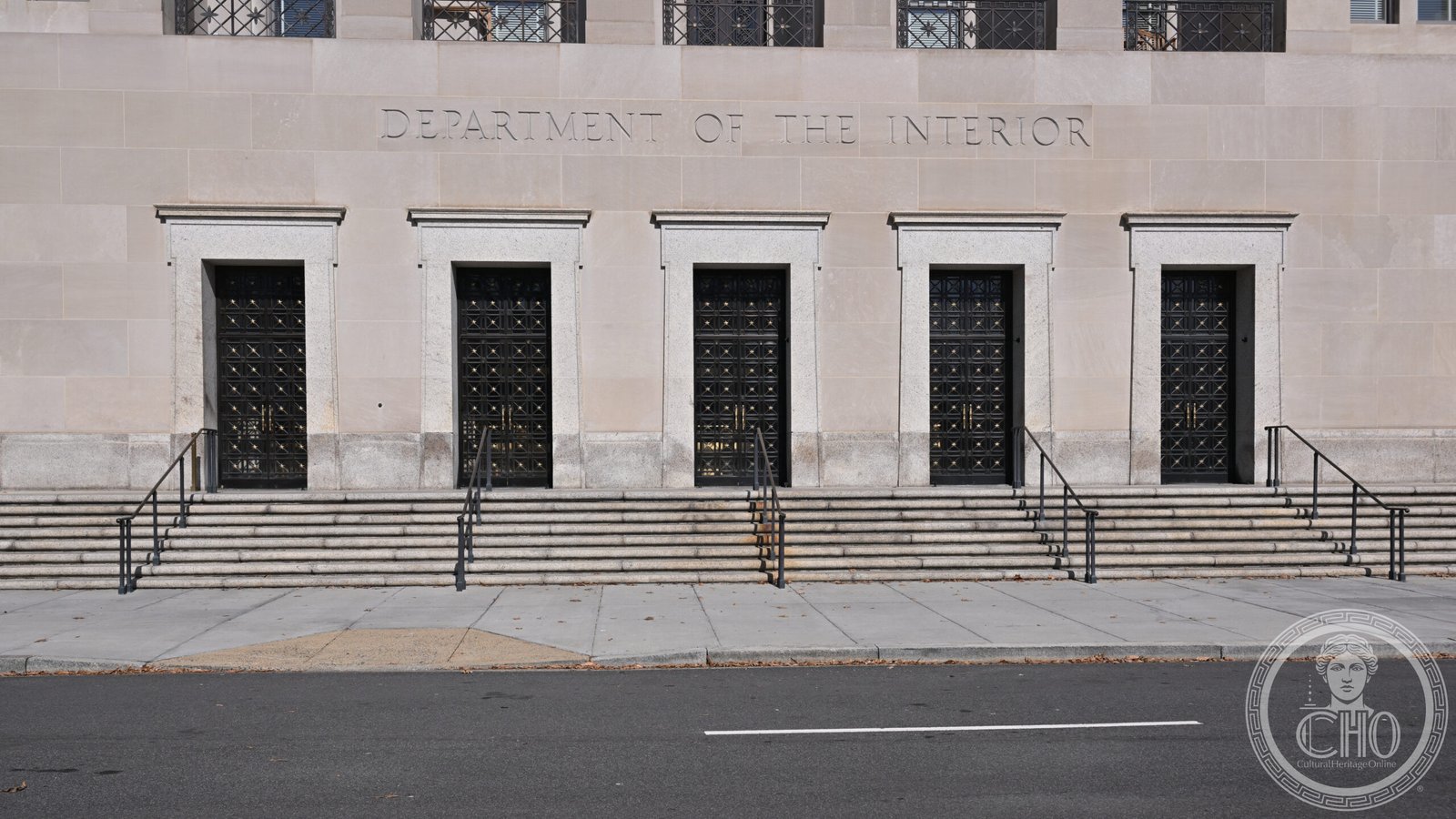
The 1936 New Deal federal office building that houses the Department of the Interior is a landmark of WPA Moderne architecture — six stories of Indiana limestone along C Street NW, its interior enriched with murals commissioned under the Public Works of Art Project depicting American Indian cultures and the landscapes of the managed public lands.
At a glance
The Department of the Interior Building at 1849 C Street NW in Washington DC was completed in 1936 as part of the New Deal expansion of the federal government. Designed by Waddy B. Wood, a Washington DC architect, the building represented a significant departure from the Neoclassical limestone vocabulary that characterised the contemporaneous Federal Triangle buildings, adopting instead the WPA Moderne aesthetic — clean geometric lines, minimal ornament, and an emphasis on well-proportioned limestone surfaces. The building was one of the first fully air-conditioned office buildings in Washington DC. Its interior features a notable collection of murals commissioned under New Deal arts programmes, depicting the conservation of natural resources, American Indian heritage, and the western landscapes administered by the Department.
Key facts
- Location: 1849 C Street NW, between 18th and 19th Streets, Washington DC
- Architect: Waddy B. Wood
- Completed: 1936
- Style: WPA Moderne / New Deal federal architecture
- Features: New Deal murals; first fully air-conditioned federal office building in Washington DC
- Status: National Register of Historic Places; home to the Department of the Interior Museum
History
The New Deal of the 1930s required an unprecedented expansion of the federal bureaucracy, and the Department of the Interior — responsible for managing the national parks, Indian affairs, territorial administration, and natural resource conservation — was among the agencies most in need of consolidated headquarters space. The previous Interior headquarters, spread across aging rented facilities, was inadequate for the scale of the department’s mission under Secretary Harold Ickes, who made the Interior Building project a priority of his tenure.
Waddy B. Wood designed a building whose restraint was deliberate: in contrast to the ornate Neoclassical structures of the Federal Triangle completed in the same years (such as the Justice Department and IRS buildings to the east), the Interior Building expressed its institutional character through proportion, material quality, and the programme of interior murals rather than through elaborate exterior ornament. The murals, commissioned from American artists under New Deal arts projects, depicted the landscapes and peoples that fell under the department’s jurisdiction — the national parks, American Indian nations, the conservation of forests and mineral resources, the history of the American West.
The building introduced several firsts to Washington’s federal architecture: it was among the first government buildings designed for full mechanical air-conditioning, anticipating the office environment that would become standard in postwar construction. The Department of the Interior Museum, opened within the building, is one of the oldest federal museums in the United States.
What you see
The building’s exterior on C Street NW presents the characteristic WPA Moderne vocabulary: smooth Indiana limestone walls, regularly spaced windows with minimal sills and surrounds, and a restrained cornice that avoids both the Classical details of the earlier federal architecture and the ornamental excess of the Art Deco towers of the same period. The building’s mass is broken by internal courtyards that admit natural light to the interior spaces.
The murals inside the building, accessible through the Department of the Interior Museum on the first floor, are the primary artistic experience the building offers. The museum, open to the public with security screening, displays exhibits on the department’s history and programmes alongside selected mural galleries. The paintings depict scenes from the American West and Southwest, Native American communities, and the conservation landscapes of the national park system, in a style that combines the Social Realist clarity of the New Deal mural tradition with the particular pride the Interior Department took in its stewardship role.
Practical information
- Museum access: The Department of the Interior Museum is open to the public Monday–Friday, 8:30 AM to 4:30 PM; closed federal holidays. Advance reservations required; photo ID needed.
- Security: Government building; enter through the main entrance on C Street with valid photo ID.
- Free admission: The museum is free of charge.
- Time needed: 45 minutes to 1 hour for the museum galleries and mural viewing.
Getting there
The Department of the Interior Building is at 1849 C Street NW in the Foggy Bottom neighbourhood of Washington DC, between 18th and 19th Streets. The nearest Metro station is Foggy Bottom/GWU (Blue/Silver/Orange Lines) on 23rd and I Streets, approximately a five-minute walk. The building is close to the State Department and the Eisenhower Executive Office Building, making it convenient to combine with a tour of the diplomatic and executive district of Washington.
Nearby
- Eisenhower Executive Office Building (1871–1888) — The enormous French Second Empire building adjacent to the White House complex, one block northeast, housing the Executive Office of the President.
- State Department Building (1961) — The Harry S Truman Building at 2201 C Street, the diplomatic headquarters of the United States, two blocks west.
- National Mall — The Lincoln Memorial, Vietnam Veterans Memorial, and the western end of the National Mall are a ten-minute walk south from the Interior Building.
- Renwick Gallery (1861) — The Smithsonian’s decorative arts and contemporary craft museum, in the former Corcoran Gallery building, three blocks northeast.
Sources
- National Register of Historic Places nomination: Department of the Interior Building, Washington DC.
- Swinth, Kirsten. Painting Professionals: Women Artists and the Development of Modern American Art. University of North Carolina Press, 2001.
- U.S. Department of the Interior Museum. Interior Building History and Murals. Washington DC: DOI, 2018.
- Wikipedia, “United States Department of the Interior Building,” https://en.wikipedia.org/wiki/United_States_Department_of_the_Interior_Building.
Find it on the map
See this place and what’s around it →📷 Become a Cultural Heritage Online photographer
Share your photos of places: they stay published under your name as the author. The more they're seen, the more you get noticed — and soon a contest will reward the most appreciated photos.
Log in or sign up free to add a photoIs this page about you?
This page is read by travellers and heritage enthusiasts who find it on Google. Tell us how you are connected to this place and we will take it from there.