

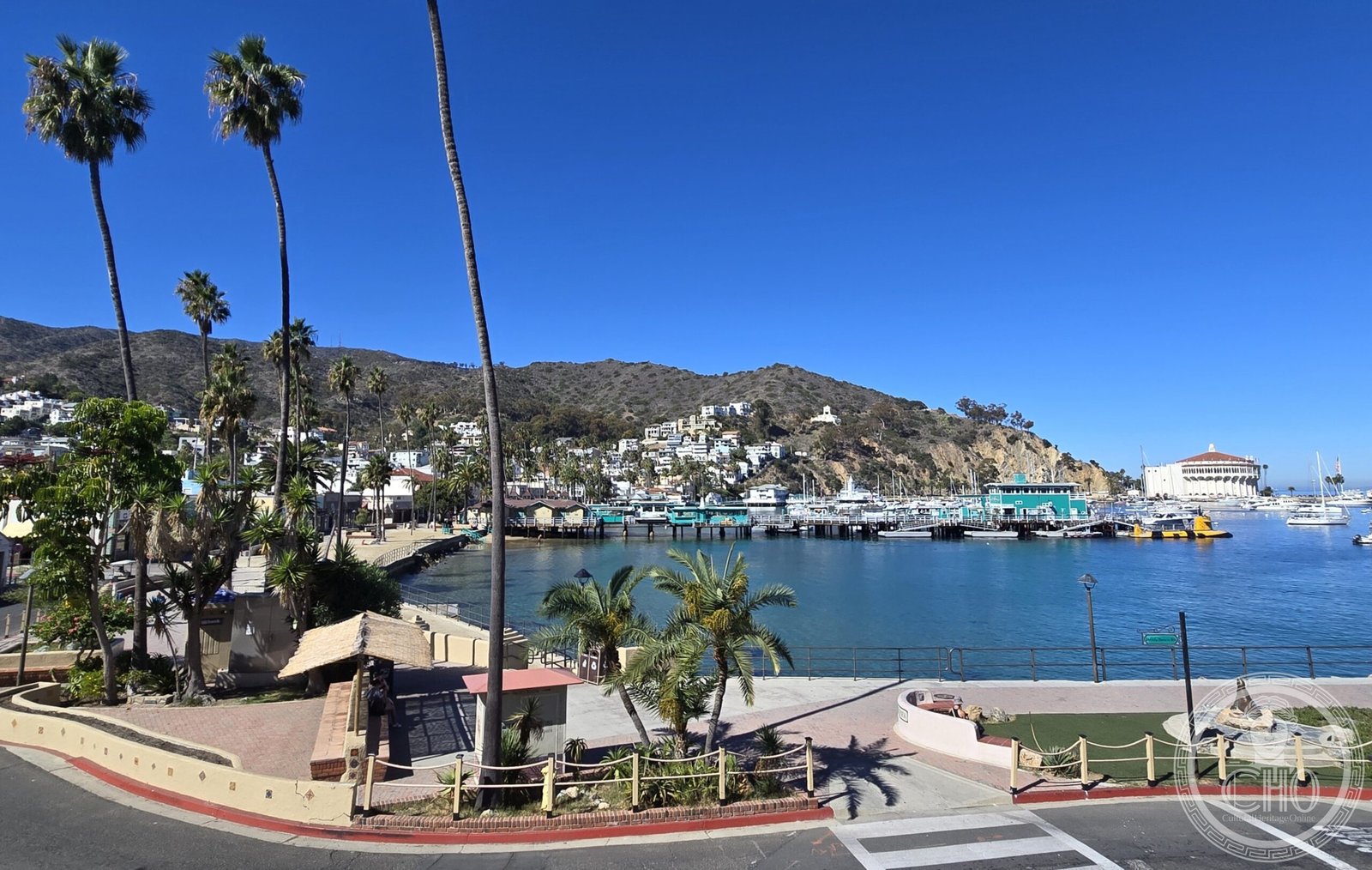
The Avalon Casino on Catalina Island is not a gambling hall but a circular Art Deco landmark — the Italian word casino meaning a gathering place — whose 180-foot round tower houses the largest circular ballroom in the world and one of the finest surviving Art Deco cinema interiors in the United States, set at the edge of the Pacific on an island 22 miles from Los Angeles.
At a glance
The Avalon Casino, completed in 1929 on the north point of Avalon harbor, was the signature building of the resort island developed by chewing-gum magnate William Wrigley Jr., who purchased Santa Catalina Island in 1919 and transformed it into one of California’s most visited tourist destinations. Designed in a distinctive Art Deco style with Spanish Mediterranean overtones, the circular building has a diameter of 180 feet and stands about 140 feet tall, and houses two principal spaces: the Avalon Ballroom on the upper level, where big bands played to thousands of dancers in the 1930s and 1940s, and the Avalon Theatre at ground level, a 1,154-seat Art Deco cinema with an extraordinary interior featuring trompe-l’oeil murals by John Gabriel Beckman. The building has been a California Historical Landmark since 1967 and remains a functioning venue for concerts, films, and ballroom dancing.
Key facts
- Location: 1 Casino Way, Avalon, Santa Catalina Island, California
- Completed: 1929
- Style: Art Deco with Spanish Mediterranean influence
- Dimensions: 180-foot diameter; approximately 140 feet tall
- Principal spaces: Avalon Ballroom (upper level, world’s largest circular ballroom when built); Avalon Theatre (ground level, 1,154 seats)
- Murals: Art Deco interior painting by John Gabriel Beckman
- Status: California Historical Landmark; listed on the National Register of Historic Places
History
When William Wrigley Jr. acquired Santa Catalina Island in 1919, he envisioned it as a resort accessible to middle-class Californians by the new steamship lines he helped establish. The existing Casino at Sugarloaf Point, built in 1920, was considered inadequate for the crowds Catalina was attracting, and in 1928 Wrigley commissioned a new, larger building to anchor the north end of the Avalon harbor. The result was one of the most structurally ambitious buildings on the California coast, its circular form and scale unprecedented for the island.
The Avalon Theatre, which opened in May 1929, was among the first commercial theatres in California wired for sound films, installed less than two years after The Jazz Singer established the “talkie” format. The mural programme by John Gabriel Beckman — a Los Angeles artist who specialised in architectural painting — depicted stylised undersea life and Californian flora in Art Deco conventions that complemented the building’s ornamental ceiling and pilasters.
The Avalon Ballroom became one of the most celebrated dance venues in the country. Big-band broadcasts from the Casino were transmitted nationally over CBS and NBC radio, making Catalina Island’s name familiar to millions who had never left the mainland. Glenn Miller, Benny Goodman, Kay Kyser, and many others played the Casino. The radio broadcasts, and the dancing that accompanied them, make the Avalon Casino a primary site of American popular music history.
What you see
The Casino is best approached by the ferries from San Pedro or Long Beach, which provide a first view of the circular white tower as the boat enters Avalon harbor — a theatrical arrival that Wrigley designed intentionally. The exterior reads as a series of circular tiers culminating in the ballroom floor, its windows ringing the upper level, with the Spanish-tiled roof providing the final crown. The exterior murals by Beckman decorate the lower levels visible from the water.
Inside, the Avalon Theatre retains its complete Art Deco interior: the painted ceiling vaults, the Beckman murals of kelp forests and marine life, the original organ chambers, and the Art Deco light fittings are all intact. The theatre still shows films and hosts special events. The ballroom above, though no longer in nightly use, is open for tours and occasional concerts; its unobstructed circular floor, surrounded by the panoramic windows looking out over the Pacific, is one of the most extraordinary interior spaces in California architecture.
Practical information
- Access: The theatre is open for film screenings; the ballroom via guided tour.
- Tours: Daily guided tours of the Casino depart from the building; check the Catalina Island Conservancy schedule.
- Film screenings: The Avalon Theatre shows films on a regular schedule (check the Avalon Cinema website).
- Getting to the Casino: On foot from the Avalon ferry terminal, a 15-minute walk along the harbor front.
- Time needed: Allow 45–60 minutes for a guided tour; add 1.5–2 hours if attending a film or evening event.
Getting there
Santa Catalina Island is reached by ferry from the California mainland. Catalina Express operates multiple daily crossings from San Pedro (Port of Los Angeles), Long Beach, and Dana Point; crossing time is approximately 75 minutes from San Pedro and Long Beach. On the island, the Casino is a fifteen-minute walk along the Avalon harbor front from the ferry terminal, or five minutes by golf cart (the primary vehicle on the island). A helicopter service also connects the island to San Pedro (15 minutes). Once in Avalon, the Casino is the most prominent building visible from the harbor.
Nearby
- Avalon Harbor Village — The compact Art Deco resort town of Avalon, with its Spanish Colonial and Deco-era buildings, wraps around the harbor a short walk from the Casino.
- Catalina Island Museum (Casino Building) — The museum occupying the Casino’s ground-floor galleries documents the island’s history from the Tongva people through the Wrigley era.
- Wrigley Memorial & Botanic Garden — Two miles from the harbor, reached by golf cart or foot; the memorial to William Wrigley Jr. and the native-plant botanic garden established in his memory.
- Two Harbors — The remote second settlement on Catalina, 22 miles by boat from Avalon across the island’s interior, accessible by the island ferry service.
Sources
- California Office of Historic Preservation, California Historical Landmark No. 965: Avalon Casino.
- National Register of Historic Places, Avalon Casino nomination.
- Ovnick, Merry. Los Angeles: The End of the Rainbow. Balcony Press, 1994.
- Catalina Island Conservancy. The Avalon Casino: A History. Avalon, CA, 2015.
- Wikipedia, “Avalon Casino,” https://en.wikipedia.org/wiki/Avalon_Casino.
Find it on the map
See this place and what’s around it →📷 Become a Cultural Heritage Online photographer
Share your photos of places: they stay published under your name as the author. The more they're seen, the more you get noticed — and soon a contest will reward the most appreciated photos.
Log in or sign up free to add a photoIs this page about you?
This page is read by travellers and heritage enthusiasts who find it on Google. Tell us how you are connected to this place and we will take it from there.