

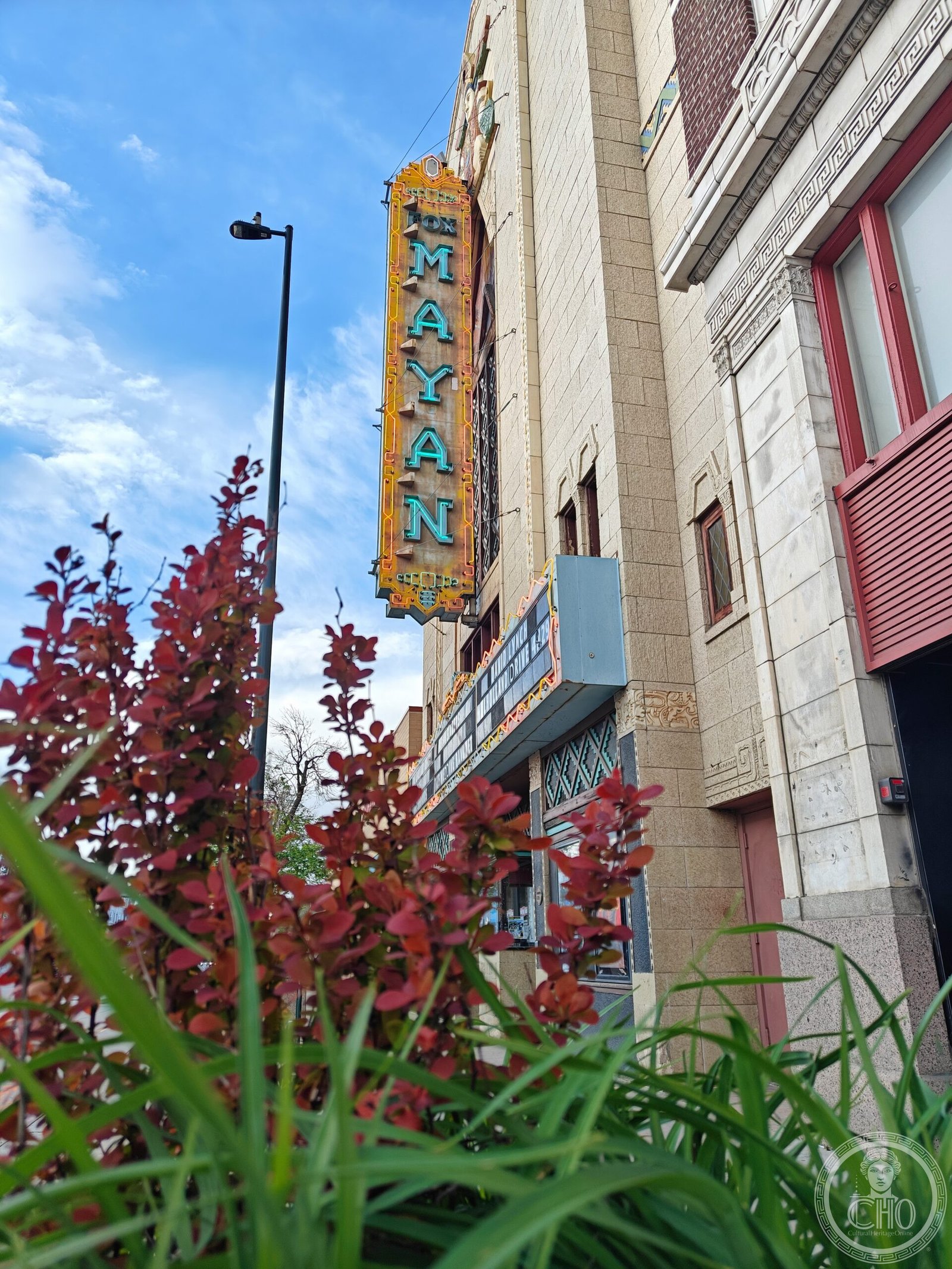
The 1930 Mayan Theatre on Broadway in Denver is one of the most distinctive examples of the Mayan Revival style in American cinema architecture: a polychrome terracotta facade animated by serpents, masks, and geometric ornament drawn from pre-Columbian sources, crowning a neighbourhood theatre that has remained in continuous operation for nearly a century.
At a glance
The Mayan Theatre at 110 Broadway in Denver, Colorado was completed in 1930, during the peak of the American enthusiasm for pre-Columbian Revival styles that followed the popular success of the 1893 World’s Columbian Exposition and was amplified by early twentieth-century archaeology of Mayan sites in Mesoamerica. The facade presents a vertical composition of richly coloured terracotta ornament — masks, feathered serpents, geometric interlace — rendered in a palette of ochre, red, and gold against a buff ground. The building was listed on the National Register of Historic Places in recognition of its architectural significance. Unlike many theatres of its era that were subdivided or converted, the Mayan has remained in use as a cinema, making it one of the longest continuously operating purpose-built movie theatres in Colorado.
Key facts
- Location: 110 Broadway, Denver, Colorado
- Completed: 1930
- Style: Mayan Revival / Art Deco; polychrome terracotta facade
- Capacity: Approximately 800 seats
- Status: National Register of Historic Places; in continuous operation as a cinema
- Setting: South Broadway corridor, Denver’s historic theatres and arts district
History
The Mayan Revival style in American architecture emerged in the late nineteenth century and reached its fullest expression in the 1920s and early 1930s, when Mayan archaeology was generating popular interest through publications, expeditions, and exhibitions. For theatre architecture in particular, the Mayan and Egyptian Revival styles offered an alternative to the Spanish Colonial Revival and Italian Baroque vocabularies that dominated American cinema design — they were dramatic, exotic, and richly ornamental in ways that promised a total environment of escapism for audiences.
Denver in 1930 was a growing regional city with a well-developed theatre circuit. The South Broadway corridor had become a commercial entertainment strip by the late 1920s, and the Mayan Theatre was conceived as a neighbourhood cinema in that context rather than a downtown palace. Its modest size — compared to the great 3,000-seat downtown movie palaces — suited the audience base of a residential and commercial neighbourhood. The facade’s ornamental programme announced the theatre’s character to the street in unmistakable terms: the masks and serpents of the polychrome terracotta skin made the building instantly identifiable and offered a concentrated visual experience of the Mayan Revival vocabulary even from a moving vehicle.
The theatre survived the mid-century conversion wave that destroyed or subdivided hundreds of American cinemas. The building’s listing on the National Register of Historic Places has helped to stabilise its status. Today it operates as an independently owned cinema, screening art-house and independent films in a context that suits its architecture.
What you see
The facade is the Mayan Theatre’s primary architectural experience. The polychrome terracotta ornament concentrates Mayan iconography — serpent heads, masks with exaggerated features, geometric step-and-fret patterns — into a vertical composition that reads as a single billboard-like panel from the Broadway sidewalk. The colour is unusual in its specificity: the warm ochres and reds of the terracotta read against the buff ground in a way that changes substantially under different light conditions, becoming more vivid in afternoon sun and more muted under Denver’s flat overcast light.
The ground floor entrance zone is the most accessible for close examination, where the ornamental detail can be studied at hand level. The marquee over the entrance portal interrupts the composition but has been a feature of the building for most of its history. The interior, adapted for contemporary cinema operations, retains elements of the original decorative scheme; the lobby in particular preserves some of the Mayan motifs that extend the facade’s iconographic programme into the building.
Practical information
- Access: Functioning cinema; tickets available for screenings. The facade can be viewed from the sidewalk at any time.
- Programming: Art-house and independent films; check the theatre’s current programming online.
- Best light: The terracotta ornament is most vivid in afternoon and early evening light when the facade faces west.
- Time needed: 15 minutes for exterior; add time for a screening to experience the interior.
Getting there
The Mayan Theatre is at 110 Broadway in the South Broadway (SoBo) neighbourhood of Denver. The nearest light rail stations are Broadway and I-25/Broadway (RTD W/C/E lines) approximately six blocks south, and 10th and Osage (RTD W/C/E) approximately eight blocks west. By car, the theatre is accessible from I-25 (Exit 209A for 6th Avenue) and from Broadway southbound from downtown. Parking is available on South Broadway and on adjacent side streets.
Nearby
- Denver Art Museum (main building 1971; Frederic C. Hamilton Building 2006) — The city’s principal art museum, with the Mayan and pre-Columbian collections providing historical context for the theatre’s ornamental sources, one mile north in the Civic Center cultural campus.
- Kirkland Museum of Fine & Decorative Art — Denver’s dedicated decorative arts museum, housing an internationally significant collection of Art Deco furniture, ceramics, and objects, including pieces by Colorado artists of the interwar period.
- Byers-Evans House Museum (1883) — The Victorian house museum in the Civic Center campus, six blocks northeast, provides historical context for Denver’s pre-Art Deco built environment.
- South Broadway Arts District — A concentration of vintage shops, galleries, and dining along Broadway from 1st Avenue south; the Mayan Theatre anchors the northern end of this strip.
Sources
- National Register of Historic Places nomination: Mayan Theatre, Denver, Colorado.
- Noel, Thomas J. Buildings of Colorado. Oxford University Press, 1997.
- Gebhard, David. Architecture in Los Angeles. Peregrine Smith, 1977. (Mayan Revival context)
- Historic Denver, Inc. Denver Architecture: A Survey of Significant Buildings. Denver: Colorado Historical Society.
- Wikipedia, “Mayan Theatre (Denver),” https://en.wikipedia.org/wiki/Mayan_Theatre_(Denver).
Find it on the map
See this place and what’s around it →📷 Become a Cultural Heritage Online photographer
Share your photos of places: they stay published under your name as the author. The more they're seen, the more you get noticed — and soon a contest will reward the most appreciated photos.
Log in or sign up free to add a photoIs this page about you?
This page is read by travellers and heritage enthusiasts who find it on Google. Tell us how you are connected to this place and we will take it from there.