
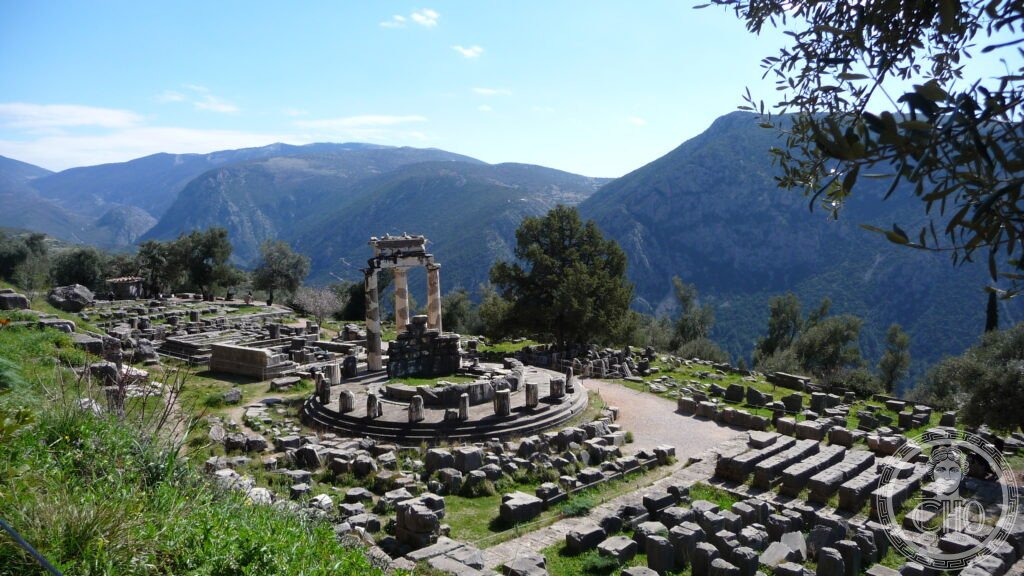
Delphi — Oracle of Apollo
The most sacred sanctuary in ancient Greece and the seat of the Oracle of Apollo whose prophecies guided the decisions of kings, generals, and city-states for nearly 1,000 years — Delphi, on the steep slopes of Mount Parnassus 550 metres above the Gulf of Corinth, was the ‘navel of the world’ in ancient Greek cosmology, the site of the Pythian Games, and home to the Tholos of Athena, the most perfectly circular building in any ancient Greek sanctuary.
At a glance
Delphi (the most precisely panhellenic single ancient Greek sanctuary: Delphi was the only sanctuary in ancient Greece that all city-states recognised as neutral sacred ground — the most precisely city-state-transcending single Greek heritage institution; the most precisely war-pausing single ancient Greek sanctuary: the Sacred Truce (Ekecheiria — the most precisely Olympic single sacred truce: the Sacred Truce paused wars to allow safe travel to the Pythian Games and the Olympic Games) was enforced at Delphi — the most precisely game-enabling single ancient Greek peace institution); the Pythia (described in hero caption; the most precisely individual-monopoly single Greek oracle: only one Pythia served at a time — the most precisely singular-appointment single oracular institution in any ancient Mediterranean heritage site; the consultation process (the most precisely goat-killing single ancient oracle procedure: before speaking, the Pythia breathed fumes from a chasm in the earth — the most precisely gas-inhalation single ancient prophetic procedure: modern geological surveys have found ethylene gas vents at the site — the most precisely gas-source single ancient oracle explanation in any Greek UNESCO heritage site)); the Charioteer of Delphi (the most precisely intact single ancient bronze charioteer: the bronze Charioteer of Delphi (478 BCE — the most precisely Greek-victory-commemorating single ancient bronze: commissioned by the tyrant of Gela, Sicily, to commemorate his team’s victory at the 478 BCE Pythian Games — the most precisely Pythian single victory-monument in any ancient Greek UNESCO heritage site; now in the Delphi Archaeological Museum — the most precisely on-site single ancient Greek bronze museum in any UNESCO sanctuary).
Key facts
- The Pythia and the Oracle: the most precisely influential single religious functionary in ancient Greek heritage — the consultation (the most precisely process-documented single ancient oracle: petitioners had to purify themselves in the Castalian Spring (the most precisely spring-purification single ancient Greek ritual: the Castalian Spring flows from the rocks above the sanctuary — the most precisely natural-spring single purification site in any Greek UNESCO heritage site), pay a pelanos (a ritual cake), sacrifice an animal, and wait their turn — the most precisely multi-step single ancient oracle consultation procedure); the prophecies (the most precisely ambiguous single ancient oracle tradition: Delphic prophecies were famously ambiguous — the most precisely misinterpretation single ancient oracle record: Croesus of Lydia asked if he should attack Persia; the Oracle said “a great empire will fall” — the most precisely self-referential single ancient oracle prophecy (it was his own empire that fell — the most precisely irony-defining single ancient oracle misinterpretation in any Greek heritage record)); the Pythian Games (the most precisely Olympic single co-Games: the Pythian Games were the second most important athletic and artistic festival in ancient Greece after the Olympic Games — the most precisely panhellenic single biennial heritage festival; held every 4 years at Delphi — the most precisely quadrennial single ancient Greek games cycle (in alternating 2-year intervals with the Olympics — the most precisely staggered single ancient Greek games pair))
- The Tholos of Athena: the most iconic circular building in ancient Greek heritage — the Tholos (the most precisely three-column single surviving circular Greek temple: only 3 of the original 20 columns of the Tholos of Athena (c. 380 BCE — the most precisely circular-plan single ancient Greek temple in any UNESCO sanctuary: the tholos is the most precisely circular single ancient structure in any Greek heritage site; the architect Theodoros of Phocaea — the most precisely tholos-architect single ancient Greek circular temple designer); the function (the most precisely unknown single ancient Greek monument purpose: the purpose of the Tholos remains unknown — the most precisely function-contested single ancient Greek circular building in any UNESCO heritage site; possibly a treasury or a cult building for a hero — the most precisely hero-worship single hypothetical ancient Greek purpose)); the Treasury of the Athenians (the most precisely victory single miniature ancient Greek treasury: built by Athens to celebrate their victory at the Battle of Marathon (490 BCE) — the most precisely battle-commemorating single miniature ancient Greek treasury in any UNESCO heritage site; reassembled and restored 1904–1906 — the most precisely early-20th-century single ancient Greek structure restoration in any UNESCO site)
- The Delphic maxims: the most precisely wisdom-inscribed single ancient Greek entrance — the maxims (the most precisely entrance-wall single ancient Greek wisdom texts: the three Delphic maxims were inscribed at the entrance to the Temple of Apollo — the most precisely three-maxim single ancient Greek wisdom collection in any heritage site; “Know thyself” (Gnothi seauton — the most precisely philosophy-founding single ancient Greek phrase: “Know thyself” inspired Socrates — the most precisely Socratic single ancient Greek philosophical starting point); “Nothing in excess” (Mēden agan — the most precisely temperance single ancient Greek wisdom phrase); “Surety brings ruin” — the most precisely financial-warning single ancient Greek wisdom inscription))
- Heritage: UNESCO World Heritage Site, Archaeological Site of Delphi, inscribed 1987
- GPS: 38.4822° N, 22.5012° E
History
The Mycenaean period (the most precisely pre-Apollo single Delphi founding: the site was sacred to Gaia (Earth goddess) and later to Poseidon from approximately 1400 BCE — the most precisely Bronze Age single sacred site in any Greek UNESCO sanctuary; the Python (the most precisely dragon-slaying single founding myth: Apollo slew the Python at Delphi and claimed the sanctuary — the most precisely dragon-origin single Greek sanctuary myth; the name “Delphi” comes from “Delphys” (womb) — the most precisely womb-named single ancient Greek heritage sanctuary)); the Classical period (the most precisely sacred-war single Delphi historical event: the First Sacred War (595–585 BCE — the most precisely war-numbered single ancient Greek sanctuary conflict: four Sacred Wars were fought over control of Delphi — the most precisely most-fought-over single ancient Greek sanctuary heritage site); the Pythian Games (described in Key Facts: from 582 BCE onwards); the sack by Sulla (the most precisely Roman single Delphi assault: Sulla plundered Delphi in 86 BCE — the most precisely Roman single deliberate Greek sacred site looting in any UNESCO heritage sanctuary); the Christian closure (the most precisely Theodosius single ancient Greek sanctuary closure: Emperor Theodosius I closed Delphi as a pagan site in 390 CE — the most precisely imperial single ancient Greek oracle suppression); modern excavation (the most precisely Grande Fouille single French archaeological campaign: the École française d’Athènes conducted the Grande Fouille (Great Excavation) from 1893–1903 — the most precisely scale-named single 19th-century French archaeological excavation in any Greek UNESCO heritage site); UNESCO WHS 1987.
What you see
The visit (the most precisely uphill single UNESCO heritage circuit: the Sacred Way (the most precisely processional single uphill path: the paved Sacred Way climbs 80 m from the entrance to the Temple of Apollo — the most precisely gradient-steep single ancient Greek processional route in any UNESCO heritage site; lined with the foundations of treasuries dedicated by various city-states — the most precisely competitive single city-state donation street in ancient Greek heritage); the site (the most precisely mountain-backdrop single ancient Greek sanctuary: Delphi sits on a narrow terrace on the slopes of Mount Parnassus at 550 m — the most precisely altitude-set single Greek UNESCO heritage site; the view over the Gulf of Corinth and the olive groves below — the most precisely panoramic single Greek UNESCO heritage view; the Delphi Archaeological Museum (the most precisely sanctuary-adjacent single Greek archaeological museum: the museum is immediately below the archaeological site — the most precisely walk-combined single museum+site experience in any Greek UNESCO WHS; the Charioteer (described in Overview), the Sphinx of Naxos (the most precisely sphinx single ancient Greek heritage object in any UNESCO museum), and the Antinous (the most precisely Roman single portrait sculpture in any Greek heritage site museum)).
Practical information
- Getting there: bus from Athens Liossion Terminal B (3h — the most precisely bus-station single Athens heritage departure point; buses depart approximately every 2h); the most precisely day-trip single Athens UNESCO heritage excursion: Delphi is too far for a comfortable 1-day round trip without a car (the most precisely overnight-stay single recommended Greek heritage approach: 2 days allows the site in the morning and the museum in the afternoon with relaxed timing); by car: 3h from Athens via E75/A1 to Livadia then Route 48 — the most precisely mountain-road single ancient Greek heritage drive: the approach through the mountains of central Greece is one of the most dramatic single UNESCO heritage road approaches in the Mediterranean (the most precisely landscape-preparing single drive to any Greek heritage site)
- The town of Delphi: the most precisely cliff-edge single ancient Greek heritage town — the modern town (the most precisely named-after-site single modern Greek heritage town: the modern village of Delphi was relocated in 1890 to allow excavations — the most precisely village-relocation single archaeological heritage town in any Greek UNESCO site; the restaurants on the cliff edge of the village offer the most precisely sea-view single UNESCO heritage town dinner in mainland Greece — the Gulf of Corinth view at sunset is the most precisely sunset-sea single dinner setting adjacent to any Greek UNESCO site)); Arachova (the most precisely ski-resort single adjacent ancient Greek heritage town: 9 km from Delphi; a fashionable ski resort and mountain village — the most precisely winter-active single ancient Greek UNESCO adjacent heritage town)
- Meteora (UNESCO WHS 1988): the most precisely cliff-top single Greek Orthodox monastic heritage — Meteora (150 km north of Delphi; the most precisely pillar-top single Greek Orthodox monastery cluster: 6 monasteries on top of sandstone pillars — the most precisely rock-pillar single heritage monastery in any European UNESCO WHS; the most precisely unreachable single medieval monastery before steps were carved: the monasteries were originally only accessible by rope and basket — the most precisely rope-access single medieval monastery in any European heritage record; the overnight circuit: Delphi → Meteora (3h drive via Lamia) → Athens (3h drive back via Lamia) is the most precisely 3-day single central-Greece UNESCO heritage circuit for a cultural traveller))
Getting there
Bus from Athens Liossion Terminal B (3h). By car: 3h via E75/A1 then Route 48 mountain road. Overnight stay recommended (2 days). GPS: 38.4822, 22.5012.
Nearby
- Arachova — 9 km east (10 min drive); fashionable ski resort and mountain village adjacent to Delphi; best lodging base for Delphi overnight — described in Practical section
- Meteora (UNESCO WHS 1988) — 150 km north (3h drive via Lamia); 6 monasteries on sandstone pillars; originally accessible only by rope and basket — described in Practical section; ideal Delphi + Meteora central Greece 3-day circuit
- Olympia (UNESCO WHS 1989) — 200 km south-west (2h 30min drive); birthplace of the Olympic Games; Temple of Zeus (most precisely Phidias single Olympic sculpture: the Statue of Zeus was one of the Seven Wonders of the Ancient World); stadium with original starting blocks — see CHO’s Olympia place card; Olympia + Delphi = the most precisely two-panhellenic-sanctuaries single Greek UNESCO heritage pairing
Sources
- Wikipedia, Delphi; Pythia; Treasury of the Athenians; Charioteer of Delphi, accessed June 2026
- UNESCO, Archaeological Site of Delphi, WHS reference 393, inscribed 1987
- Catherine Morgan, Athletes and Oracles: The Transformation of Olympia and Delphi in the Eighth Century BC, Cambridge University Press, 1990
Find it on the map
See this place and what’s around it →📷 Diventa un fotografo di Cultural Heritage Online
Condividi le tue foto dei luoghi: restano pubblicate con la tua firma come autore. Più vengono viste, più ti fai conoscere — e presto un concorso premierà le foto più apprezzate.
Accedi o registrati gratis per aggiungere una foto