
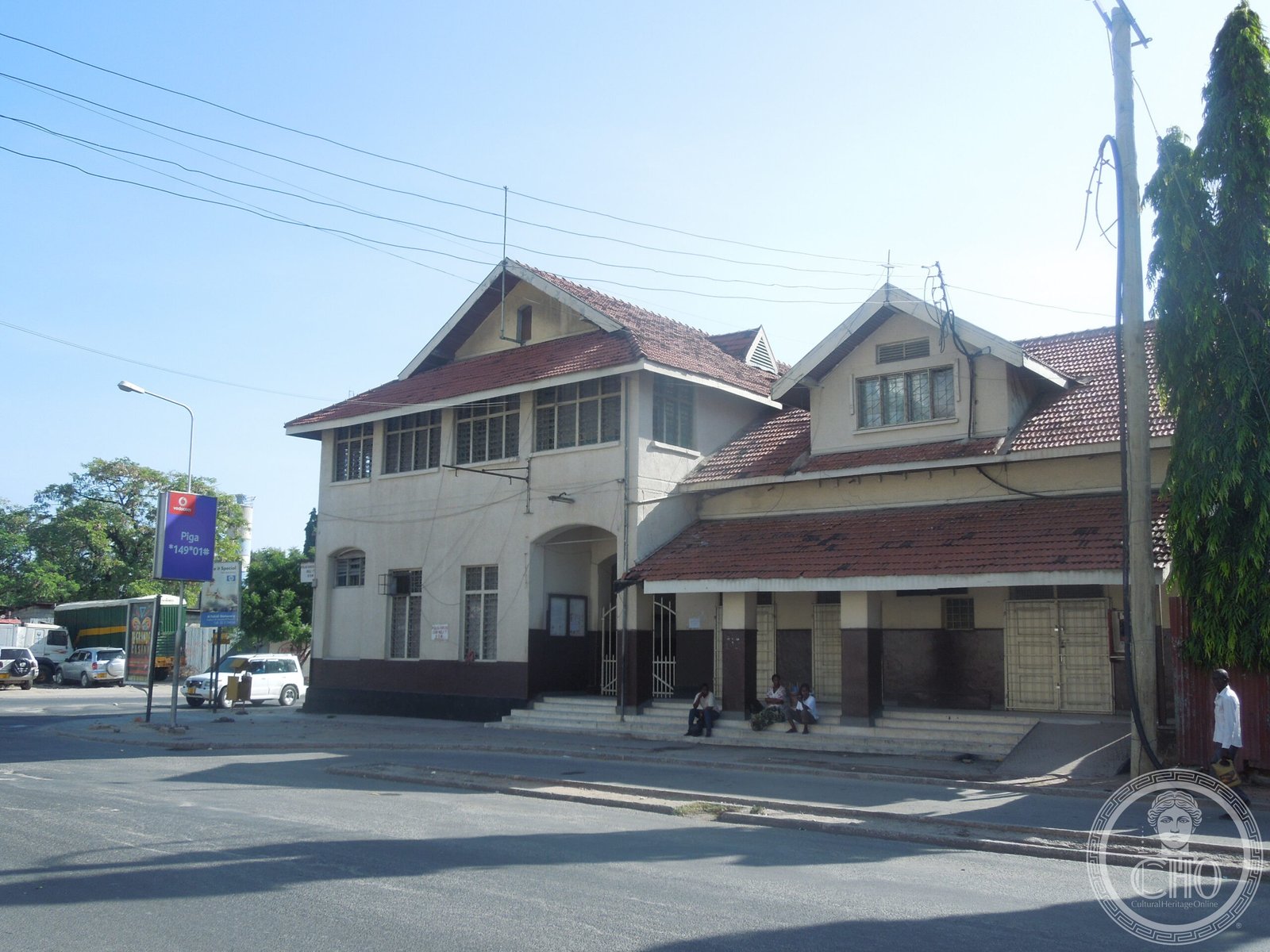
At the edge of the Kisutu district in central Dar es Salaam, the Central Railway Station is one of East Africa’s most evocative colonial landmarks — a low, white-washed building of arched verandas, terracotta roof tiles, and faintly Swahili proportions that the German colonial administration erected in 1897 as the ocean terminus of the Central Line to the interior. When construction began the line was intended to carry ivory, rubber, and sisal from the Great Lakes to the port; by the time the first trains ran the building had already acquired the weathered dignity of something much older. The architecture mingles Wilhelmine railway aesthetics with the whitewashed masonry and shaded arcades of the Swahili coast, producing what historians call “Swahili Baroque” — a hybrid vernacular unique to German East Africa. After World War I the British retained the station and the line, and both have operated continuously ever since, linking Dar es Salaam to Kigoma on Lake Tanganyika and making this modest building the physical origin point of an 1,254-kilometre journey into the heart of the continent.
At a glance
- Type
- Railway terminus / passenger station
- Period
- 1897 (German colonial era)
- Style
- German Colonial / Swahili Baroque
- Location
- Kisutu, Ilala District, Dar es Salaam, Tanzania
- Coordinates
- 6.816° S, 39.280° E
- Architect(s)
- German Colonial Railway Administration (architect unrecorded)
Overview
The Central Railway Station serves as the Dar es Salaam terminus for Tanzania Railways Corporation’s Central Line, which runs westward for 1,254 kilometres to Kigoma on Lake Tanganyika via Dodoma, Tabora, and Mpanda. The station building dates from the original German construction in 1897, making it one of the oldest surviving railway structures in sub-Saharan Africa. It occupies a prominent position in the Kisutu neighbourhood, close to the city centre and the harbour, in keeping with the German planners’ intention to link port and interior as efficiently as possible.
History
The Central Line was conceived by the German East Africa colonial administration as a strategic artery to extract resources from the interior and project military power across a territory roughly the size of France. Construction of the line began from the Dar es Salaam terminus in 1905 and the station building was operational from 1897, serving shorter initial sections of track. Following Germany’s defeat in World War I, Tanganyika became a British League of Nations mandate in 1919 and the railway passed to British control. Operations continued largely unchanged through the colonial period and survived into independence in 1961. The station remains the operational terminus of the Tanzania Railways Corporation network and has been used continuously for over 125 years.
Architecture & Design
The station exemplifies the hybrid colonial style that German architects developed on the Swahili coast — a vocabulary combining the functional requirements of a European railway terminal with the climate-adapted forms of the coastal vernacular. Long, shaded verandas run along the platform facade, providing shelter from both sun and monsoon rain. The walls are rendered in white lime plaster in the Swahili tradition. Arched openings, terracotta roof tiles, and modest decorative mouldings give the building a quiet dignity without the bombast of grander colonial buildings elsewhere. The human scale and the weathered surfaces make it feel rooted in its landscape in a way that few colonial structures achieve.
Cultural significance
For Tanzanians the Central Railway Station is more than a transport hub — it is the place where the country’s modern economic geography was written. The line it anchors connected isolated interior communities to the coast, transformed regional trade, and shaped the distribution of population and agriculture across what is now central Tanzania. As one of the oldest surviving colonial buildings in Dar es Salaam, the station is an important site of memory for historians of East Africa’s colonial and post-colonial experience.
Visiting today
The station is operational and open to the public during departure and arrival times. Passenger services on the Central Line run several times per week. The building’s exterior and platform can be visited freely. Travellers planning overnight journeys to Tabora, Kigoma, or Mpanda should book tickets in advance through the Tanzania Railways Corporation office at the station.
Getting there
The station is located in the Kisutu neighbourhood of central Dar es Salaam, approximately two kilometres from the Julius Nyerere waterfront. Dala-dala minibuses connect it to most parts of the city. Taxis and ride-hailing services (Bolt, Uber) are available outside the station entrance. Julius Nyerere International Airport is about thirteen kilometres south; the journey by taxi takes twenty to forty minutes depending on traffic.
Sources & resources
Find it on the map
See this place and what’s around it →Record researched and written by Luigi De Marchi for Cultural Heritage Online, 2026.
📷 Become a Cultural Heritage Online photographer
Share your photos of places: they stay published under your name as the author. The more they're seen, the more you get noticed — and soon a contest will reward the most appreciated photos.
Log in or sign up free to add a photoIs this page about you?
This page is read by travellers and heritage enthusiasts who find it on Google. Tell us how you are connected to this place and we will take it from there.