
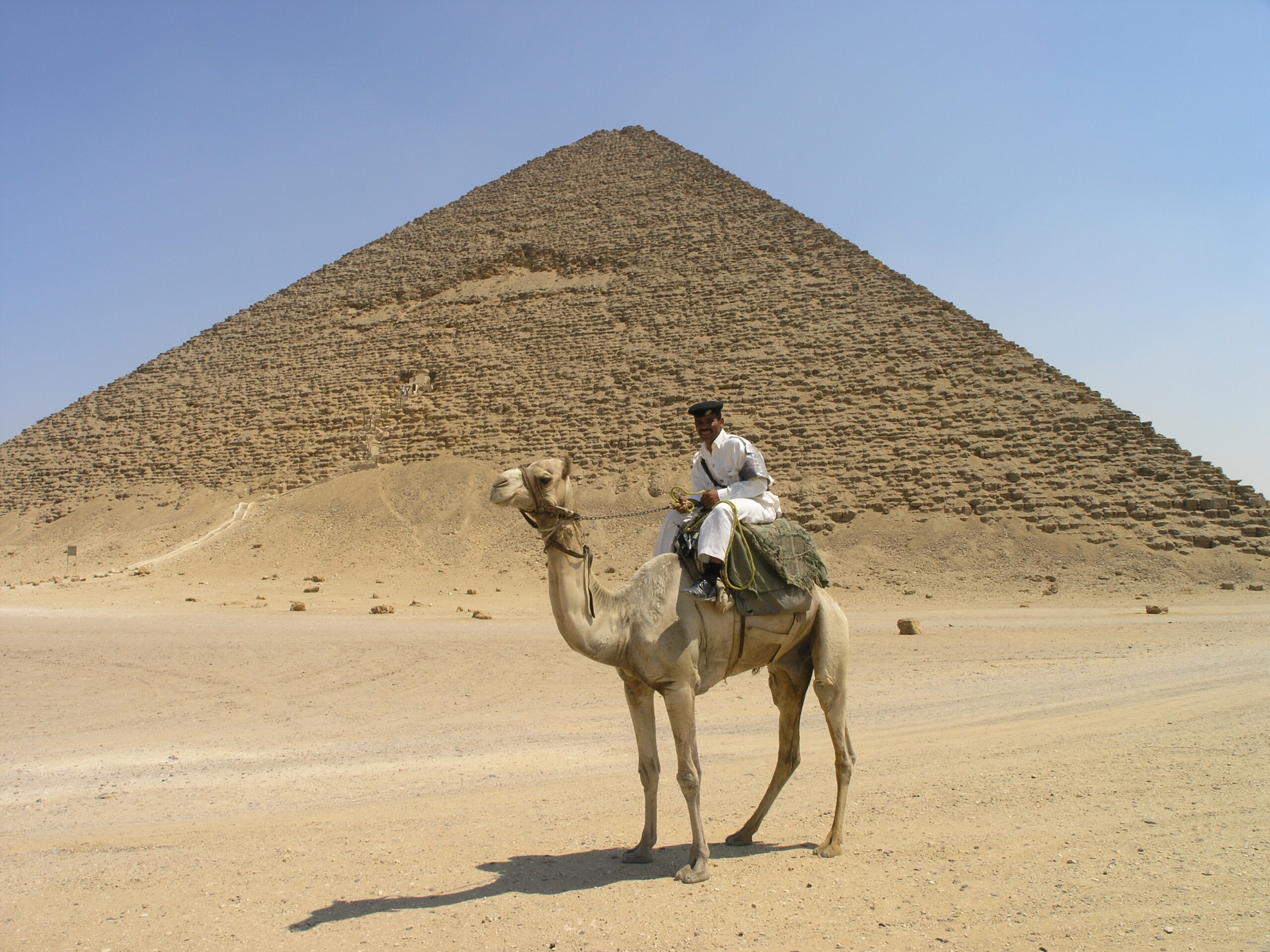
The Bent Pyramid and the Red Pyramid — Pharaoh Sneferu experimental proving ground for pyramid design, where two consecutive structural failures and successes made Giza possible.
At a glance
On the west bank of the Nile approximately 40 km south of Cairo, the Dahshur pyramid field contains two monuments built by Fourth Dynasty pharaoh Sneferu (c. 2613–2589 BC) that are indispensable for understanding how the ancient Egyptians invented the true pyramid: the Bent Pyramid and the Red Pyramid. Together they document the two consecutive phases — structural failure, emergency correction, then success — that solved the engineering problem of building a stable smooth-sided pyramid and directly enabled Sneferu son Khufu to construct the Great Pyramid of Giza. Dahshur is also accessible to visitors who want to enter an Old Kingdom pyramid interior without the crowds of the Giza plateau.
Key facts
- Period: Old Kingdom (c. 2613–2589 BC, Sneferu) and Middle Kingdom (c. 1991–1650 BC)
- Builder of main pyramids: Pharaoh Sneferu, founder of the Fourth Dynasty
- Bent Pyramid angles: lower section 54 degrees, upper section 43 degrees — the kink visible from miles away
- Red Pyramid: world first successful true smooth-sided pyramid; third largest in Egypt
- Interior access: Red Pyramid interior open to visitors; corbelled chambers retain original atmosphere
- UNESCO status: Part of Memphis and its Necropolis UNESCO World Heritage Site (1979)
- Location: 40 km south of Cairo, west bank of the Nile; Giza Governorate
History
Pharaoh Sneferu, founder of the Fourth Dynasty and father of Khufu, built at least three pyramids — more than any other pharaoh in history — at the sites of Meidum and Dahshur. At Dahshur he began with the Bent Pyramid (c. 2600 BC), an ambitious attempt to build a large smooth-sided pyramid at an angle of 54 degrees. Approximately halfway through construction, cracks began to appear in the structure — likely caused by the steep angle combined with the rapid pace of building — and the architects made an emergency decision to reduce the angle to 43 degrees for the remaining upper half. The resulting kink was not a stylistic choice but an engineering response to impending structural failure.
The lesson was learnt. The Red Pyramid (c. 2590 BC, named for the reddish tint of its limestone core in afternoon light) was built immediately after using the corrected 43 degree angle throughout from the base. The result was the world first true smooth-sided pyramid, successfully completed, and the third largest pyramid in Egypt. When Sneferu son Khufu began planning what became the Great Pyramid, he had his father two Dahshur monuments as direct structural evidence of what worked. Dahshur also contains pyramid complexes from the Middle Kingdom, including those of Amenemhat II, Senusret III, and Amenemhat III.
What you see
The Bent Pyramid distinctive double-angle profile is visible from several kilometres away and immediately communicates its experimental history. The structure retains much of its original smooth white Tura limestone casing on the lower section — unusually complete compared to other pyramids, whose casing was stripped for building materials in the medieval period. The satellite pyramid of the Bent Pyramid, a small subsidiary pyramid to the south, is also visible and accessible.
The Red Pyramid interior is accessible via a descending passage 62 metres long that leads to three corbelled chambers — tall, narrow antechambers built with progressively corbelled limestone blocks. These chambers are open to visitors and retain a distinctive atmosphere, including the faint smell of ancient enclosing resins — an extraordinary olfactory survival of an Old Kingdom experience largely absent at the better-visited Giza pyramids. The third and innermost chamber rises approximately 15 metres to its corbelled apex.
Practical information
- Opening hours: Generally open daily 08:00–17:00 (verify locally)
- Entry: Combined ticket for the Dahshur archaeological zone; separate from Saqqara and Giza tickets
- Interior access: Descending passage is narrow and low; visitors must crouch for the full 62-metre length — not recommended for claustrophobia
- Crowds: Far fewer visitors than Giza; often effectively empty on weekday mornings
- Guides: Official guides available at the site entrance; independent visiting is straightforward
Getting there
Dahshur is approximately 40 km south of Cairo, most easily reached by private car or taxi from Cairo (around 1 hour depending on traffic). There is no direct public transport to the site. Dahshur is commonly combined in a day trip with Saqqara (approximately 10 km north), and occasionally with Meidum for visitors with interest in Sneferu pyramid-building programme. The Memphis UNESCO WHS open-air museum at Mit Rahina is nearby.
Nearby
- Saqqara — the Step Pyramid of Djoser and the oldest complete stone building complex in the world, 10 km north; the direct predecessor in the sequence that leads through Dahshur to Giza
- Memphis (Mit Rahina) — open-air museum on the site of ancient Egypt first capital, with a colossal fallen statue of Ramesses II and the alabaster sphinx; 15 km north
- Giza pyramid complex — the Great Pyramid, Khafre, and Menkaure, built by Sneferu son and grandsons using the technology proved at Dahshur; 40 km north
Sources
- Lehner, M. (1997). The Complete Pyramids. Thames and Hudson. London
- Verner, M. (2001). The Pyramids: The Mystery, Culture, and Science of Egypt Greatest Monuments. Grove Press
- UNESCO World Heritage List: Memphis and its Necropolis (1979)
- Egyptian Ministry of Tourism and Antiquities — official site information
- Wikipedia: Dahshur — cross-reference and image attribution
Find it on the map
See this place and what’s around it →📷 Become a Cultural Heritage Online photographer
Share your photos of places: they stay published under your name as the author. The more they're seen, the more you get noticed — and soon a contest will reward the most appreciated photos.
Log in or sign up free to add a photo