
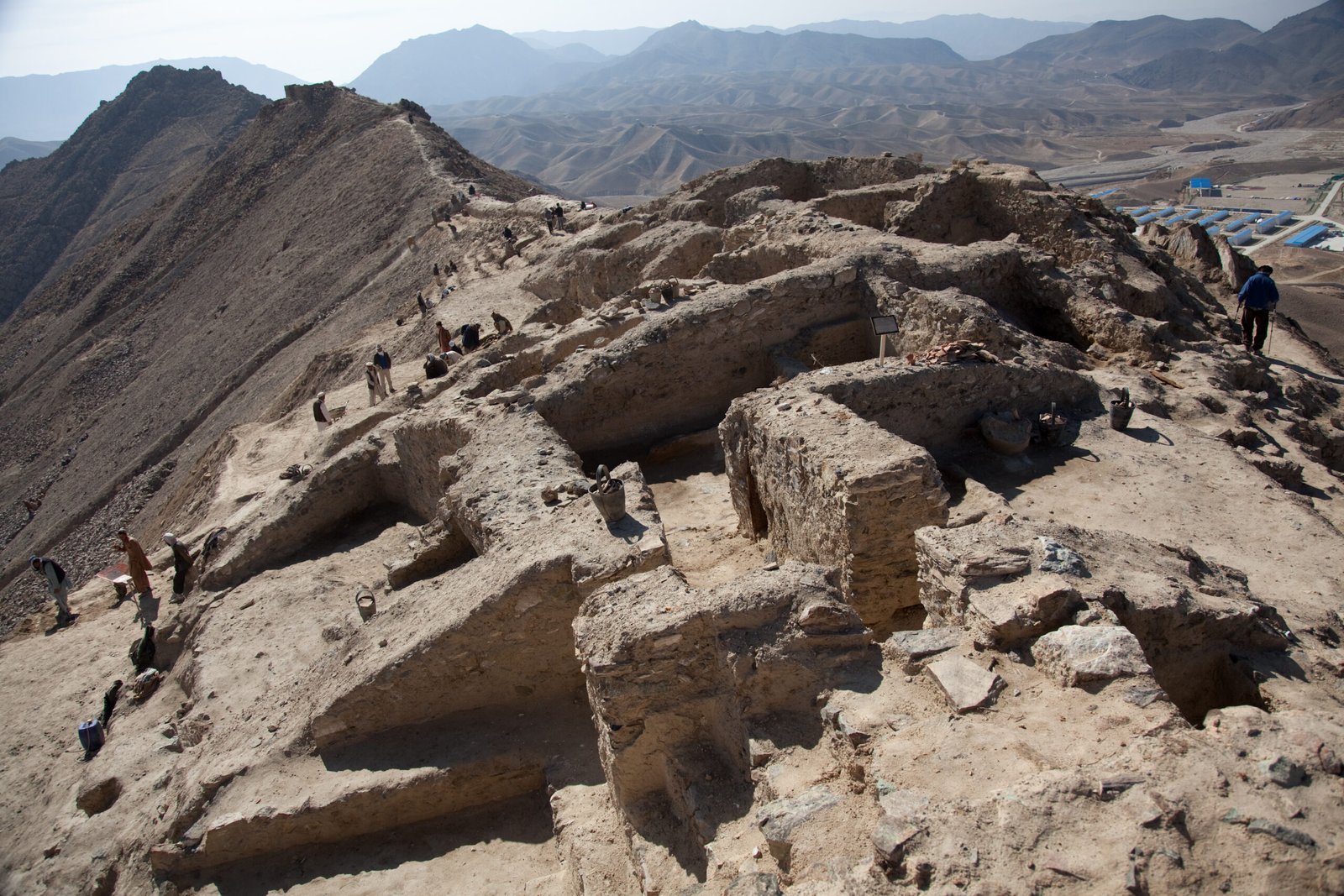
Central Asia’s largest Buddhist monastery complex, built over a Bronze Age copper-working site and now threatened by a $100-billion open-cast mine — the most dramatic confrontation between archaeological preservation and extractive industry in the modern world.
At a glance
Forty kilometres southeast of Kabul, a 400-hectare hilltop site in Logar Province contains the accumulated remains of a Buddhist monastic community that flourished for more than a millennium — from the Mauryan-era foundations of the 3rd century BC to the final abandonment during the early Islamic period in the 9th century AD. The site encompasses dozens of stupas, monastery buildings, meditation cells and shrines, many preserving exceptional Gandharan-style sculpture and painted murals. Beneath this monastic landscape lie Bronze Age copper-working deposits dating to approximately 2500 BC, and beneath those, what geologists estimate as the world’s second-largest untapped copper reserve: roughly 11.4 million tonnes of ore, valued at approximately $100 billion, leased in 2008 to a Chinese state-mining corporation for open-cast extraction.
Key facts
- Site area: approximately 400 hectares across multiple ridges
- Occupation span: c. 2500 BC (Bronze Age copper smelting) through 9th century AD (Buddhist monastic use)
- Buddhist period: c. 3rd century BC – 9th century AD (>1,000 years of continuous use)
- Scale of Buddhist complex: the largest Buddhist monastery complex in Central Asia
- Copper reserve: approximately 11.4 million tonnes of ore; world’s estimated second-largest untapped deposit
- Mining lease: signed 2008 between Afghan government and China Metallurgical Group Corporation (MCC), 30-year term
- Emergency excavation: ongoing since 2010, led by Afghan archaeologists (DAFA, UNESCO support); estimated 6,000–10,000 artefacts recovered
- Documentary: Saving Mes Aynak (dir. Brent Huffman, 2015)
History
The name Mes Aynak means “little copper well” in Dari, a direct reference to the extraordinary copper deposits that have defined human activity at this location for at least 4,500 years. The earliest occupation, dated to approximately 2500 BC, consisted of Bronze Age copper-working installations — smelting furnaces, slag heaps, and tool-making areas — whose craftsmen exploited the surface exposures of malachite and other copper-bearing minerals in the surrounding ridges. This Bronze Age industrial activity connects Mes Aynak to the broader network of prehistoric metallurgy that supplied copper across the ancient Near East and Central Asia, and may have contributed to the copper objects found at sites across the Oxus Civilisation and Indus Valley.
The Buddhist monastic settlement that came to define the site appears to have begun in the Mauryan or early post-Mauryan period (3rd–2nd century BC), making Mes Aynak among the earliest Buddhist establishments in the region that would later be called the Kushan Empire (1st–3rd century AD). The Kushan period saw the site’s greatest expansion, as the patronage of a dynasty whose realm stretched from Bactria to northern India enabled the construction of large stupas and elaborate monastic complexes with sophisticated sculptural programmes in the Gandharan style — a distinctive synthesis of Hellenistic, Iranian, and Indian visual traditions that produced some of antiquity’s most refined Buddhist art. The site continued in active use through the Sassanid-influenced Kushano-Sassanid period and into the early Islamic era, with the final abandonment occurring sometime in the 9th century AD as Buddhism retreated before the advance of Islam across Central Asia.
Modern awareness of the site dates to the Soviet-Afghan War period (1979–1989), when geologists mapped the copper deposits for potential industrial exploitation. The site came to international attention only after 2001, when Afghan and international archaeologists began to understand the monumental scale of both the mineral deposits and the threatened archaeological heritage. In 2008 the Afghan government — desperate for revenue in a post-conflict economy — signed the 30-year mining lease with the China Metallurgical Group Corporation for approximately $3.4 billion in promised investment, triggering an international campaign for archaeological salvage that has produced extraordinary finds but has left the site’s long-term fate uncertain.
What you see
Emergency excavations since 2010 have exposed an extraordinary density of Buddhist religious architecture across the site’s multiple ridges: more than 400 individual structures have been identified, including large ceremonial stupas with decorated drum bases, smaller votive stupas, monastery courtyard complexes, individual monk’s cells, and assembly halls. The sculptural finds include Gandharan-style clay and schist Buddha figures, bodhisattva reliefs, and narrative panels depicting scenes from the Jataka tales (stories of the Buddha’s previous lives) — many of which retain traces of original polychrome pigment. Painted murals in the monastery rooms, though severely damaged by centuries of collapse and the effects of water infiltration through the fractured hillside, preserve fragments of figure compositions and decorative borders in the sophisticated Gandharan style.
Among the most significant finds are thousands of clay tablets and manuscript fragments, and — most controversially for the site’s future — the visual evidence in the topography itself of the vast copper deposit: the ochre and green surface staining of malachite-bearing rocks is visible across the hillsides, and the Bronze Age smelting slag heaps sit in direct stratigraphic relationship with the Buddhist buildings above them, meaning that any open-cast mining operation would remove not merely the surface archaeology but the geological and stratigraphic record of 4,500 years of human activity in a single operation.
Practical information
- Access: Logar Province is currently inaccessible to foreign visitors due to the security situation in Afghanistan (post-2021 Taliban administration). The site is closed to independent archaeological research.
- Status: Active emergency excavation by Afghan archaeologists; mining operations repeatedly delayed but lease remains in force. Site not open for public visits.
- Monitoring: Follow UNESCO, the Mes Aynak Working Group, and director Brent Huffman’s updates for current status of the mining/preservation conflict.
- The film: Saving Mes Aynak (2015, dir. Brent Huffman) offers the most comprehensive documentary portrait of the site and the conflict. Available on major streaming platforms.
Getting there
Mes Aynak lies approximately 40 km southeast of Kabul on the road toward Gardez in Logar Province. Under pre-2021 conditions, the site was reachable by road from Kabul in under two hours; the district of Logar was considered relatively accessible by Afghan standards. As of the current security situation under Taliban administration, no independent access is possible for foreign nationals, and professional archaeological access requires formal negotiation with Afghan authorities. The site should be treated as effectively closed for international visitors for the foreseeable future.
Nearby
- Kabul — Afghanistan’s capital, approximately 40 km northwest; the Kabul Museum (partially restored) holds significant Gandharan collections including items from Mes Aynak
- Ghazni — historic city approximately 130 km southwest; Islamic-era capital of the Ghaznavid Empire with surviving towers and a major archaeological zone
- Bamiyan Valley — approximately 230 km northwest; UNESCO World Heritage site and the location of the destroyed Buddha niches, the most famous Buddhist heritage site in Afghanistan
Sources
- Besenval, Roland & Marquis, Philippe. “The Logar Archaeological Project, 2004–2007.” Afghan Archaeology, DAFA, 2008.
- Huffman, Brent (dir.). Saving Mes Aynak. Kartemquin Films, 2015.
- UNESCO. “Mes Aynak: Afghan Archaeologists Race the Clock.” UNESCO Culture, 2014.
- Marquis, Philippe. “From Bactria to Gandhara: The Buddhist Monasteries of Mes Aynak.” Arts Asiatiques, 2009.
- Afghanistan Ministry of Mines and Petroleum. Aynak Copper Mineral Deposit: Project Documents. Kabul, 2008.
Find it on the map
See this place and what’s around it →📷 Become a Cultural Heritage Online photographer
Share your photos of places: they stay published under your name as the author. The more they're seen, the more you get noticed — and soon a contest will reward the most appreciated photos.
Log in or sign up free to add a photo