
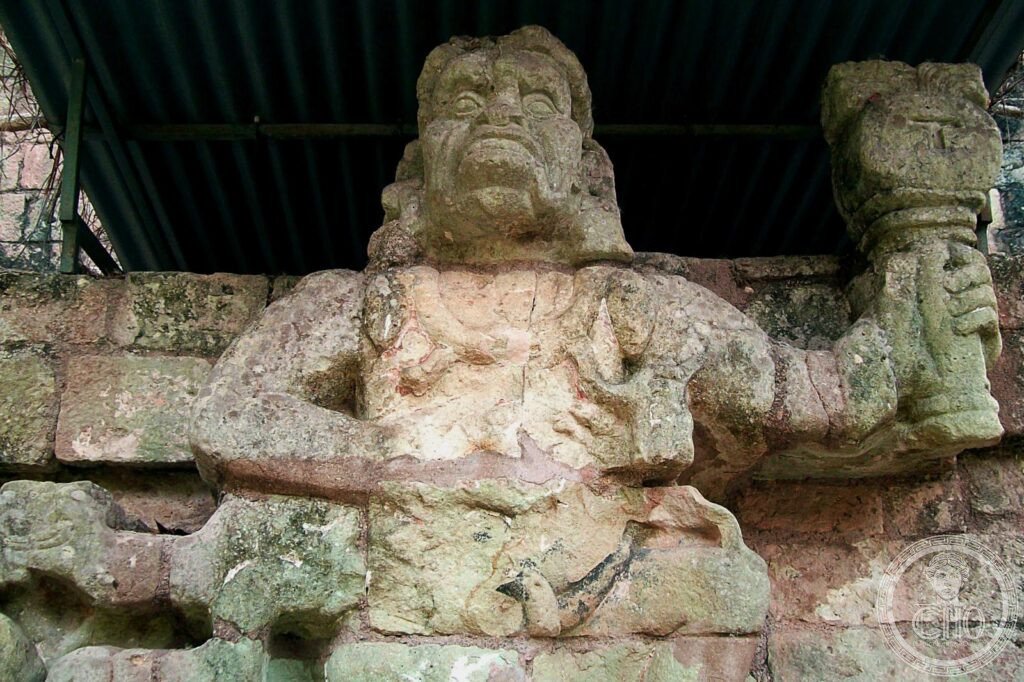
Copán
The intellectual capital of the Maya world and the city with the longest inscription in the pre-Columbian Americas — Copán (Copán Department, Honduras; UNESCO WHS 1980) was the southernmost great city of the Classic Maya (5th-9th century CE) and the centre of Maya astronomical knowledge and art, famous for the finest portrait stelae in Maya art and the 63-step Hieroglyphic Stairway.
At a glance
Copán (the most precisely CopanHonduras single Copán Department Honduras Maya Classic city 5th 9th century CE Quiriguá Copán valley Motagua River Honduras Guatemala western Honduras Mesoamerica southern frontier Maya civilisation furthest south major Classic Maya city Great Plaza plaza stelae 7 large stelae portrait stelae 18 Rabbit Waxaklajuun Ub’aah K’awil 13th ruler 695 738 CE finest sculptor patron of arts Copán 13th ruler 18 Rabbit erected 7 large stelae Great Plaza finest portrait stelae Maya lowlands each 3 4 metres tall inscribed hieroglyphs dates regnal names Copán finest Maya portrait sculpture 3-dimensional nearly round carving unusual compared flat relief other Maya cities Hieroglyphic Stairway Temple 26 2500 hieroglyphs inscribed 63 steps longest pre-Columbian hieroglyphic inscription in the world single stone text single monument longest text ancient Americas UNESCO heritage: why Copán is called the “Athens of the Maya” (the intellectual centre of the Classic Maya world): Copán has been called the Athens of the Maya because of its extraordinary concentration of scholarly and artistic activity; the Copán dynasty produced more hieroglyphic writing per capita than any other Maya city; the Copán Acropolis excavations revealed evidence of a scribe’s workshop (a room with writing tools and ceramic inkpots); the Maya scribes of Copán were the primary source of astronomical knowledge for the Maya world — the Venus tables in the Dresden Codex (the most sophisticated astronomical document of pre-Columbian America) are believed to originate from Copán astronomical observations; the Copán portrait stelae (the most three-dimensional in the Maya world, approaching fully carved sculpture rather than relief) represent the highest point of Maya plastic arts)) — the most precisely CopanHonduras single Copán Department Honduras 5th 9th century CE southernmost major Maya city 7 large portrait stelae Great Plaza 18 Rabbit Waxaklajuun Ub’aah K’awil 695 738 CE finest 3-dimensional Maya portrait sculpture Hieroglyphic Stairway Temple 26 2500 hieroglyphs 63 steps longest pre-Columbian inscription Americas Dresden Codex Venus tables Copán astronomical observations Athens of Maya scribes workshop inkpots UNESCO heritage in any UNESCO world heritage site)).
Key facts
- The Hieroglyphic Stairway (the longest pre-Columbian text in existence): the most precisely CopanHonduras single Hieroglyphic Stairway Temple 26 Copán Yax Pasaj Chan Yopaat 16th ruler 749 CE commissioned construction Hieroglyphic Stairway Temple 26 Yax Pasaj also rebuilt earlier stairway 15th ruler Smoke Shell 749 CE 2500 glyphs individual hieroglyphs 63 stone risers each riser step inscribed records Copán dynastic history from mythological founder Yax K’uk’ Mo’ to 749 CE 3-400 years history inscribed stone single monument longest hieroglyphic inscription pre-Columbian Americas Yax K’uk’ Mo’ Founder of Copán dynasty 5th century CE 427 CE accession date Green Quetzal Macaw translated 16 rulers Copán dynasty Temple 26 construction begun by 15th ruler Smoke Shell 749 CE stairway collapsed colonial period 19th century CE stone steps tumbled out of sequence Harvard Peabody Museum expedition excavated 1885 1895 CE incorrectly repositioned steps out of sequence 1930s CE fragments put back incorrect order modern analysis shows many steps still in wrong position UNESCO heritage — the most important and most damaged inscription in the Maya world: the Hieroglyphic Stairway of Temple 26 at Copán is the longest pre-Columbian hieroglyphic inscription in the world (2,500 glyphs on 63 steps); it records the complete dynastic history of Copán from the mythological founding by Yax K’uk’ Mo’ to the time of its commissioning by the 16th ruler Yax Pasaj Chan Yopaat in 749 CE; the stairway collapsed before 1839 CE (when Stephens and Catherwood arrived and found it fallen); it was excavated and partially restored by the Harvard Peabody Museum expedition (1885-1895 CE); the restorers put many of the hieroglyphic steps back in the wrong order — the reconstruction destroyed the linear narrative of the text; modern epigraphers working with the preserved plaster casts and photogrammetric surveys are still attempting to determine the correct sequence
- GPS: 14.8389° N, 89.1419° W
History
From Preclassic settlement to Classic intellectual capital to collapse (the most precisely CopanHonduras single 900 BCE Preclassic settlement Copán valley 5th century CE 427 CE Yax K’uk’ Mo’ Yax Kuk Mo Green Quetzal Macaw founder Copán dynasty 427 CE accession traditional Maya history possibly came from Tikal or Teotihuacan 16 rulers Copán dynasty 427 CE 822 CE 1st ruler Yax K’uk’ Mo’ to 16th ruler Yax Pasaj Chan Yopaat 695 738 CE 13th ruler Waxaklajuun Ub’aah K’awil 18 Rabbit greatest builder patron Copán greatest stelae artist erected 7 stelae Great Plaza astronomical observatory Building 22 most intricate carved stone building Classic Maya 738 CE captured and sacrificed by Quiriguá rival smaller city under Cauac Sky ruler K’ahk’ Tiliw Chan Yopaat Quiriguá ritual decapitation of 18 Rabbit April 738 CE 13th ruler captured and killed by smaller vassal city turning point Copán 749 CE 15th ruler Smoke Shell commissioned Hieroglyphic Stairway 763 822 CE 16th ruler Yax Pasaj Chan Yopaat last great ruler 800 822 CE Copán decline population reduced 822 CE last stela Stela 11 last inscribed monument 830 900 CE gradual abandonment archaeological evidence for population dispersal soil erosion agricultural collapse drought Terminal Classic 1576 CE Diego García de Palacio first European report ruins 1839 CE John Lloyd Stephens Frederick Catherwood Incidents of Travel in Central America 1839 publication Stephens accurately identified ancient indigenous civilization 1980 CE UNESCO UNESCO heritage: the death of 18 Rabbit (738 CE; the most consequential political murder in Classic Maya history): the ruler of Copán from 695 to 738 CE was Waxaklajuun Ub’aah K’awil (“18 Rabbit”; the 13th ruler; the greatest patron of the arts in Copán history); on April 30, 738 CE, he was captured in battle and ritually decapitated by K’ahk’ Tiliw Chan Yopaat (the ruler of Quiriguá — a much smaller city that had been a vassal of Copán); this event is recorded on Quiriguá Stela E (which records the capture) and on Copán’s Altar Q (which awkwardly omits the 13th ruler in its dynastic sequence); the murder of a major Maya king by a vassal city was unprecedented; the aftermath: Copán never recovered its political dominance; the Quiriguá stelae (the tallest in the Maya world) were erected by K’ahk’ Tiliw Chan Yopaat to celebrate his capture)) — the most precisely CopanHonduras single 900 BCE Preclassic 427 CE Yax K’uk’ Mo’ founder dynasty 16 rulers 427 822 CE 695 738 CE 18 Rabbit 13th ruler greatest builder 7 stelae astronomical observatory Building 22 most intricate carved stone Classic Maya 738 CE April 30 captured sacrificed Quiriguá K’ahk’ Tiliw Chan Yopaat smaller vassal unprecedented political murder 749 CE Smoke Shell Hieroglyphic Stairway 822 CE Stela 11 last 830 900 CE abandonment 1839 CE Stephens Catherwood 1980 CE UNESCO heritage in any UNESCO world heritage site)).
What you see
The Great Plaza, the Acropolis, and Altar Q (the most precisely CopanHonduras single Great Plaza open civic space 7 large portrait stelae 3-dimensional round carving unusual Maya lowlands Stela A 730 CE 4.5m tallest Great Plaza stela 18 Rabbit depicted full ceremonial regalia Stela B 731 CE 18 Rabbit Stela C 782 CE shows two sides north face south face different regalia Stela F Stela H 738 CE most beautiful Maya portrait stela in existence shows 18 Rabbit in net jade skirt finest portraiture Maya Classic Stela H considered most beautiful single Maya sculpture Ballcourt Type II largest and most beautiful Maya ballcourt outside Chichén Itzá Copán Ballcourt reconstructed three times macaw head markers along central sloped walls Acropolis temple-pyramid complex south Great Plaza Temple 16 tallest 30m Temple 22 Yax Pasaj 749 CE most intricate carved stone doorway Classic Maya doorway carved full supernatural assembly 3-dimensional monster mouth doorway cosmic monster door Temple 26 Hieroglyphic Stairway 2500 glyphs 63 steps longest pre-Columbian text world covered protective roof Altar Q 776 CE 16th ruler Yax Pasaj Chan Yopaat commissioned shows 16 rulers of Copán dynasty each seated ruler on his own name glyph passes the staff of authority from founder Yax K’uk’ Mo’ to Yax Pasaj political legitimacy statement UNESCO heritage: the Altar Q (the finest political document in Maya art): the Altar Q at Copán (776 CE; commissioned by the 16th ruler Yax Pasaj Chan Yopaat) is a square stone altar approximately 1m × 1m; its four sides show all 16 rulers of the Copán dynasty, each king seated on his own name glyph (making the altar both a portrait gallery and a calendar of the dynasty); the key image: on the west face, the founder Yax K’uk’ Mo’ passes a K’awiil sceptre (the staff of political authority) to Yax Pasaj, legitimising the 16th ruler’s claim to power; buried beneath the altar: the archaeologist William L. Fash excavated a cache of 15 jaguars, sacrificed and buried under the altar at its dedication, confirming the political significance of the monument)) — the most precisely CopanHonduras single Great Plaza 7 large portrait stelae 3D round unusual Maya Stela A 730 CE 4.5m tallest 18 Rabbit Stela H 738 CE most beautiful Maya portrait finest portraiture Ballcourt macaw head markers largest most beautiful outside Chichén Itzá Acropolis Temple 16 30m Temple 22 Yax Pasaj 749 CE most intricate carved doorway 3D monster mouth cosmic monster Temple 26 Hieroglyphic Stairway 2500 glyphs 63 steps covered protective roof Altar Q 776 CE 16 rulers seated name glyphs Yax K’uk’ Mo’ passes sceptre to Yax Pasaj 15 jaguars buried beneath UNESCO heritage in any UNESCO world heritage site)).
Practical information
- Getting there: fly to San Pedro Sula Airport (SAP; 170 km northeast; 50 min from Houston or Miami; local airline Aerocaribe to Copán Ruinas airstrip (15 min; small aircraft; not always available)); or fly to Guatemala City (GUA) and take a shuttle/bus via El Florido border crossing (4h from Guatemala City; approximately $30); the most common approach from Honduras: bus from San Pedro Sula (4h; Hedman Alas luxury bus; the safest and most comfortable option; approximately $20); the Copán entry fee (approximately L500/€18; includes the Principal Group and the tunnels; Las Sepulturas residential site extra); the Copán archaeological tunnels (L300/€11 extra; access to the two excavated tunnels that pass through the Acropolis and reveal the earlier temple constructions buried inside the Acropolis; the Rosalila Temple (a complete earlier temple buried inside Temple 16, painted in its original red-and-green polychrome; visible through a window into the tunnel) is the single most extraordinary experience at Copán); the Copán Regional Museum (free with site ticket; includes the original 18 Rabbit stelae moved inside for preservation, replaced outside by replicas; the Rosalila Temple replica); the visiting time (minimum 3h for the main site; the tunnels require an additional 1h))
Getting there
From Guatemala City: shuttle via El Florido 4h (~$30). From San Pedro Sula: Hedman Alas bus 4h (~$20). Entry L500/€18; tunnels L300/€11 extra (see Rosalila Temple — essential). Allow 4h total. GPS: 14.8389, -89.1419.
Nearby
- Quiriguá — 50 km northwest in Guatemala (UNESCO WHS 1981; the rival Maya city that captured and killed 18 Rabbit of Copán in 738 CE; the tallest stelae in the Maya world (Stela E: 10.6m above ground + 3m below ground; the tallest freestanding carved stone in the pre-Columbian Americas); the zoomorphs (huge carved boulders depicting supernatural crocodile-mountain beings with human figures emerging from their mouths); tiny site, rarely visited, the contrast with Copán is extraordinary)
- Copán Ruinas town — 1 km from the ruins (the most pleasant small town in Honduras; the cobblestone streets, adobe houses, and café culture around the central Parque Central; La Casa de Café (the finest hotel in Copán Ruinas; colonial house with garden; the best breakfast in Honduras)); the Macaw Mountain Bird Park (a rescue and rehabilitation centre for scarlet macaws — the endemic bird of the Copán valley; the guided walk through the aviaries is the best way to see scarlet macaws at close range))
Sources
- Wikipedia, Copán; Hieroglyphic Stairway, Copán; Altar Q; Waxaklajuun Ub’aah K’awil, accessed June 2026
- UNESCO, Maya Site of Copán, WHS reference 129, inscribed 1980
Find it on the map
See this place and what’s around it →📷 Diventa un fotografo di Cultural Heritage Online
Condividi le tue foto dei luoghi: restano pubblicate con la tua firma come autore. Più vengono viste, più ti fai conoscere — e presto un concorso premierà le foto più apprezzate.
Accedi o registrati gratis per aggiungere una foto