
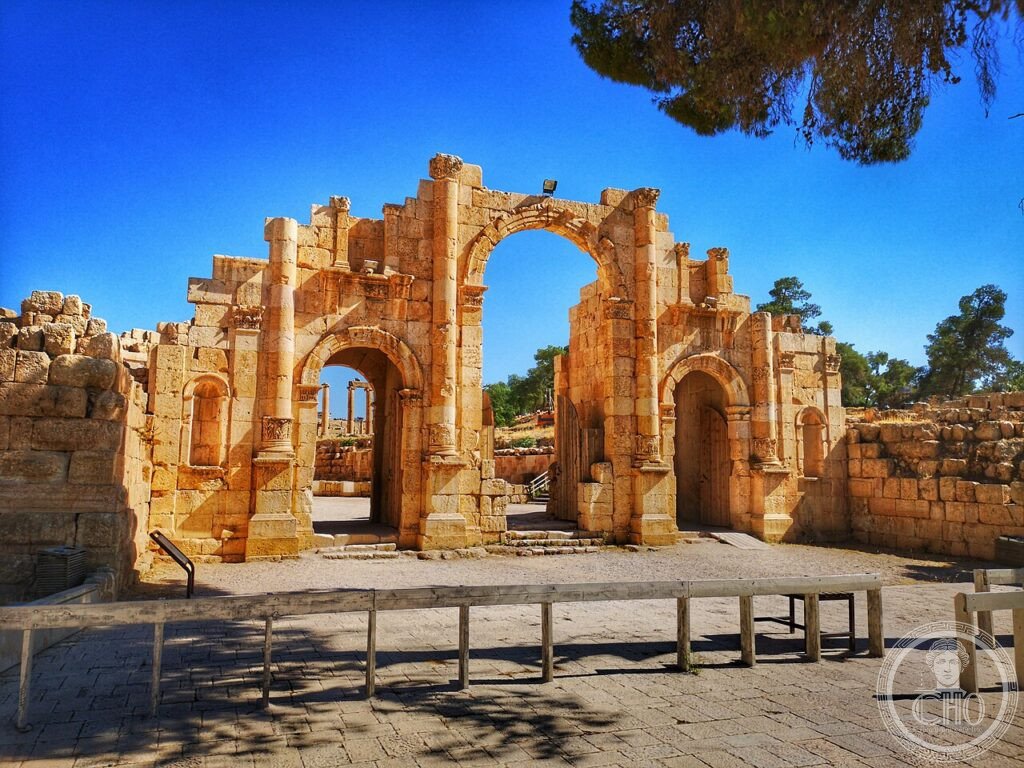
Jerash, ancient Gerasa, preserves an unusually complete Roman provincial city in the Jordanian hills: colonnaded avenues, temples, theatres, baths and a forum with no equivalent elsewhere in the Roman world. Visitors walk streets still cut with chariot ruts, beneath columns raised for emperors who once passed through in person.
At a glance
Jerash was one of the cities of the Decapolis, a loose league of Greco-Roman towns on the eastern frontier of the empire that also included Philadelphia (Amman), Scythopolis (Beth-Shean), Gadara (Umm Qais), Pella, Abila, Dium and Capitolias, among others. Tradition credits its foundation to the age of Alexander the Great, in 332 BCE, though the city’s Roman character took shape after Pompey’s conquest of Syria in 63 BCE brought it into the Roman province.
Its major monuments date largely from the first and second centuries CE, when a sustained building programme under the Flavian and then the Antonine emperors gave Jerash the colonnaded streets, temples and theatres that survive today. The city is popularly nicknamed Jordan’s Pompeii and is often described as one of the best-preserved Roman provincial cities outside Italy.
Key facts
- Oval Plaza: an elliptical colonnaded forum measuring roughly 90 by 80 metres, dated to the 1st–2nd century CE, ringed by 56 Ionic columns; it is the only oval forum known from the Roman world.
- Cardo Maximus: the main colonnaded street running north–south for about 800 metres and roughly 8 metres wide, originally lined by some 600 Ionic columns, with chariot wheel ruts still visible worn into the paving.
- Arch of Hadrian: a triumphal arch about 21 metres high, built in 129 CE to mark the visit of Emperor Hadrian in 129–130 CE, standing outside the city wall.
- South Theatre: a Roman theatre seating around 5,000, built under Domitian around 90–92 CE, with acoustics that carry a voice from stage to the upper tiers.
- Temple of Artemis: the largest temple at Jerash, dedicated to the city’s patron goddess and dated to around 150–180 CE; six of its original eleven columns still stand, each about 12 metres high.
History
Jerash’s origins are traced by tradition to the Hellenistic period, with a foundation date of 332 BCE associated with the age of Alexander the Great. The city entered the Roman orbit after Pompey’s conquest of Syria in 63 BCE, becoming one of the semi-autonomous cities of the Decapolis league. The main monumental building programme began in the first century CE under the Flavian emperors and reached its height under Trajan, and especially Hadrian, whose visit in 129–130 CE prompted the construction of the great arch that still stands outside the walls. A second city wall was planned to enclose a new southern quarter but was never completed, reportedly abandoned after an outbreak of plague around the middle of the second century, close to the city’s peak under the Antonine emperors.
Christianity transformed Jerash from the fourth century, following Constantine’s Edict of Milan in 313 CE: pagan temples were converted into churches and new ones built, and excavation has revealed a dozen Byzantine churches within the city along with a cathedral raised on an earlier temple site. Persian Sassanid forces took the city in 614 CE, and it passed into Muslim Arab hands after the Islamic conquests of the seventh century. A severe earthquake in the mid-eighth century devastated Jerash, and the city was largely abandoned, its ruins gradually buried under accumulated soil and debris. It remained largely forgotten until the German traveller Ulrich Seetzen recorded it in 1806, with the first major archaeological excavations following under the British Mandate in the 1920s.
In more recent times the ruins have taken on a second life as a stage: the Jerash Festival of Culture and Arts, established in 1981 and held annually in late summer, brings concerts and performances into the ancient theatres, with the South Theatre serving as its principal venue.
What you see
Approach to the ancient city is marked by the Arch of Hadrian, standing outside the walls where it was raised for the emperor’s visit. Beyond it opens the Oval Plaza, its elliptical run of Ionic columns enclosing the original Roman paving, from which the Cardo Maximus extends northward for some 800 metres, its stones still grooved by generations of chariot wheels. A monumental staircase climbs from the plaza to the Temple of Zeus, set on the highest ground on the city’s south side.
Along and off the Cardo stand the city’s two theatres: the large South Theatre, built under Domitian, with its tiered seating still in use, and the smaller North Theatre from the Trajanic period, originally built to house civic assembly. To the west, reached by a long processional approach and monumental gateway, the Temple of Artemis rises on its podium, its surviving columns dominating the skyline. Elsewhere in the city, the Byzantine cathedral, built over an earlier temple, and the Nymphaeum, a two-storeyed public fountain of 191 CE with traces of its marble decoration, mark the transition from pagan to Christian Jerash, while fragments of mosaic survive along the street named for the cathedral.
Practical information
- Opening arrangements: current visiting hours and admission arrangements are best checked through Jordan’s official tourism and antiquities channels before travelling.
- Festival visits: the Jerash Festival of Culture and Arts runs in the theatres each summer; those wishing to combine a visit with a performance should check the festival’s own programme and dates.
- On site: the ruins cover a large area on foot, including the full length of the Cardo Maximus, so a visit benefits from comfortable footwear and time set aside to walk the site properly.
Getting there
Jerash lies within Jerash Governorate in Jordan, at coordinates 32.2762° N, 35.8907° E. Current transport options from Amman and other Jordanian cities are best confirmed through official tourism information before setting out.
Nearby
- Amman — identified in antiquity with Philadelphia, another of the ten cities of the Decapolis league.
- Umm Qais — ancient Gadara, a further Decapolis city.
- Pella — one of the Decapolis cities associated with Jerash in the ancient league.
- Beth-Shean — ancient Scythopolis, another member of the same Decapolis grouping.
Sources
- Jerash Festival of Culture and Arts
Find it on the map
See this place and what’s around it →📷 Become a Cultural Heritage Online photographer
Share your photos of places: they stay published under your name as the author. The more they're seen, the more you get noticed — and soon a contest will reward the most appreciated photos.
Log in or sign up free to add a photo