

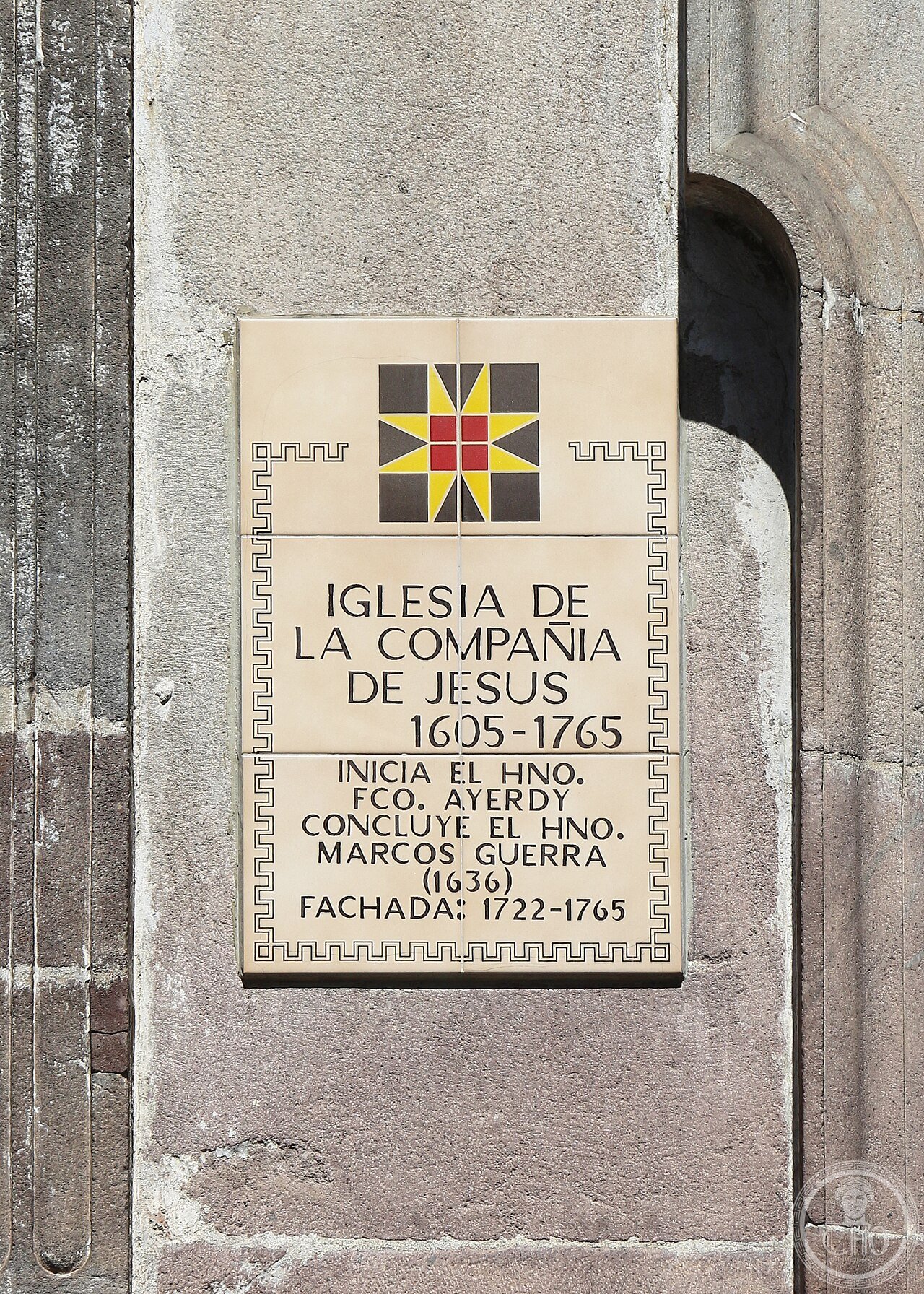
In the historic centre of Quito, Ecuador, construction of the church of the Society of Jesus began in 1605, when Father Nicolás Durán Mastrilli received from Rome the drawings inspired by the Church of the Gesù. It ended only on 24 July 1765: one hundred and sixty years of work, an exceptionally long time even by the standards of the colonial era. Several religious succeeded one another in charge of the works, among them the Italian Jesuit Marcos Guerra, who from 1636 introduced domes and barrel vaults of Renaissance inspiration. The façade, carved in grey volcanic stone, was begun in 1722 by the German Jesuit Leonardo Deubler and completed, after an interruption, between 1760 and 1765 by the Italian brother Venancio Gandolfi. It is considered one of the finest Baroque façades in South America. Inside, almost every surface is covered in 23-24 carat gold leaf, in a style that blends Baroque with Moorish influences and with the Quito School, the colonial Andean artistic current that united European and Indigenous sensibilities. Estimates of the amount of gold used vary enormously between sources, from about 50 kilograms to over a tonne. Since 1978 the church has been part of the UNESCO World Heritage site of the city of Quito, the first city in the world to be inscribed on the list.
About La Compañía de Jesús
The Church of the Society of Jesus, known simply as La Compañía, stands in the historic centre of Quito, Ecuador, its construction begun in 1605 when the Jesuit priest Nicolás Durán Mastrilli received plans from Rome inspired by the Church of the Gesù, and not completed until 24 July 1765 — a construction period of 160 years, extraordinarily long even by the standards of colonial-era church building. Successive Jesuit architects and priests directed the work over this long span, notably the Italian priest Marcos Guerra, who from 1636 introduced Renaissance-derived domes and barrel vaulting to the design. The church’s carved grey volcanic stone facade, begun in 1722 by the German Jesuit priest Leonardo Deubler and completed, after a period of interruption, between 1760 and 1765 by the Italian brother Venancio Gandolfi, is widely regarded as one of the finest examples of Baroque architecture anywhere in South America. Inside, nearly every surface is covered in 23- to 24-karat gold leaf, in a style blending dominant Baroque forms with Mudéjar geometric patterning and the broader Escuela Quiteña, the colonial-era Andean-Christian artistic tradition that fused European Baroque sensibility with Indigenous and mestizo craftsmanship; estimates of the total gold used vary enormously across sources, from roughly 50 kilograms to figures exceeding a tonne, reflecting genuine uncertainty rather than a single settled figure. Since 1978, La Compañía has formed part of the UNESCO World Heritage Site covering the City of Quito, the first city in the world ever inscribed on the World Heritage List, within which the church is specifically cited as a defining monument.
Key facts
- 1605-1765: construction period, roughly 160 years.
- 1722-1765: the carved volcanic stone facade, begun by Leonardo Deubler and completed by Venancio Gandolfi.
- Interior: nearly entirely covered in gold leaf, quantity estimates ranging widely across sources.
- Style: Baroque with Mudéjar and Escuela Quiteña influences.
- 1978: the church becomes part of the UNESCO World Heritage Site “City of Quito,” the first city ever inscribed.
- Status: major landmark and tourist attraction in Quito’s historic centre.
History
La Compañía’s 160-year construction, spanning the work of successive Jesuit architects and priests from across Europe, embodies the sustained institutional ambition of the Jesuit order in colonial Quito, resulting in a building whose interior decoration remains among the most lavish anywhere in Spanish colonial America. Its inclusion within the 1978 UNESCO inscription of Quito’s historic centre, the first city ever added to the World Heritage List, recognises the church’s central place within one of the best-preserved colonial urban ensembles in the Americas.
What you see
The church’s carved grey volcanic stone facade presents a dense programme of Baroque sculptural ornament, among the finest of its kind in South America, opening onto an interior where gilded surfaces, Mudéjar-patterned columns, and Escuela Quiteña sculpture and painting combine in one of the most visually overwhelming church interiors in the Americas. Renaissance-derived domes and barrel vaulting, introduced by the Italian priest Marcos Guerra in the 17th century, shape the nave’s ceiling above the gilded altarpieces below.
Practical information
- Opening hours: generally open daily with seasonal variation; admission fee applies; check current hours before visiting.
- Address: García Moreno, Historic Centre, Quito, Ecuador.
Getting there
La Compañía de Jesús stands in Quito’s historic centre, easily reached on foot from the Plaza de la Independencia. GPS: 0.2208° S, 78.5139° W.
Nearby
- Plaza de la Independencia — Quito’s main square, a short walk away.
- San Francisco Church and Monastery — another major colonial-era religious complex, nearby.
- Quito Cathedral — the city’s principal cathedral, near the Plaza de la Independencia.
Sources
- Wikipedia — “Church of La Compañía, Quito” (en.wikipedia.org).
- UNESCO World Heritage Centre — “City of Quito” (whc.unesco.org).
- El Comercio (Ecuador) — “Iglesia La Compañía,” Patrimonio Histórico (patrimonio.elcomercio.com).
Find it on the map
See this place and what’s around it →📷 Become a Cultural Heritage Online photographer
Share your photos of places: they stay published under your name as the author. The more they're seen, the more you get noticed — and soon a contest will reward the most appreciated photos.
Log in or sign up free to add a photo