
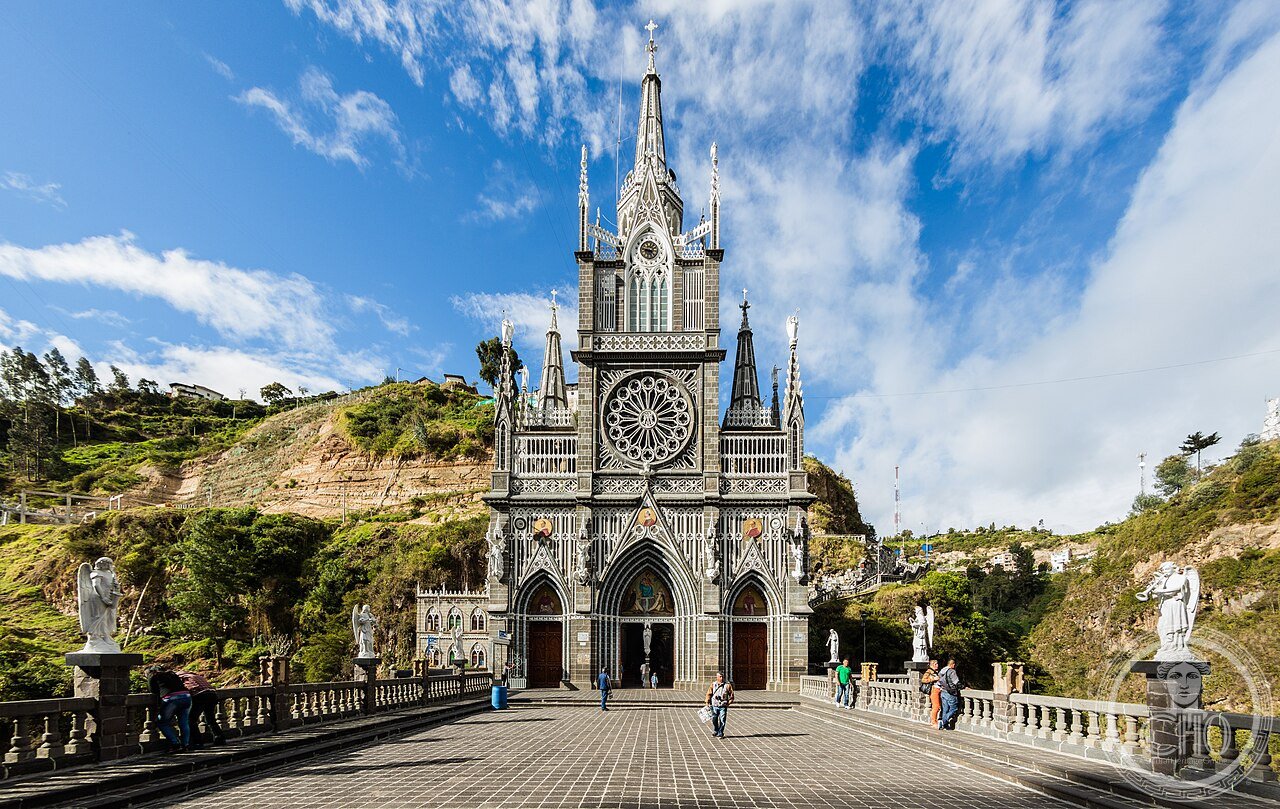
Near Ipiales, in the Colombian department of Nariño, the Sanctuary of Las Lajas stands literally on a bridge across the canyon of the river Guáitara. According to tradition, around 1754 an indigenous woman, María Mueses de Quiñones, and her deaf-mute daughter Rosa took shelter among the slabs of rock (the “lajas”) of the canyon during a storm: Rosa is said to have pointed to a figure lit by a flash of lightning on the rock face, exclaiming that “the Mestiza” was calling her. A polychrome image of the Virgin of the Rosary with the Child appeared on the rock itself; according to popular devotion the colour penetrates the stone without human intervention, a detail historical sources have never verified. After a first sanctuary of wood and straw, followed by a brick chapel around 1795–96 and a larger sanctuary from 1802, the present basilica was built between 1 January 1916 and 20 August 1949 to a design by the self-taught Ecuadorian architect Lucindo María Espinosa, thanks to donations from Colombian and Ecuadorian pilgrims. The building rises some 100 metres from the canyon floor, resting on a stone bridge about 50 metres high, and is built directly against the rock face, incorporating the rock with the Marian image into the altar itself. The sanctuary is today the second most important pilgrimage place in Colombia.
About Las Lajas Sanctuary
Las Lajas Sanctuary, near Ipiales in Colombia’s Nariño department, stands as one of the most visually dramatic pilgrimage churches in the world, built literally on a bridge spanning the canyon of the Guáitara River. According to tradition, around 1754 an Indigenous woman, María Mueses de Quiñones, and her deaf-mute daughter Rosa took shelter among the stone slabs, or “lajas,” of the canyon during a storm; Rosa reportedly pointed to a lightning-illuminated figure on the rock face, exclaiming that “the Mestiza” was calling to her. A polychrome image of the Virgin of the Rosary with the Christ child subsequently appeared on the rock itself; popular devotion holds that the colour penetrates the stone without human intervention, though this claim has never been independently verified by historical sources and should be understood as tradition rather than established fact. Following an initial straw-and-wood shrine, a brick chapel built around 1795-96, and a larger shrine erected from 1802 onward, the present Neo-Gothic basilica was constructed between 1 January 1916 and 20 August 1949, designed by the self-taught Ecuadorian architect Lucindo María Espinosa and funded largely through donations from Colombian and Ecuadorian pilgrims alike. The building rises roughly 100 metres from the canyon floor, carried on a stone bridge some 50 metres tall, and is built directly against the canyon rock face so that the stone bearing the venerated image forms part of the sanctuary’s altar area itself. Today, Las Lajas ranks as Colombia’s second most important pilgrimage site after Our Lady of the Rosary of Chiquinquirá, drawing large numbers of visitors from both Colombia and neighbouring Ecuador given its location just a few kilometres from the border.
Key facts
- c. 1754: tradition holds an apparition of the Virgin Mary was witnessed at the site
- c. 1795-1802: a sequence of earlier shrines built at the site before the current basilica
- 1916-1949: construction of the present Neo-Gothic basilica, designed by Lucindo María Espinosa
- ~100 metres: height of the church above the canyon floor
- ~50-metre stone bridge across the Guáitara River gorge carries the church
- Colombia’s second most important pilgrimage site, drawing pilgrims from both Colombia and Ecuador
History
Las Lajas Sanctuary’s evolution from a simple straw shrine to a monumental Neo-Gothic basilica spanning an entire river canyon reflects nearly two centuries of continuous popular devotion, funded incrementally by the pilgrims who have visited the site since the reported 18th-century apparition. Its location just a few kilometres from the Colombia-Ecuador border has made it a shared devotional landmark for both nations, its construction between 1916 and 1949 sustained specifically by cross-border pilgrim donations rather than any single institutional patron.
What you see
The basilica’s slender Gothic spires, flying buttresses and stained glass rise dramatically from a stone bridge spanning the Guáitara canyon, the entire structure appearing to grow directly out of the rock face it is built against. Inside, the sanctuary incorporates the actual canyon rock bearing the venerated image of the Virgin into its altar area, connecting the building’s architecture directly to the site’s founding apparition legend.
Practical information
- Opening hours: generally open daily with seasonal variation; free admission; check current hours before visiting
- Address: Las Lajas, Ipiales, Nariño Department, Colombia
Getting there
Las Lajas Sanctuary lies a few kilometres from the town of Ipiales, near the Colombia-Ecuador border, reachable by taxi or local bus from Ipiales. GPS: 0.8055° N, 77.5860° W.
Nearby
- Ipiales — the nearest town, a short drive away
- Rumichaca border crossing — the Colombia-Ecuador border post, nearby
- Guáitara River canyon — the dramatic gorge spanned by the sanctuary itself
Sources
- Wikipedia — “Sanctuary of Las Lajas” (en.wikipedia.org)
- Visit My Colombia — “Sanctuary of Las Lajas: Colombia’s most spectacular basilica suspended over a canyon” (visitmycolombia.com)
- Miracle Hunter — “Our Lady of Las Lajas” (miraclehunter.com)
Find it on the map
See this place and what’s around it →📷 Become a Cultural Heritage Online photographer
Share your photos of places: they stay published under your name as the author. The more they're seen, the more you get noticed — and soon a contest will reward the most appreciated photos.
Log in or sign up free to add a photo