

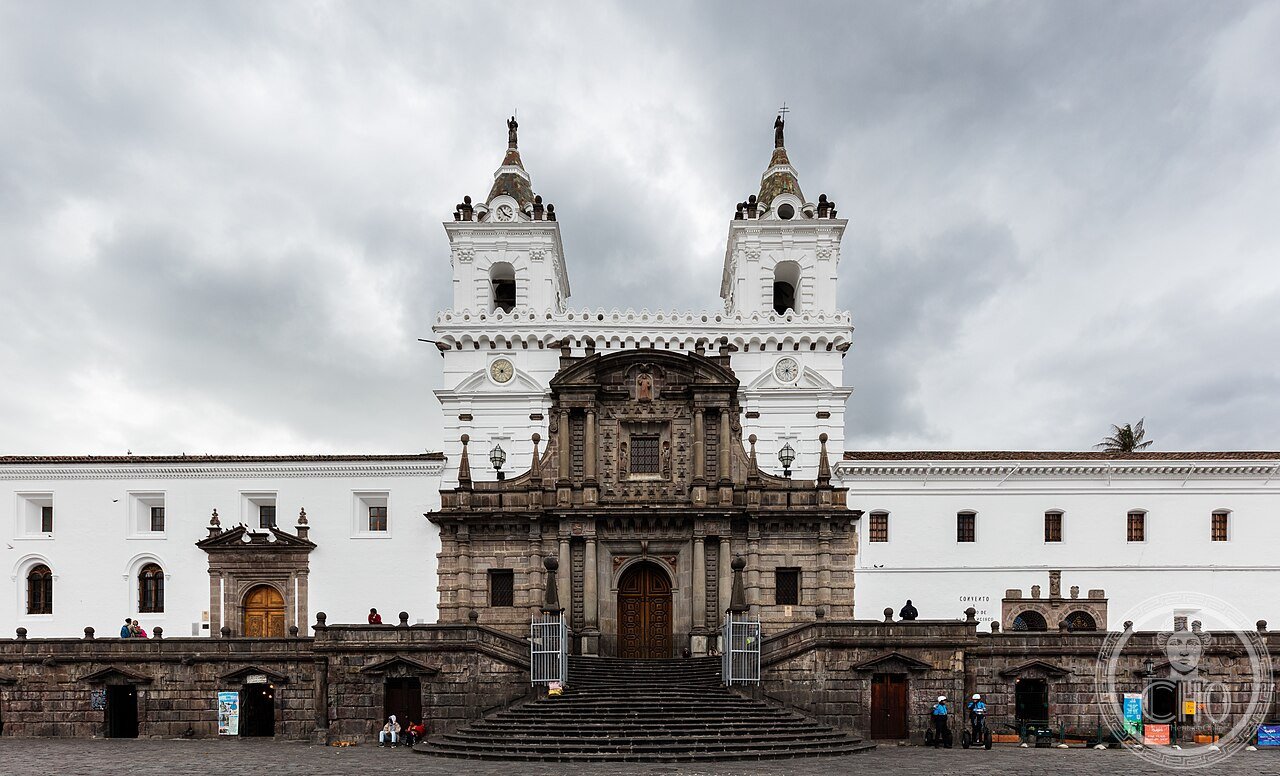
In the heart of the historic centre of Quito, in Ecuador, the church and convent of San Francisco were among the first religious buildings raised after the Spanish foundation of the city, on 6 December 1534. The Flemish Franciscan friars Jodoco Ricke and Pedro Gosseal, by tradition cousins of the emperor Charles V, arrived the following year and almost at once had a first temporary chapel built of adobe and straw. Building of the stone church began around 1550 and went on for more than a century, with an official inauguration recorded in 1705. According to a tradition widely repeated but not archaeologically confirmed, the complex stands on the ground of the royal palace of the Inca Huayna Cápac. At some 3.5 hectares, with thirteen cloisters and three churches, it is considered the largest colonial architectural complex in the whole of South America, earning it the nickname “the Escorial of the New World”. The convent is the cradle of the Quito School, the colonial Andean artistic movement, and holds more than 3,500 works of art, among them the famous Virgin of Quito, or “Winged Virgin”, carved around 1734 by Bernardo de Legarda, which inspired the giant aluminium statue on the Panecillo hill that looks over the city today.
About the Church and Convent of San Francisco
The Church and Convent of San Francisco, in the historic centre of Quito, Ecuador, ranks among the very first religious buildings constructed following the Spanish founding of the city on 6 December 1534. Flemish Franciscan friars Jodoco Ricke and Pedro Gosseal, said by tradition to be cousins of Emperor Charles V, arrived the following year and had a provisional adobe-and-straw chapel built almost immediately; construction of the permanent stone church began around 1550 and continued for well over a century, with a formal inauguration recorded in 1705. Widely repeated tradition holds that the complex was built on land that had formed part of the royal palace of the Inca ruler Huayna Cápac, though this claim remains a historical tradition rather than an archaeologically confirmed fact. Covering roughly 3.5 hectares with thirteen cloisters and three temples, the complex is regarded as the largest architectural ensemble surviving from the colonial period anywhere in South America, earning it the popular nickname “the Escorial of the New World.” The convent is considered the birthplace of the Escuela Quiteña, the colonial-era Andean-Christian artistic tradition, and today preserves a collection of more than 3,500 works of colonial art, most famously the Virgin of Quito, also known as the “Winged Virgin,” carved around 1734 by the sculptor Bernardo de Legarda and displayed on the church’s main altar. This image later directly inspired the enormous aluminium statue erected on Panecillo hill overlooking Quito, making the modest carved figure inside San Francisco the artistic ancestor of one of the city’s most recognisable modern landmarks.
Key facts
- 1535: Flemish Franciscan friars Jodoco Ricke and Pedro Gosseal arrive in Quito and build a first provisional chapel
- c. 1550-1705: construction and inauguration of the permanent stone church and convent
- ~3.5 hectares with thirteen cloisters, the largest colonial-era complex in South America
- Birthplace of the Escuela Quiteña, preserving over 3,500 colonial-era artworks
- Virgin of Quito (c. 1734) by Bernardo de Legarda, inspiration for the giant Panecillo statue
- 1978: the church becomes part of the UNESCO World Heritage Site “City of Quito”
History
As one of the earliest and largest religious complexes built anywhere in South America following the Spanish conquest, the Church and Convent of San Francisco embodies the scale of the Franciscan order’s ambitions in the newly founded city of Quito, its construction unfolding across more than a century and a half of continuous building and elaboration. The site’s tradition-linked association with an Inca royal palace, even if not archaeologically proven, situates the complex within the broader pattern of colonial religious architecture rising directly upon the political and sacred sites of the societies the Spanish conquest displaced.
What you see
The complex’s main church combines Renaissance exterior elements with Mudéjar-influenced arcades in its principal cloister, built between 1573 and 1581, and a surviving 16th-century artesonado wooden ceiling over the crossing and choir, while a Baroque coffered ceiling installed around 1770 replaced sections damaged by the 1755 earthquake. Inside, gilded Baroque altarpieces and Escuela Quiteña sculpture, including Bernardo de Legarda’s Virgin of Quito, fill a church raised above a broad atrium overlooking the Plaza de San Francisco, one of Quito’s principal historic squares.
Practical information
- Opening hours: generally open daily with seasonal variation; museum sections require a separate ticket; check current hours before visiting
- Address: Plaza de San Francisco, Historic Centre, Quito, Ecuador
Getting there
The Church and Convent of San Francisco stands on the Plaza de San Francisco in Quito’s historic centre, easily reached on foot from the Plaza de la Independencia. GPS: 0.2203° S, 78.5156° W.
Nearby
- Plaza de San Francisco — the large historic square directly in front of the church
- La Compañía de Jesús — another major colonial-era Baroque church, nearby
- Panecillo hill — site of the giant Virgin of Quito statue inspired by Legarda’s original, visible across the city
Sources
- Wikipedia — “Basilica and Convent of San Francisco, Quito” (en.wikipedia.org)
- Wikipedia — “Virgin of Quito” (en.wikipedia.org)
- UNESCO World Heritage Centre — “City of Quito” (whc.unesco.org)
Find it on the map
See this place and what’s around it →📷 Become a Cultural Heritage Online photographer
Share your photos of places: they stay published under your name as the author. The more they're seen, the more you get noticed — and soon a contest will reward the most appreciated photos.
Log in or sign up free to add a photo