
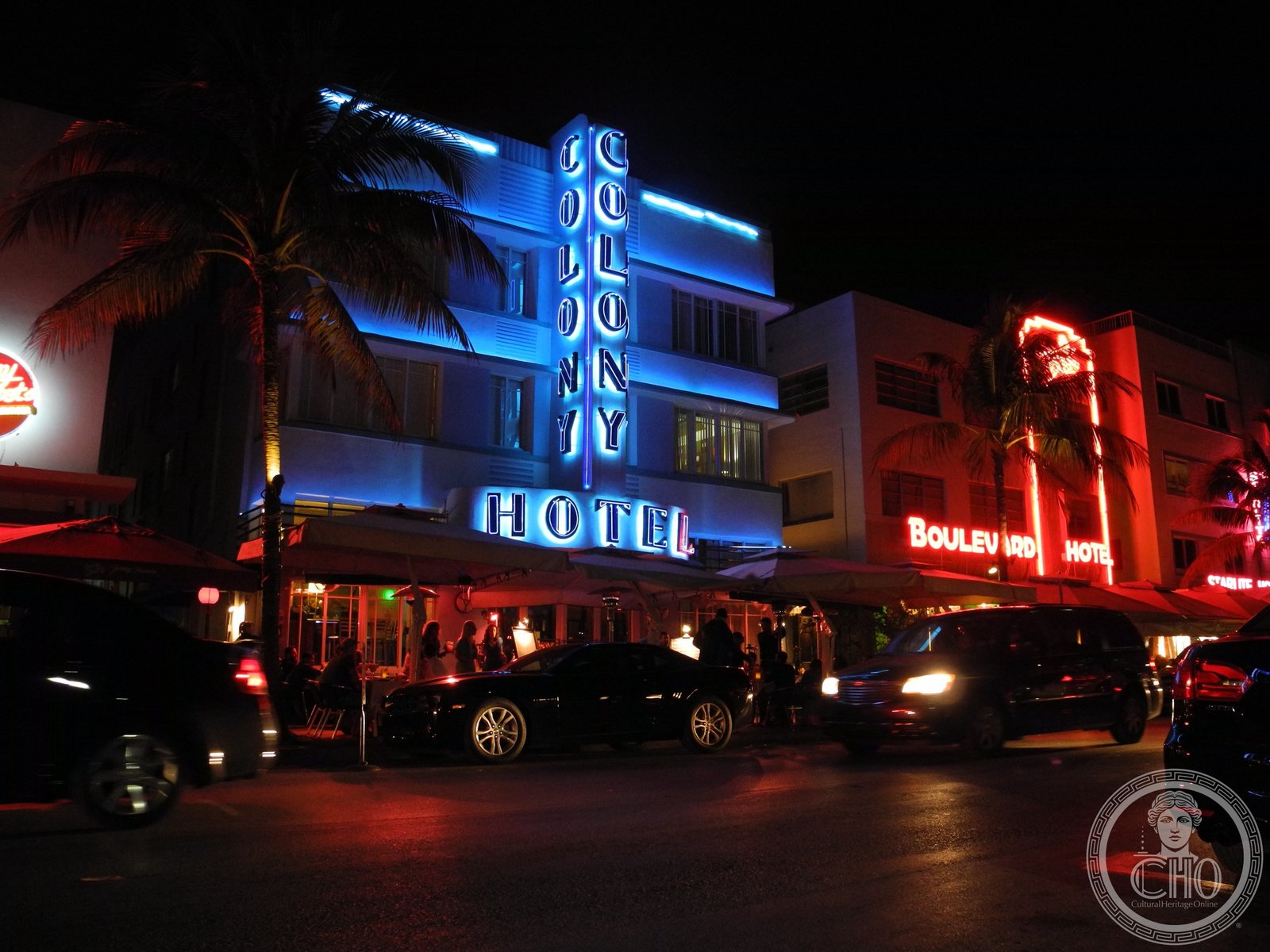
At 736 Ocean Drive, the Colony Hotel is one of the most photographed buildings in Miami Beach — Henry Hohauser’s rooftop neon sign, cantilevered eyebrow canopies, and Streamline Moderne composition having become the visual shorthand for the South Beach Art Deco aesthetic worldwide.
At a glance
Designed by Henry Hohauser and completed in 1935, the Colony Hotel stands in the center of the Ocean Drive historic corridor — the stretch of Art Deco and Streamline Moderne buildings that defines South Beach’s identity as one of the world’s largest concentrations of 1930s resort architecture. Hohauser gave the Colony its characteristic profile: a flat-roofed, horizontally banded facade with eyebrow canopies over the windows, speed-line ornament in the stucco, and a vertical rooftop tower carrying the neon-lit Colony sign visible for blocks in either direction. The building was included in the Miami Beach Architectural District when it was listed on the National Register of Historic Places in 1979 — one of the first historic districts to recognize Art Deco and Streamline Moderne architecture as worthy of preservation.
Key facts
- Completed: 1935
- Architect: Henry Hohauser
- Address: 736 Ocean Drive, Miami Beach, FL 33139
- Style: Streamline Moderne / Art Deco
- Status: Miami Beach Architectural District (National Register of Historic Places, 1979)
- Original use: Resort hotel
- GPS: 25.7782°N, 80.1302°W
History
Miami Beach’s development as a resort town accelerated in the early 1930s following the 1926 hurricane that destroyed much of the previous generation of buildings. The reconstruction created an unusual opportunity: an entire resort community rebuilt in the architectural idiom of a single decade, producing the visual coherence that now defines Ocean Drive and Collins Avenue. Henry Hohauser arrived in Miami Beach in the early 1930s and quickly became one of the most active architects of the rebuilding, designing dozens of hotels, apartment buildings, and commercial structures in a period of roughly a decade. His work characterized the Miami Beach variant of Streamline Moderne: white stucco, eyebrow canopies, horizontal speed lines, rooftop signs, and a human scale suited to the walk-to-the-beach resort model.
The Colony Hotel was completed in 1935 during the height of the building boom. Its Ocean Drive address gave it immediate visibility, and the rooftop neon Colony sign became a visual landmark in the nighttime streetscape. The hotel operated continuously as a tourist accommodation through the mid-twentieth century, serving the winter resort market that sustained Miami Beach’s economy. By the 1970s and 1980s, South Beach had fallen into neglect, and the Colony suffered the general decline of the neighborhood. The listing of the Miami Beach Architectural District on the National Register in 1979 was the beginning of the reversal; the subsequent advocacy of the Miami Design Preservation League brought national attention to South Beach’s architectural heritage, and the neighborhood’s revival in the late 1980s and 1990s transformed the Colony back into a landmark of the now-fashionable district.
What you see
The Colony’s Ocean Drive facade is a lesson in Streamline Moderne composition at human scale. The horizontal banding — achieved through the alternation of window strips and solid stucco panels — gives the building its characteristic speed-line profile, while the eyebrow canopies at each floor project enough to cast a shadow that emphasizes the horizontal reading. The stucco surface is white, the standard Miami palette, with the decorative elements in relief rather than color — an approach that allows the building to shift dramatically between morning and evening light, reading flat and bright in the midday glare and gaining depth and shadow in the low sun of late afternoon.
At the roofline, the vertical tower element — a flat plane of stucco with the Colony sign in neon — breaks the horizontal composition with a vertical accent readable from Ocean Drive and from the beach across Lummus Park. At street level, the covered entry arcade shelters the hotel entrance from the Florida sun, maintaining the connection between the sidewalk and the hotel. The proportions throughout are calibrated to the pedestrian scale rather than the automotive one, preserving the walkable resort character that distinguishes Ocean Drive from later car-oriented hotel strips.
Practical information
- Exterior: Always freely viewable from Ocean Drive and Lummus Park
- Lobby and bar: Accessible to hotel guests; visitors can view the bar and restaurant areas
- Photography: The neon sign is most effective at dusk and after dark; morning light on the east-facing facade is clean before the crowds arrive on Ocean Drive
- Time needed: 15-20 minutes for the Colony; plan a full walk of Ocean Drive from 5th to 15th Street for context
Getting there
The Colony Hotel is at 736 Ocean Drive, between 7th and 8th Streets in South Beach, Miami Beach. The Collins Avenue corridor is two blocks west. Miami International Airport is approximately 12 miles west via the MacArthur Causeway and I-395; a ride-share from the airport takes 20-35 minutes depending on traffic. Street parking on Ocean Drive is metered and competitive; parking garages are available on 7th Street and throughout the Collins and Washington Avenue corridors. Lummus Park, across Ocean Drive to the east, provides immediate beach access.
Nearby
- Cardozo Hotel (1939, Henry Hohauser) — 1300 Ocean Drive, a block and a half north
- Breakwater Hotel (1939) — 940 Ocean Drive, two blocks north
- Wolfsonian-FIU Museum — 1001 Washington Avenue, two blocks west; collection of Art Deco and industrial design
- Lummus Park and South Beach oceanfront — directly opposite on Ocean Drive
Sources
- National Register of Historic Places, Miami Beach Architectural District, 1979 nomination
- Miami Design Preservation League, “Guide to the Architecture of Miami Beach”
- Capitman, Barbara Baer. Deco Delights: Preserving the Beauty and Joy of Miami Beach Architecture. E. P. Dutton, 1988.
- Florida Department of State, Division of Historical Resources, Colony Hotel building records
Find it on the map
See this place and what’s around it →Record researched and written by Luigi De Marchi for Cultural Heritage Online, 2026.
📷 Become a Cultural Heritage Online photographer
Share your photos of places: they stay published under your name as the author. The more they're seen, the more you get noticed — and soon a contest will reward the most appreciated photos.
Log in or sign up free to add a photoIs this page about you?
This page is read by travellers and heritage enthusiasts who find it on Google. Tell us how you are connected to this place and we will take it from there.