
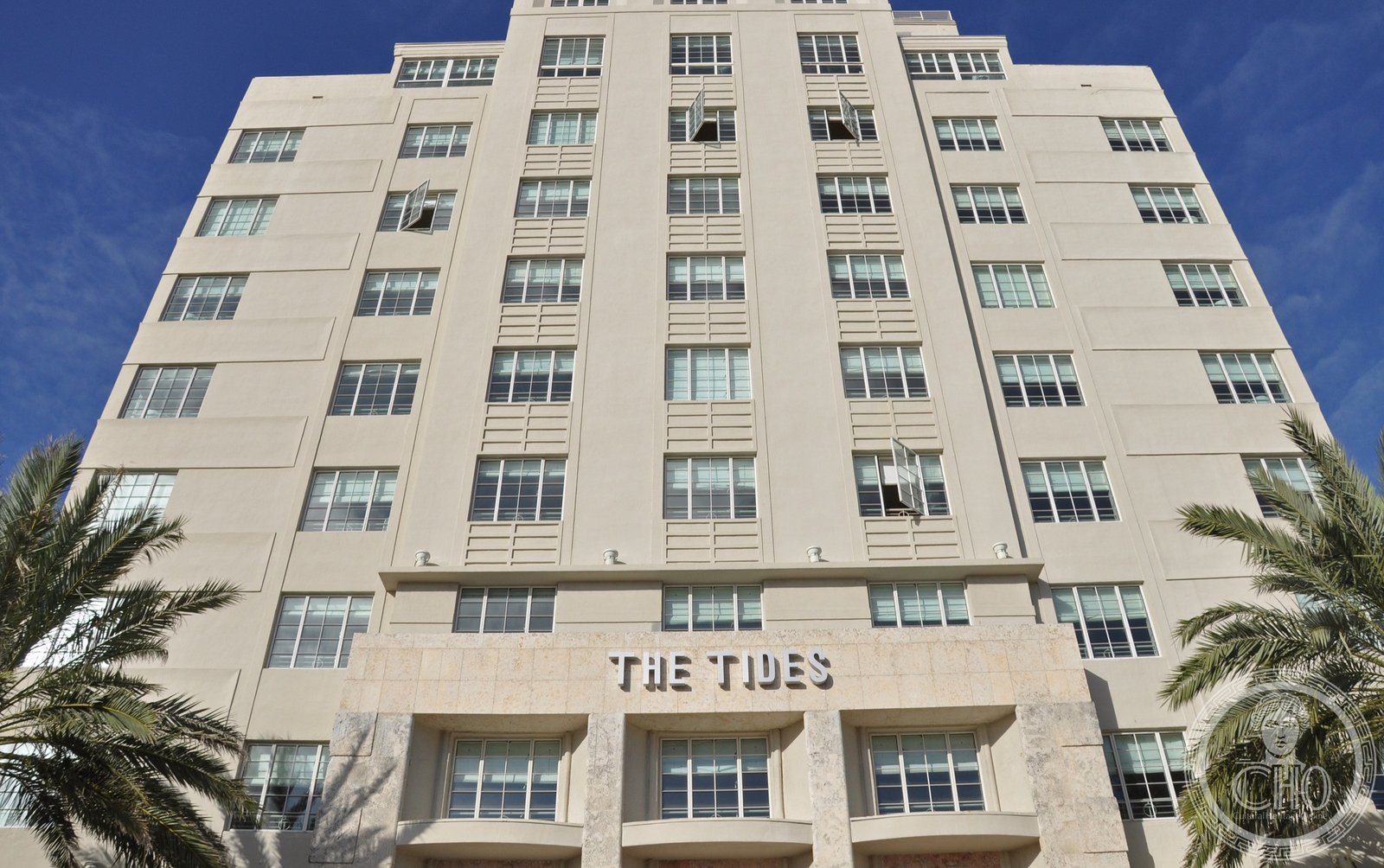
At ten stories, the Tides Hotel is the tallest building in the Miami Beach Art Deco Historic District — L. Murray Dixon’s 1936 design on Ocean Drive combining the Streamline Moderne idiom with a vertical scale that gives it visual dominance over the low-rise neighborhood without sacrificing the human-scale proportions that define the resort street.
At a glance
The Tides Hotel was designed by L. Murray Dixon and completed in 1936 at 1220 Ocean Drive, in the center of the stretch that forms the core of South Beach’s Art Deco Historic District. At ten stories, it stands notably above its neighbors — a height that Dixon used to organize the facade vertically through a composition of stacked horizontal bands, eyebrow canopies, and a roofline treatment that reads as a completion rather than a termination. The building was included in the Miami Beach Architectural District when it was listed on the National Register of Historic Places in 1979 and has operated continuously as a hotel. It is now one of the landmark addresses on Ocean Drive, combining its architectural distinction with direct views over Lummus Park to the ocean.
Key facts
- Completed: 1936
- Architect: L. Murray Dixon
- Address: 1220 Ocean Drive, Miami Beach, FL 33139
- Height: 10 stories
- Style: Streamline Moderne / Art Deco
- Status: Miami Beach Architectural District (National Register of Historic Places, 1979)
- GPS: 25.7826°N, 80.1303°W
History
L. Murray Dixon’s work in South Beach during the 1930s represents one of the most concentrated periods of hotel design in American architectural history. Between his arrival in Miami Beach in the early 1930s and the end of the decade, Dixon designed dozens of buildings along Ocean Drive and Collins Avenue, each representing a variation on the Streamline Moderne vocabulary adapted to the resort hotel type. The Tides, completed in 1936, was among his most ambitious: at ten stories, it required a different compositional strategy than the typical two-to-four-story Ocean Drive hotel, and Dixon responded by organizing the facade as a vertical sequence of horizontal bands that maintained the speed-line aesthetic of Streamline Moderne while accommodating a height that no other building in the district matched.
The Tides operated as a resort hotel through the mid-twentieth century, serving the seasonal winter tourism that sustained Miami Beach’s economy. Like its neighbors, it suffered the general decline of South Beach during the 1960s and 1970s, when the neighborhood’s population aged and investment dried up. The listing of the Miami Beach Architectural District in 1979, and the subsequent work of the Miami Design Preservation League, eventually attracted new investment to Ocean Drive. The Tides was restored and repositioned as a luxury boutique hotel, and its combination of architectural distinction and direct ocean views made it one of the most desirable addresses on the strip.
What you see
The Ocean Drive facade is organized as a vertical stack of horizontal elements: the eyebrow canopies at each floor project uniformly across the full width of the building, creating a horizontal rhythm that reads from the street as a series of shadow lines ascending the facade. The stucco surface between the canopies is white, the standard Miami palette, with the window openings grouped to maintain the reading of each floor as a single horizontal band. At the top floors, the composition shifts slightly — the upper setbacks and the roofline treatment give the building a crown that distinguishes it from the simple flat terminations of the smaller hotels on either side. Dixon’s proportioning of the window-to-wall ratio is generous: the Tides feels lighter than its height would suggest, its facade more glass than stucco at the upper floors.
From the beach across Lummus Park, the Tides reads differently: its vertical scale makes it a visual anchor of the Ocean Drive skyline, its silhouette visible from the waterline in a way that the lower buildings cannot achieve. The white stucco reflects the Florida sun at midday into a flat brightness, but in the early morning and late afternoon light, the shadow-lines cast by the eyebrow canopies give the facade a three-dimensional quality that explains Dixon’s adherence to the canopy form across building after building.
Practical information
- Exterior: Always freely viewable from Ocean Drive and Lummus Park
- Lobby and restaurant: Accessible to hotel guests and restaurant diners; the upper-floor rooms have direct ocean views
- Photography: The building’s full height photographs well from the beach across Lummus Park; Ocean Drive angle best in early morning before the street fills
- Time needed: 15 minutes for the exterior; combine with the full Ocean Drive Art Deco walk for context
Getting there
The Tides Hotel is at 1220 Ocean Drive, between 12th and 13th Streets in South Beach, Miami Beach. The Colony Hotel (736 Ocean Drive) and Cardozo Hotel (1300 Ocean Drive) are within a few blocks to the south and north on the same street. Miami International Airport is approximately 12 miles west; a ride-share from the airport takes 20-35 minutes. Street parking on Ocean Drive is metered; parking garages are available on 12th Street and throughout the Collins and Washington Avenue corridors.
Nearby
- Cardozo Hotel (1939, Henry Hohauser) — 1300 Ocean Drive, one block north
- Essex House Hotel (1938, L. Murray Dixon) — 1001 Collins Avenue, two blocks south and one block west
- Lummus Park and South Beach oceanfront — directly opposite on Ocean Drive
- Wolfsonian-FIU Museum (1001 Washington Avenue) — two blocks west; Art Deco and industrial design collection
Sources
- National Register of Historic Places, Miami Beach Architectural District, 1979 nomination
- Capitman, Barbara Baer. Deco Delights: Preserving the Beauty and Joy of Miami Beach Architecture. E. P. Dutton, 1988.
- Miami Design Preservation League, L. Murray Dixon architectural documentation
- Florida Department of State, Division of Historical Resources, Tides Hotel building records
Find it on the map
See this place and what’s around it →Record researched and written by Luigi De Marchi for Cultural Heritage Online, 2026.
📷 Become a Cultural Heritage Online photographer
Share your photos of places: they stay published under your name as the author. The more they're seen, the more you get noticed — and soon a contest will reward the most appreciated photos.
Log in or sign up free to add a photoIs this page about you?
This page is read by travellers and heritage enthusiasts who find it on Google. Tell us how you are connected to this place and we will take it from there.