

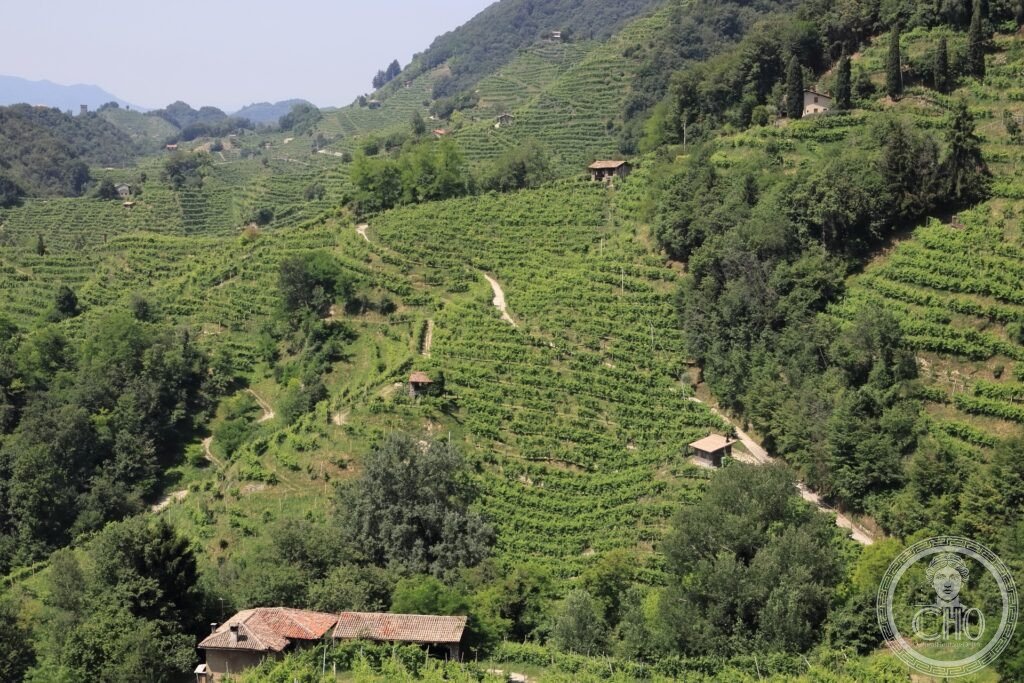
The hillsides of the Prosecco Superiore DOCG zone between Conegliano and Valdobbiadene — inscribed by UNESCO in 2019 as a cultural landscape (ref. 1571) — are a living example of a viticultural system that has remained substantially unchanged for three centuries: the “hogback” terrace technique (rows of vines planted to follow the contour lines of steep hills, creating the characteristic parallel-wave profile visible from any hilltop), the small-farm structure (no industrial vineyards; the average holding is less than 1 hectare), and the family-based harvest traditions that make the Colline del Prosecco one of the last surviving examples of peasant wine culture in a wine zone that has simultaneously become one of the most commercially successful in the world.
At a glance
Colline del Prosecco di Conegliano e Valdobbiadene (province of Treviso, Veneto; UNESCO 2019, ref. 1571) was inscribed as a Cultural Landscape under criterion v (an outstanding example of a traditional human settlement or land use that is representative of a culture or cultures, especially when it has become vulnerable). The property covers approximately 29,000 hectares of hillside terrain across 15 comuni in the Treviso province (from the slopes above Conegliano in the east to Valdobbiadene in the west), including a core zone of approximately 8,100 hectares and a buffer zone. The Glera grape (the primary variety for Prosecco production) has been cultivated here since at least the 17th century; the current DOCG (Denominazione di Origine Controllata e Garantita) was established in 2009, elevating the Conegliano Valdobbiadene Prosecco Superiore from the previous DOC status (1969). UNESCO recognized the landscape primarily for the “hogback” vine training system (a locally-developed technique for managing slopes) and for the persistence of the small-farm structure.
Key facts
- Il sistema hogback (ciglionata): The “hogback” or “ciglionata” vine training system plants vines in rows that follow the terrain’s contour lines rather than running straight up and down the slope, and it was developed locally to manage the steep pre-Alpine hillsides, with slopes of 15-40°. The technique creates a characteristic visual effect visible from any elevated point: a series of parallel horizontal wave-like ridges, the “backs” of the “hogs”, across the hillside. The agricultural advantage is erosion control and microclimate optimization, since each row has the same solar exposure. The visual advantage, recognized by UNESCO, is that the system creates a landscape identifiable from the air and from adjacent hillsides, and one that changes dramatically with the seasons: green in spring and summer, golden in autumn, brown and structured in winter
- Le Rive (il Prosecco Superiore di alta collina): The highest-quality Prosecco Superiore from the steepest hillsides is labeled “Rive” (from the Venetian dialect for “steep slope”); each Riva is identified with a specific municipality (e.g. “Riva di Vidor”, “Riva di Refrontolo”) and must be harvested by hand (mechanical harvesting is impossible on the steepest slopes); the Rive represent approximately 10% of total Prosecco Superiore DOCG production but command premium prices; tasting comparison between a Rive and a standard Valdobbiadene Prosecco Superiore DOCG illustrates the terroir difference
- Il Cartizze: The Cartizze is a 107-hectare subzone within the Valdobbiadene DOCG (the highest-quality subzone; only 5 producers have parcels; the wines are labeled “Valdobbiadene Superiore di Cartizze DOCG”); it is often called “the Grand Cru of Prosecco” although the comparison is imprecise (Champagne Grand Crus are specified in regulation; Cartizze is a geographical subzone within an already restricted DOCG); Cartizze wines are typically sweeter (dry to extra-dry) and have a more complex fruity aromatic profile than standard Valdobbiadene Prosecco Superiore
- La scuola enologica di Conegliano (1876): The Scuola Enologica di Conegliano (established 1876; the oldest wine school in Italy and one of the oldest in Europe) played a decisive role in establishing the technical standards for Prosecco production; its graduates disseminated the method champénoise-based “metodo Charmat” for Prosecco production (the Charmat method, where secondary fermentation happens in autoclave rather than in bottle, was perfected for Prosecco at Conegliano)
- UNESCO: 2019, ref. 1571
- GPS: 45.9000, 12.0500 — Google Maps (Colline del Prosecco, area centrale)
History
The Glera grape and wine production in the Treviso hills are documented at least from the 17th century (the word “Prosecco” appears in a document of 1593 as a village name — the Prosecco di Trieste is a different grape variety from the same Friulian area — and the association of the grape name with the current production zone became standardized only in the 20th century). The Scuola Enologica di Conegliano (1876) systematized production methods; the DOC was established in 1969; the Cartizze subzone was recognized in 1969; the DOCG was elevated from DOC in 2009. The UNESCO inscription in 2019 came at the peak of Prosecco’s global commercial success (Prosecco overtook Champagne in global volume sales in 2013; Italy now exports more than 600 million bottles of Prosecco annually), creating an interesting tension: the landscapes were recognized as traditional/vulnerable at the same moment when the commercial product they produce was reaching unprecedented global success.
What you see
The Prosecco UNESCO landscape is experienced in two ways: by car or bicycle (the Strada del Prosecco e Vini dei Colli Coneglianese e Valdobbiadenesi — the official wine road — covers 120 km between Conegliano and Valdobbiadene, passing through the 15 comuni of the DOCG; the best viewpoints are the Colbertaldo belvedere, the Follina belvedere, and the Miane belvedere) or on foot (the UNESCO hiking trail “Percorso UNESCO” runs 30 km through the core zone, with 15 km feasible for a day hike from Valdobbiadene to Pieve di Soligo). The best visual experience of the hogback terracing is from any hilltop viewpoint in October-November, when the vine leaves are yellow-gold and the horizontal wave-structure of the rows is most legible against the autumn light. The Cantina Giol (Oderzo, 20 km south-east) and the Cantina Adami (Colbertaldo di Vidor) offer guided tastings with views over the DOCG zone.
Gallery
Practical information
- Wine route (Strada del Prosecco): The Strada del Prosecco e Vini dei Colli Coneglianese e Valdobbiadenesi runs 120 km; best explored by car or e-bike (e-bike hire in Conegliano and Valdobbiadene). The route is officially managed by the Consorzio Tutela del Prosecco DOCG (prosecco.it); they publish itinerary maps.
- Cantina open days: Most small producers in the 15 comuni offer weekend tastings (April-November); the Valdobbiadene tourist office (valdobbiadeneturismo.com) maintains a current list of open cantinas.
- Conegliano attractions: The Scuola Enologica di Conegliano (wine school, founded 1876; occasional open days) + the Sala dei Battuti (a medieval flagellant confraternity hall with a 14th-century painted programme by Giambattista Cima da Conegliano) + the castle ramparts above the town (best view over the start of the Prosecco hills).
Getting there
Colline del Prosecco, area Valdobbiadene-Conegliano (TV), Veneto. GPS 45.9000, 12.0500. By train: Trenitalia from Venice to Conegliano (45 min regional; frequent); from Treviso to Conegliano (25 min). Conegliano is the eastern gateway to the Prosecco hills; Valdobbiadene (western gateway) has a less frequent train service (from Vittorio Veneto, change required). By car: from Venice, A27 north to Conegliano (50 km, 40 min); from Treviso, SS13 north (30 km, 30 min).
Nearby
- Treviso — 40 km south-east; the best-preserved small medieval city in the Veneto (the canals of the city centre, the canvases by Titian and Lotto in the Museo Civico, the covered fish market “La Pescheria” on the river canal island); Treviso airport (TSF) serves several European budget carriers (easyJet, Ryanair)
- Venezia — 80 km south; by train from Conegliano, 1h to Venice Santa Lucia; by car, A27 south to the Mestre junction then the Ponte della Libertà
- Dolomiti di Belluno — 50 km north; the southern approach to the Dolomites from the Treviso plain; the Passo Duran (above Agordo) and the Parco Nazionale delle Dolomiti Bellunesi give mountain hiking without the crowds of the Val Gardena or Cortina d’Ampezzo
Sources
- UNESCO: whc.unesco.org/en/list/1571
- Wikipedia EN: Prosecco Hills of Conegliano and Valdobbiadene
- Consorzio Tutela Prosecco DOCG: prosecco.it
- Scuola Enologica di Conegliano (fondata 1876): iissconegliano.it
Find it on the map
See this place and what’s around it →📷 Become a Cultural Heritage Online photographer
Share your photos of places: they stay published under your name as the author. The more they're seen, the more you get noticed — and soon a contest will reward the most appreciated photos.
Log in or sign up free to add a photo