

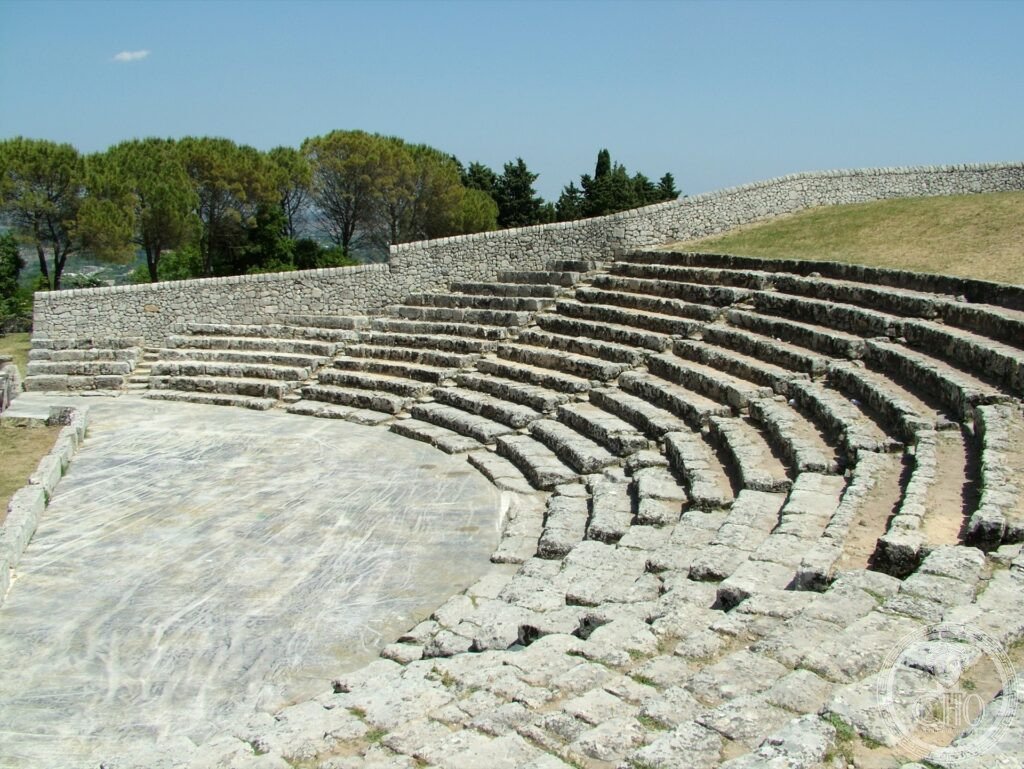
Palazzolo Acreide — the site of the Greek colonial city of Akrai (founded in 664 BCE by Syracusan settlers on a strategic hilltop plateau) and a small Baroque city rebuilt from the earthquake ruins of 1693 — is the least visited and most quietly intact of the eight cities of the UNESCO Late Baroque Val di Noto inscription: a town where the Greek theatrical tradition (the Akrai theatre, 241 BCE, still used for summer performances) coexists with the Sicilian Baroque on a scale that has not been overwhelmed by tourism.
At a glance
Palazzolo Acreide (province of Syracuse, Sicilia; UNESCO 2002, ref. 1024) is one of eight cities in the serial inscription “Late Baroque Towns of the Val di Noto” (along with Noto, Ragusa, Scicli, Caltagirone, Catania, Militello in Val di Catania, and Modica), all of which were entirely or substantially rebuilt after the catastrophic Val di Noto earthquake of January 11, 1693 (the most destructive seismic event in Sicilian recorded history). Palazzolo Acreide is inscribed for: (1) the Late Baroque urban fabric (churches, palaces, piazze built 1693-1750); and (2) the coexistence of the Baroque city with the archaeological site of Akrai (the Greek colony, 664 BCE), which includes the best-preserved Greek theatre in the Val di Noto region (the Akrai theatre, 3rd century BCE), the rock-cut sanctuaries of Cybele (the “Santoni,” 3rd-2nd century BCE), and the early Christian catacombs (3rd-6th century CE).
Key facts
- Il Teatro Greco di Akrai (241 a.C.): The theatre of Akrai is a small Greek theatre (diameter approximately 60 m; capacity approximately 600 spectators) cut into the limestone bedrock of the Akrai plateau; it was built in the middle of the 3rd century BCE (the date traditionally given is 241 BCE, during the reign of Hiero II of Syracuse) as the civic theatre of the colonial city; despite its small size (compared with the large theatres of Syracuse or Taormina), the Akrai theatre is in particularly good condition (the cavea/seating area, the orchestra circle, and the stage foundation are all visible); summer theatrical and musical performances are held here regularly
- I Santoni di Cibele (III-II sec. a.C.): The “Santoni” (big saints) are a series of 12 high-relief sculptures cut directly into the rocky walls of a cliff face approximately 500 m east of the Akrai site: the figures (averaging 1.2-1.5 m in height) represent the goddess Cybele (Magna Mater, the Phrygian/Anatolian mother goddess) enthroned, accompanied by attendant figures (Hermes, Hecate, and others); the reliefs date to the 3rd-2nd century BCE and represent one of the largest surviving ensembles of Cybele cult sculpture in the western Greek world; the technical quality and iconographic complexity of the Santoni make them significant both as sculptural objects and as evidence of the syncretistic religious culture of Hellenistic Sicily
- Il Barocco di Palazzolo Acreide (1693-1750): The city was entirely rebuilt after the 1693 earthquake on the same hilltop plan as the Greek Akrai; the key Baroque monuments are: the Duomo di San Nicola (the cathedral, 1703-1727, with a facade of two unequal towers that is characteristic of Val di Noto Baroque asymmetry), the Church of San Sebastiano (1710-1740, with a concave facade and a large decorative programme), the Palazzo Judica (18th century, with one of the most elaborate wrought-iron balcony supports — “mensole” — of the Val di Noto), and the Church of the Annunziata (1697-1720)
- UNESCO: 2002, ref. 1024
- GPS: 37.0578, 14.9002 — Google Maps (Palazzolo Acreide, area centrale)
History
Akrai was founded as a sub-colony of Syracuse in 664 BCE (the date comes from Thucydides, VI.5) on a commanding plateau 45 km west of Syracuse, controlling the inland routes of south-eastern Sicily. The city developed its own coinage, theatre, and cult sites (including the Cybele sanctuary) during the Hellenistic period (4th-1st century BCE) and continued as a Roman town (the catacombs date from this phase). After the Arab conquest of Sicily (9th century) and the Norman reconquest (11th century), the settlement moved from the plateau (Akrai) to the more protected current hilltop site and was renamed “Palazzolo” (from “Palatiolum” = small palace, referring to a Byzantine fortification). The earthquake of January 11, 1693 destroyed virtually the entire city; the rebuilding in the 18th century created the current Baroque townscape.
What you see
Palazzolo Acreide has two distinct circuits: the Baroque city (30-45 min walk from the main parking area on Via Vittorio Emanuele: the Piazza del Popolo, the Duomo di San Nicola, the Church of San Sebastiano with its concave facade, and the series of Baroque palaces along Via Carlo Alberto with their wrought-iron balcony brackets); and the Akrai archaeological site (1.5 km outside the town centre, on the Akrai plateau to the east; the site includes the theatre, the bouleuterion/small council chamber, the quarries, and a short path to the Santoni di Cibele; combined ticket available; allow 2 hours for the full site). The combination of Greek theatre + Baroque city + Cybele cult reliefs is unique in Sicily and makes Palazzolo Acreide the most historically multi-layered of the eight UNESCO Val di Noto sites.
Gallery
Practical information
- Parco Archeologico di Akrai (Teatro + Santoni): Contrada Colle Orbo, Palazzolo Acreide; open daily 9:00-16:00 (winter) and 9:00-18:00 (summer); admission ~€5 (combined ticket with the Museo Archeologico Regionale “Antonino Salinas” di Palermo and other archaeological sites). Note: the Santoni are a 15-min walk from the theatre; the path is unpaved; comfortable footwear required.
- Centro storico barocco: The Baroque historic centre is freely accessible; the Duomo di San Nicola is open during services (09:00-12:00 daily) and by appointment; the Palazzo Judica (exterior only) is on Via Judica off the main piazza.
- Estate a Palazzolo (summer programme): The Palazzolo Acreide municipality organizes summer theatrical and musical performances in the Akrai theatre (June-September); check the Comune di Palazzolo Acreide website for the current year programme.
Getting there
Palazzolo Acreide (SR), Sicilia. GPS 37.0578, 14.9002. By car: from Siracusa, SS124 west (45 km, 45 min); from Ragusa, SP14/SS114 north-east (60 km, 1h). Limited public transport: AST buses from Siracusa (several daily, approximately 1h). Palazzolo Acreide has limited parking in the Piazza Roma; day-trip visitors best served by car from Siracusa or Ragusa as a base.
Nearby
- Siracusa — 45 km east; (CHO card: Siracusa UNESCO 2005); the Greek theatre (5th century BCE), the Roman amphitheatre, Ortigia and the Duomo (with the Greek temple columns incorporated into the church walls), and the Museo Archeologico Regionale Paolo Orsi
- Ragusa Ibla — 60 km south-west; (CHO card: Ragusa Ibla UNESCO 2002); the most dramatic of the Val di Noto Baroque cities, perched on its limestone spur
- Pantalica Necropolis — 20 km north-east; the rock-cut Bronze Age and early Iron Age necropolis in the Anapo canyon (UNESCO 2005, part of the Siracusa and Pantalica inscription), with more than 5,000 rock-cut tombs
Sources
- UNESCO: whc.unesco.org/en/list/1024
- Wikipedia EN: Palazzolo Acreide
- Thucydides: History of the Peloponnesian War, VI.5 (founding date of Akrai)
- Parco Archeologico di Akrai (Regione Siciliana): regione.sicilia.it
Find it on the map
See this place and what’s around it →📷 Become a Cultural Heritage Online photographer
Share your photos of places: they stay published under your name as the author. The more they're seen, the more you get noticed — and soon a contest will reward the most appreciated photos.
Log in or sign up free to add a photo