
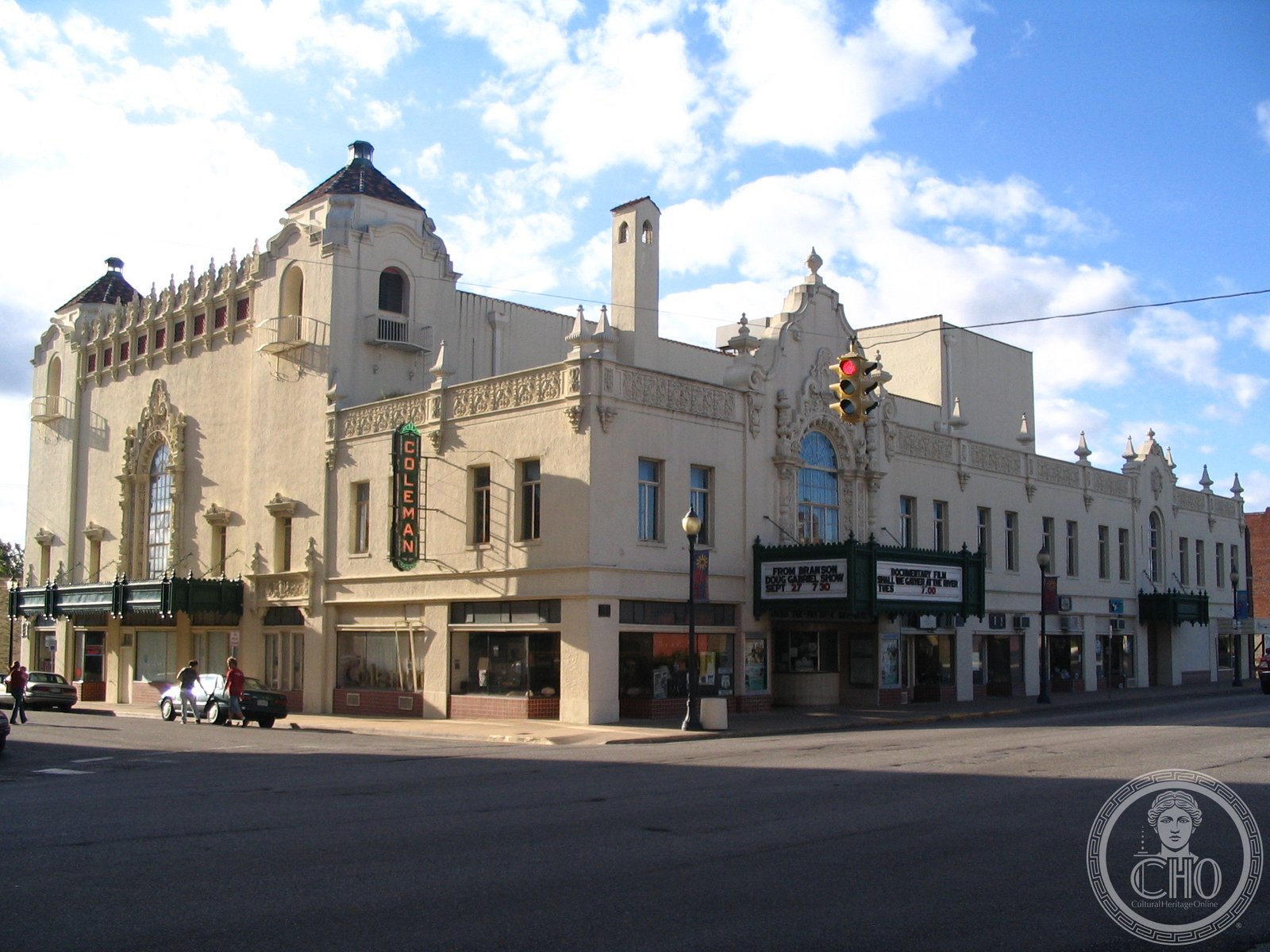
George L. Coleman Sr. built this theater in 1929 at the height of the Oklahoma mining boom, commissioning a design of deliberate extravagance — white terracotta, gilded interiors, and the ornate vocabulary of Spanish Mission Revival blended with the era’s decorative flourishes — in a city that briefly rivaled larger regional centers for civic ambition.
At a glance
The Coleman Theatre Beautiful in Miami, Oklahoma, stands as one of the most exuberantly decorated performance venues in the American Southwest, built in 1929 by lead and zinc mining magnate George L. Coleman Sr. as a gift to the town that had made his fortune. Its Mission Revival facade and richly appointed auditorium — gilded relief work, ornate plasterwork ceilings, and a Louis XV-style interior of deliberate grandeur — represent the intersection of extractive-industry wealth and civic theater-building that marked the Oklahoma territorial era’s maturation into statehood prosperity. Listed on the National Register of Historic Places, the theater continues to operate as a community performing arts venue in the Tri-State Mining District of northeastern Oklahoma.
Key facts
- Address: 103 North Main Street, Miami, Oklahoma 74354.
- Opened: 1929.
- Patron: George L. Coleman Sr., lead and zinc mining magnate.
- Style: Spanish Mission Revival with ornate decorative interior; late 1920s decorative arts.
- Capacity: approximately 1,600 seats.
- GPS: 36.8764° N, 94.8783° W.
- Status: National Register of Historic Places; active performing arts venue.
History
Miami (pronounced locally as MY-am-uh) sits in the far northeastern corner of Oklahoma, in the Tri-State Mining District where Oklahoma, Kansas, and Missouri converge. The district’s lead and zinc deposits, discovered in the late nineteenth century, generated extraordinary wealth that transformed a frontier settlement into a prosperous small city by the 1920s. George Coleman Sr., whose mining interests had made him one of the district’s wealthiest men, decided in the late 1920s to invest that wealth in a civic monument that would signal Miami’s ambitions: a theater built to a standard that smaller cities typically did not attempt.
Coleman commissioned a design of deliberate theatrical spectacle. The exterior presents a Mission Revival facade of glazed white terracotta, its ornamental vocabulary drawn from the Spanish Colonial architecture then fashionable for civic and commercial buildings across the American Southwest. The interior pushed further still: an auditorium decorated with gilded ornamental work, hand-painted murals, and the elaborate plasterwork that theater designers of the era — drawing on the Baroque tradition and the French Louis XV style that the major Hollywood theater chains were deploying nationally — used to surround audiences with an atmosphere of dream-world magnificence. The 1929 opening coincided with the height of the silent film era’s transition to sound, placing the Coleman at the forefront of the new entertainment medium in its region.
The theater weathered the Depression, the postwar shift to television, and the broader decline of downtown commercial districts to emerge as a landmark of northeastern Oklahoma. Restoration work beginning in the late twentieth century stabilized and rehabilitated the building, returning its decorative program to something close to its original splendor. Today the Coleman operates as a community theater presenting live performances, films, and educational programming for the Miami and Tulsa regions.
What you see
The facade presents itself in glazed white terracotta ornament: shallow pilasters, decorative tile insets, and the layered horizontal moldings characteristic of the Mission Revival. The marquee extends over the sidewalk in the manner of the great American downtown theater, a luminous frame for the building’s name — lettered in the bold, confident typography of the late 1920s — that reads as an invitation from half a block away. The overall composition is one of ornamental density held in check by the whiteness of the material, which gives the building a brightness unusual in the prairie streetscape around it.
Inside, the auditorium reveals the full ambition of Coleman’s commission. The ceiling, the proscenium arch, the box fronts, and the wall panels carry relief ornament in gilded plaster — scrollwork, floral motifs, classical figures — applied with a generosity that leaves almost no surface undecorated. The effect is of stepping into a room designed on the premise that the audience deserves surroundings more magnificent than their daily lives; a premise central to the American movie palace tradition from its 1910s origins through the last great theater buildings of the early 1930s.
Practical information
- Access: Tours and performances; check colemantheater.org for schedule and tour availability.
- Tours: Free self-guided tours during box office hours.
- Season: Year-round programming; summer brings increased performance schedule.
- Duration: Self-guided tour 30–45 minutes; guided tour approximately 1 hour.
Getting there
Miami sits on US Highway 69 in Ottawa County, approximately 90 miles northeast of Tulsa via US-69. Tulsa International Airport (TUL) is the nearest major airport, approximately 90 miles southwest, with connections to Dallas, Chicago, Denver, and other hubs. The theater is in downtown Miami at Main Street and Commerce Street. Regional bus services connect Miami to Tulsa and Joplin, Missouri; Route 66, which passes through Miami, provides an alternative scenic approach from the west.
Nearby
- Dobson Museum — Ottawa County history museum in downtown Miami, documenting the Tri-State Mining District’s lead and zinc heritage.
- Tar Creek Superfund Site — the environmental legacy of the mining era, approximately 5 miles north; interpretive signage documents the industrial history.
- Joplin, Missouri — approximately 25 miles northeast via US-69; the Joplin Museum Complex at Seventh Street and Schifferdecker Road covers the region’s mining and cultural history.
- Historic Route 66 — runs through Miami on Main Street; the restored Waylan’s Ku-Ku Hamburgers diner is a Route 66 icon half a block from the theater.
Sources
- Coleman Theatre Beautiful official website — colemantheater.org.
- National Register of Historic Places — Oklahoma SHPO nomination, Ottawa County.
- Oklahoma Historical Society — Encyclopedia of Oklahoma History and Culture.
- Wikimedia Commons — Coleman Theater in Miami, OK (CC BY-SA 3.0, TheWhitePelican).
- Route 66 Association of Missouri and Oklahoma — route documentation.
Find it on the map
See this place and what’s around it →Record researched and written by Luigi De Marchi for Cultural Heritage Online, 2026.
📷 Become a Cultural Heritage Online photographer
Share your photos of places: they stay published under your name as the author. The more they're seen, the more you get noticed — and soon a contest will reward the most appreciated photos.
Log in or sign up free to add a photoIs this page about you?
This page is read by travellers and heritage enthusiasts who find it on Google. Tell us how you are connected to this place and we will take it from there.