
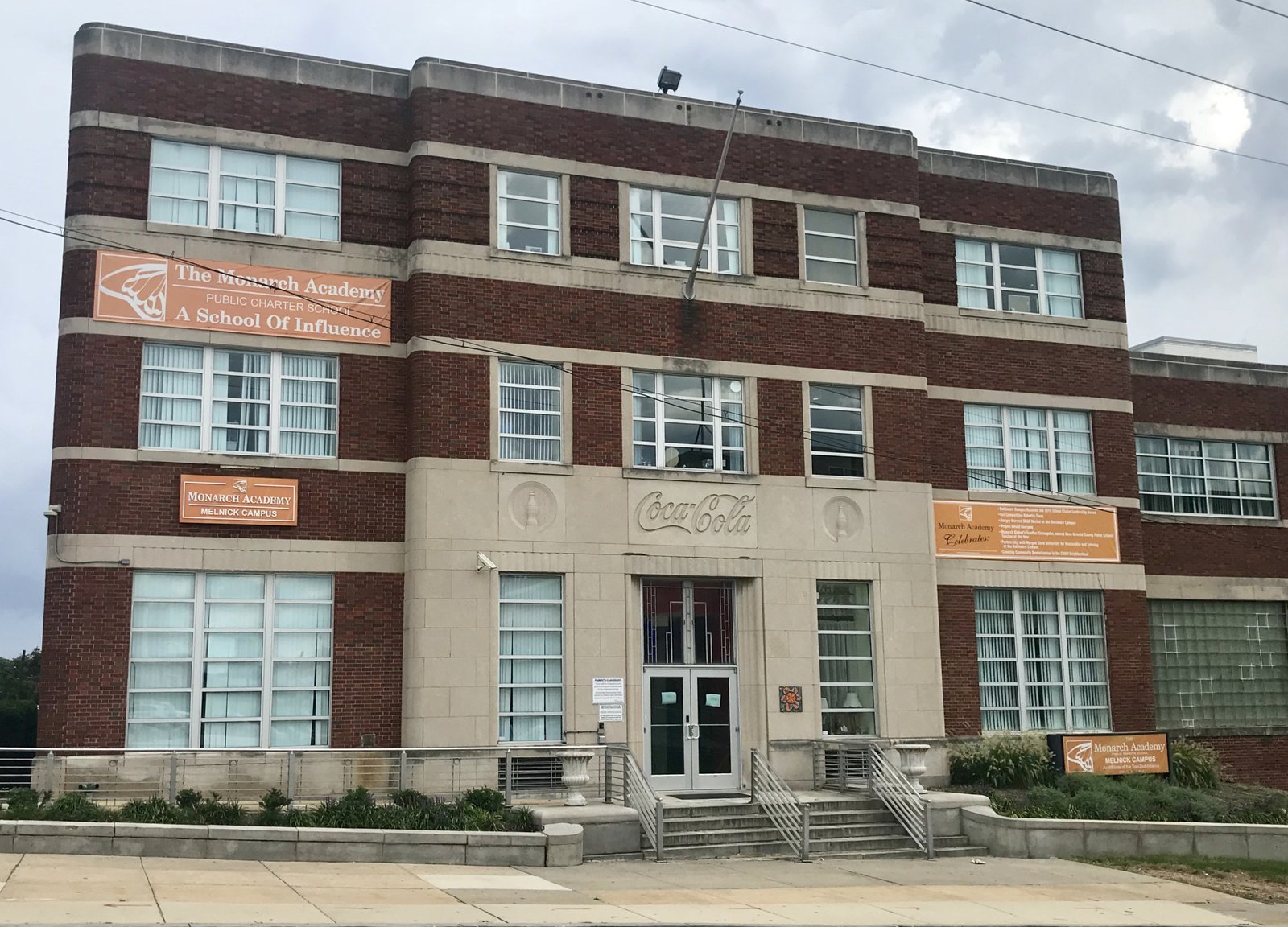
A 1939 Streamline Moderne factory on Kirk Avenue whose rounded corners, horizontal stonework bands, and stylized logo reliefs made a beverage plant into a piece of industrial sculpture.
At a glance
The Coca-Cola Bottling Plant at 2525 Kirk Avenue in Baltimore is a 1939 Streamline Moderne building whose industrial purpose never prevented it from being beautiful. Rounded corners soften the massing; horizontal bands of stonework run the full length of the facade in the manner of a streamlined railway car; and stylized relief panels bearing renditions of the Coca-Cola script logo ornament the street elevation in a vocabulary that blurs advertising into architecture. Listed on the National Register of Historic Places in 2013, the building now houses a school—a second life that has kept its Moderne shell intact and visible to Baltimore’s northeast neighborhoods.
Key facts
- Built: 1939
- Style: Streamline Moderne (Art Deco)
- Address: 2525 Kirk Avenue, Baltimore, MD 21218
- NRHP: ref. 13000847, added 23 October 2013
- Current use: School building
- Distinctive features: Rounded corners, horizontal stonework bands, Coca-Cola logo relief panels
History
The Coca-Cola Company built this bottling plant in 1939 as part of its national expansion of purpose-built production facilities. The site on Kirk Avenue placed the factory in Baltimore’s northeast industrial belt, where it could receive sugar and syrup by rail and distribute finished product by truck across the city and its suburbs. The company’s decision to commission a building of architectural ambition rather than a standard industrial shed reflected both the brand’s marketing sophistication and the broader Streamline Moderne enthusiasm of late-1930s American commercial architecture.
The plant operated as a bottling facility for decades, its roof-level Coca-Cola signage a familiar landmark in the Kirk Avenue corridor. When the company eventually consolidated operations and closed the Baltimore plant, the building passed through several uses before finding stability as a school facility. The conversion was sensitively executed: the exterior Moderne envelope, including the signature rounded corners and the logo relief panels, was preserved and remains legible today.
Recognition of the building’s architectural significance came with its National Register of Historic Places listing in 2013, an acknowledgment that industrial Moderne buildings of this quality deserve the same preservation consideration as civic and commercial landmarks of the same era.
What you see
The Kirk Avenue facade is a sustained exercise in Streamline Moderne composition. Where earlier Art Deco buildings reached for vertical energy—setbacks, spires, tower elements—the Streamline Moderne embraced horizontality as the expression of speed and modernity, a vocabulary borrowed from ocean liners, locomotives, and the aerodynamic experiments of the 1930s. The Coca-Cola plant applies all of this to a functional single-story industrial building with a frankness that makes it more interesting than many grander buildings of the period.
The rounded corners are the building’s most immediately striking feature, wrapping the facade around the street-facing angles as though the building were designed to cut through air rather than sit on a corner lot. The horizontal stonework bands reinforce the aerodynamic reading, their continuous lines resisting any reading of the building as stacked floors or independent elements. The relief panels with their Coca-Cola script are simultaneously a brand statement and a decorative program—the company using its own identity as ornament in a way that feels less corporate in retrospect than it might have seemed at the time.
Practical information
- Access: School building; exterior viewable from Kirk Avenue
- Best view: Stand at the Kirk Avenue sidewalk to see both the rounded corner and the full horizontal facade composition
- Photography: Exterior from public sidewalk freely permitted
- Time needed: 10–15 minutes for exterior
- Context: The building is in northeast Baltimore; combine with a visit to the nearby National Shrine Grotto of Our Lady of Lourdes or the Baltimore Museum of Art
Getting there
Kirk Avenue runs northeast from the Johns Hopkins Homewood campus area. From downtown Baltimore, take North Charles Street north to 25th Street, turn right (east) onto 25th Street, and continue to Kirk Avenue; the building is at number 2525. The Maryland Transit Administration Light Rail and bus routes serve the area. Baltimore–Washington International Airport is approximately 15 miles south of the site via I-95 or the MARC Camden Line train to downtown Baltimore.
Nearby
- Baltimore Museum of Art — one mile west on North Charles Street, adjacent to the Johns Hopkins Homewood campus
- Johns Hopkins University Homewood campus (1902) — Georgian Revival collegiate ensemble a ten-minute walk southwest
- Clifton Park — Frederick Law Olmsted Jr.–designed park with historic mansion, two blocks north of the plant
Sources
- Wikipedia, “Coca-Cola Bottling Plant (Baltimore)” — primary narrative source
- National Register of Historic Places, ref. 13000847 (23 October 2013)
- Wikimedia Commons, Facade_of_the_former_Coca-Cola_bottling_factory_from_Kirk_Ave,_Baltimore_MD.jpg (Quaintly, CC BY-SA 4.0)
Find it on the map
See this place and what’s around it →Record researched and written by Luigi De Marchi for Cultural Heritage Online, 2026.
📷 Become a Cultural Heritage Online photographer
Share your photos of places: they stay published under your name as the author. The more they're seen, the more you get noticed — and soon a contest will reward the most appreciated photos.
Log in or sign up free to add a photoIs this page about you?
This page is read by travellers and heritage enthusiasts who find it on Google. Tell us how you are connected to this place and we will take it from there.