
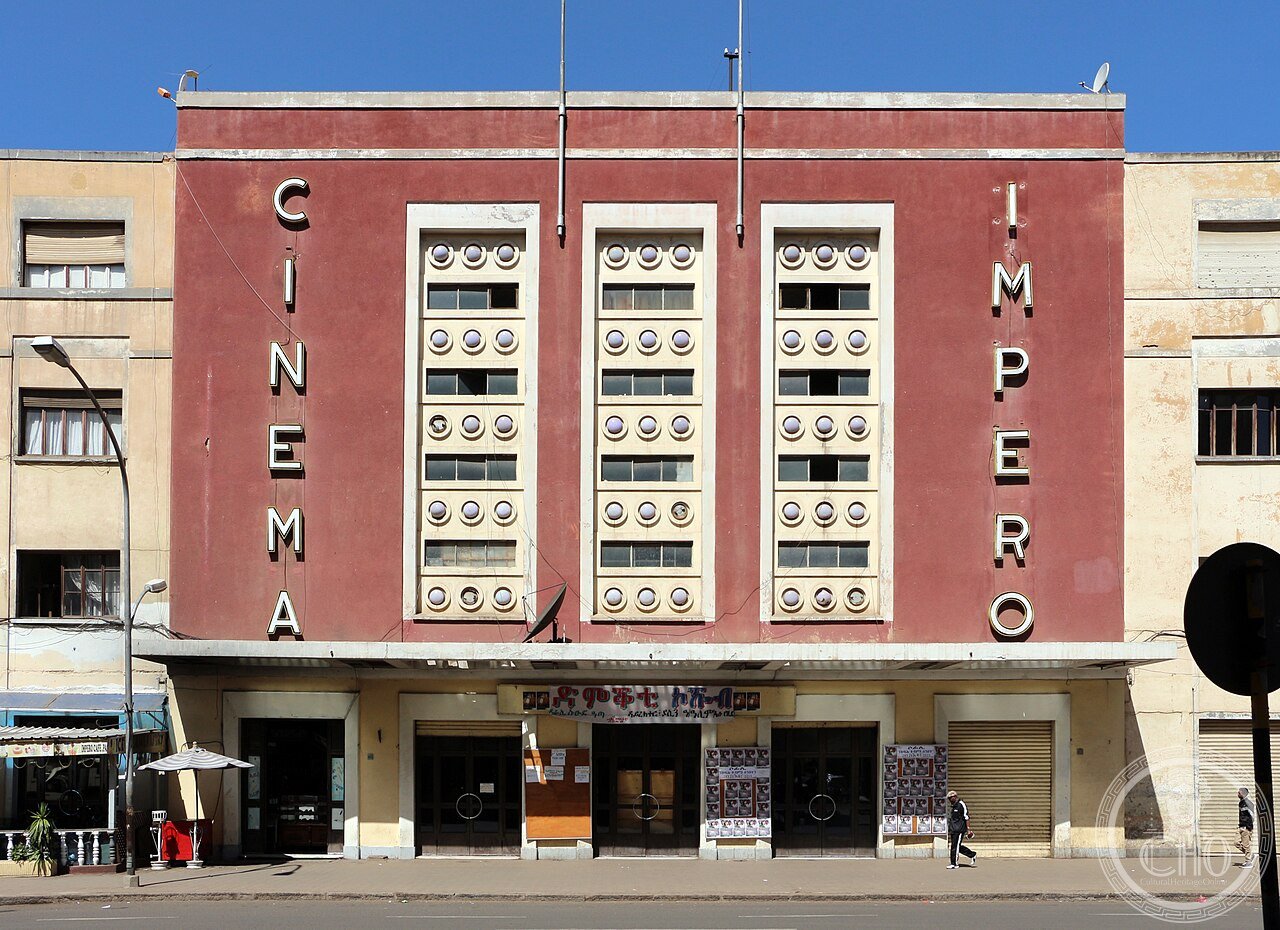
Cinema Impero is the most celebrated movie house in East Africa and the crown jewel of Asmara’s UNESCO World Heritage Art Deco district. Designed by Italian architect Mario Messina and completed in 1937 during the height of Italian colonial rule over Eritrea, the cinema was built as both cultural institution and political statement: a showcase of Italian modernity in an African colonial capital. Its name, Cinema Empire, could scarcely have been more pointed. Yet the building has survived its own politics to become one of the finest surviving examples of 1930s Art Deco cinema design anywhere in the world, with its streamlined facade, curved canopy entrance, original neon signage said to be the first neon sign ever installed in Africa, and a 2,000-seat auditorium that retains much of its original Art Deco upholstery and decorative detailing.
At a glance
- Type
- Cinema / theatre
- Period
- 1937
- Style
- Art Deco / Italian Colonial
- Location
- Asmara, Eritrea
- Coordinates
- 15.3367° N, 38.9403° E
- Architect(s)
- Mario Messina
Overview
Cinema Impero sits on Harnet Avenue, the main boulevard of Asmara’s colonial-era grid, and has been in near-continuous operation since its opening. Italian propaganda films screened here in the late 1930s; after Eritrean independence in 1993, the programming shifted to Italian classics and Eritrean productions. The auditorium, seating approximately 2,000, is one of the largest surviving Art Deco cinema interiors in sub-Saharan Africa, and its upholstery and wall treatments remain remarkably close to the original 1937 design.
History
Asmara’s transformation into a modernist showpiece accelerated after Italy’s declaration of the East African Empire in 1936. Governor Amedeo d’Aosta oversaw an ambitious building programme that produced more than 400 modernist structures in just five years, an unparalleled concentration. Cinema Impero was central to the colonial cultural project: Italian cinema was a key instrument of Fascist propaganda, and a prestige venue in the colonial capital gave the regime a platform for its messaging. After the British occupation in 1941, Ethiopian federation in 1952, and eventual Eritrean independence following a 30-year war of liberation, the cinema passed through several hands before being restored and reopened. The UNESCO inscription of Asmara’s modernist ensemble in 2017 drew international attention back to Cinema Impero as one of its defining landmarks.
Architecture & Design
The facade of Cinema Impero deploys the full repertoire of late-1930s Italian Art Deco: a flat, symmetrical front articulated by horizontal bands of render, a projecting canopy over the entrance at street level, and a tall vertical fin bearing the IMPERO sign in original neon lettering. The neon installation, reportedly the first of its kind in Africa, was itself a statement of technological modernity. The entrance foyer transitions into a double-height auditorium with Art Deco plasterwork on the walls and ceiling, curved balcony fronts, and padded seats whose fabric echoes the geometric patterns typical of the period. The projection booth and technical equipment have been updated, but the spatial sequence from street to screen preserves the 1937 design almost intact.
Cultural significance
Cinema Impero is inseparable from Asmara’s status as a UNESCO World Heritage Site, inscribed in 2017 as “Asmara: A Modernist African City,” the first modernist African city to receive the designation. For Eritreans, the cinema embodies a complex dual heritage: the physical legacy of a brutal colonialism and, simultaneously, a genuine architectural treasure that belongs to Eritrea’s own cultural identity. It features prominently in the international architectural literature on Art Deco and African modernism, and draws scholars, architects, and heritage tourists from around the world.
Visiting today
Cinema Impero is an active cinema and the best way to experience it is to attend a screening; programme details are posted at the box office and through local hotels. The facade is freely visible from Harnet Avenue at any time. Guided walking tours of Asmara’s modernist district typically include Cinema Impero alongside the Fiat Tagliero Building, the Covered Market, and the Orthodox Cathedral. Photography of the exterior is generally permitted; interior photography depends on programming schedules. Check current conditions for entry to Eritrea before planning a visit.
Getting there
Asmara International Airport (ASM) is connected to Cairo, Dubai, Frankfurt, Istanbul, and various East African destinations. Cinema Impero is located on Harnet Avenue in the city centre, approximately 3 kilometres from the airport. The building is within easy walking distance of the central post office, the main bus station, and the majority of Asmara’s other Art Deco landmarks. Shared taxis run along Harnet Avenue throughout the day and are the most convenient local transport option.
Sources & resources
Find it on the map
See this place and what’s around it →Record researched and written by Luigi De Marchi for Cultural Heritage Online, 2026.


📷 Become a Cultural Heritage Online photographer
Share your photos of places: they stay published under your name as the author. The more they're seen, the more you get noticed — and soon a contest will reward the most appreciated photos.
Log in or sign up free to add a photoIs this page about you?
This page is read by travellers and heritage enthusiasts who find it on Google. Tell us how you are connected to this place and we will take it from there.