

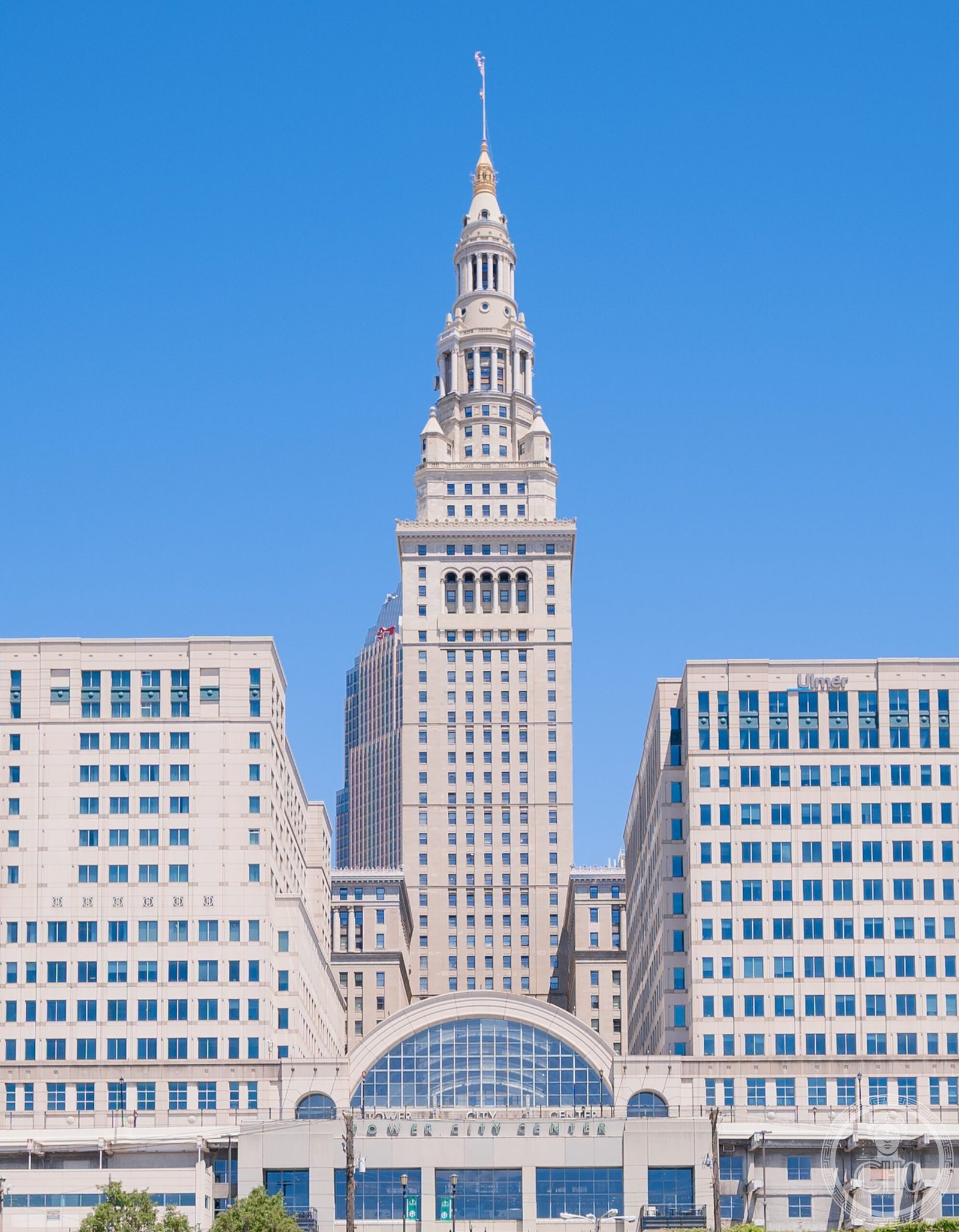

Completed in 1930 at Public Square in Cleveland and towering 708 feet above the Cuyahoga River valley, Terminal Tower was the second-tallest building in the world outside New York City at its completion — the anchor of the Van Sweringen brothers’ Terminal Group complex and the defining element of Cleveland’s skyline for six decades.
At a glance
Terminal Tower at Public Square, Cleveland, was designed by Graham, Anderson, Probst & White — the Chicago firm that had designed Union Station in Washington and the Wrigley Building — and completed in 1930 for the Van Sweringen brothers, the real estate developers whose interurban rail empire centred on the Terminal Group development below. The 52-story, 708-foot tower rises from a broad base occupied by the retail and transit concourses of Tower City Center (formerly Cleveland Union Terminal) and forms the apex of a building complex that stretches across the south side of Public Square. Clad in Indiana limestone with classical ornamental detailing, Terminal Tower is a masterpiece of the transitional Classical Moderne mode: its setback massing follows the formal logic of the New York skyscraper tradition while its limestone surfaces, carved keystones, and arched windows speak the language of the Beaux-Arts decade that preceded the Depression. The building is a National Historic Landmark.
Key facts
- Completed: 1930
- Architects: Graham, Anderson, Probst & White (Chicago)
- Developer: Oris Paxton Van Sweringen and Mantis James Van Sweringen
- Style: Classical Moderne
- Address: 50 Public Square, Cleveland, OH 44113
- Height: 708 ft (216 m) / 52 floors
- Notable: Anchor of Tower City Center (Cleveland Union Terminal); observation deck 42nd floor; Cleveland’s defining skyline landmark for 60+ years
- Designation: National Historic Landmark (1976)
History
Oris and Mantis Van Sweringen were among the most ambitious real estate operators in American history. Beginning with their development of Shaker Heights — a planned suburb east of Cleveland — in the 1900s and 1910s, the brothers built an interurban rail line to connect their suburb to downtown Cleveland, and then, as that line required terminal facilities, decided to build the most ambitious commercial and transportation complex the Midwest had ever seen. The Terminal Group development at Public Square covered sixteen acres in the heart of Cleveland’s central business district, combining a new union railroad terminal, a hotel (the Cleveland-Cattell, later the Sheraton), department stores, and the tower itself on a platform above the railroad tracks.
The design commission went to Graham, Anderson, Probst & White, the Chicago firm that had succeeded the great Daniel Burnham & Company after Burnham’s death in 1912. The firm brought to Cleveland the setback skyscraper vocabulary that its New York competitors were developing in response to the 1916 Zoning Law, combined with the classical ornamental language in which the firm was fluent. The result is a tower that reads differently from different distances: at street level, the carved limestone detailing — the keystone arches, the pilasters, the classical cornice lines of the setback floors — dominate; from a distance of half a mile or more, looking across the Cuyahoga River valley, the building reads as a pure geometric form, its setbacks creating a stepped silhouette against the sky that places it firmly in the tradition of the great American skyscrapers of the 1920s.
The Van Sweringen brothers’ empire collapsed in the Depression; the brothers died in 1935 and 1936, and the Terminal Group passed through several owners. The underground rail terminal continued to operate as a railroad station until 1977, when it was converted into Tower City Center, the retail and transit complex that now occupies the base of the building. The tower itself continues as a commercial office building. Its observation deck at the 42nd floor, which offers panoramic views of the city, Lake Erie, and on clear days across the lake to Canada, has been intermittently open to the public over the decades and has operated as a weekend tourist attraction in recent years.
What you see
The classic view of Terminal Tower is from across the Cuyahoga River to the west, where the city’s river valley provides sufficient distance to take in the tower’s full silhouette: a stepped pyramid of limestone rising from the broad base of the Terminal Group complex, the setbacks at each major floor creating a profile of controlled diminuendo. The tower’s relationship to Public Square below — the civic heart of Cleveland, originally laid out in the 1796 survey of the city — is best appreciated from the square itself, where the building’s base arcade frames the south side of the space.
Tower City Center, occupying the base structure, is accessible from Public Square or from the RTA rapid transit station below. The concourse preserves substantial elements of the original Cleveland Union Terminal interior: the arched ceiling vaults, the limestone pilasters, and the proportions of the main waiting halls survive under the retail overlay of the 1980s and 1990s conversion. The observation deck at the 42nd floor — when open — offers a 360-degree view that takes in the entire Cleveland metropolitan area, the Cuyahoga valley, and the southern shore of Lake Erie stretching east toward Erie, Pennsylvania.
Practical information
- Observation deck (42nd floor): Open weekend afternoons; small admission; check clevelandlandmarks.com for current schedule
- Tower City Center: Retail and transit concourse; free entry; connected to RTA rapid transit
- Best view: From the west bank of the Cuyahoga River (Flats area) looking east at the tower’s full profile; or from Edgewater Park on Lake Erie
- Time needed: 1 hour with tower access; 20 minutes exterior
- GPS: 41.4992° N, 81.6930° W
- Nearest transit: Tower City/Public Square RTA station (Red/Blue/Green/Orange Lines) directly below the building
Getting there
Terminal Tower is at Public Square in downtown Cleveland, at the centre of the Greater Cleveland RTA rapid transit network. Tower City/Public Square station (Red Line to airport, Blue and Green Lines east, Orange Line south) is directly below the building. Cleveland Hopkins International Airport (CLE) is approximately 12 miles south-west; the Red Line train connects the airport to Tower City in approximately 30 minutes.
Nearby
- Rock and Roll Hall of Fame (1995) — I. M. Pei; on Lake Erie waterfront; 15 minutes walk north from Public Square
- West Side Market (1912) — Hubbell & Benes; Municipal Market Hall; Beaux-Arts; Ohio City neighbourhood; 10 minutes by RTA
- Severance Hall (1931) — Walker & Weeks; home of the Cleveland Orchestra; Art Deco / Classical Moderne; University Circle; 20 minutes east
Sources
- National Park Service, NHL nomination form, Terminal Tower — nps.gov
- Johannesen, Eric. Cleveland Architecture 1876–1976. Western Reserve Historical Society, 1979.
- Rose, William Ganson. Cleveland: The Making of a City. World Publishing, 1950. Van Sweringen development history.
- HABS documentation, Cleveland Union Terminal Complex, HAER OH-26 — loc.gov
- Wikidata, Terminal Tower — wikidata.org
Find it on the map
See this place and what’s around it →📷 Become a Cultural Heritage Online photographer
Share your photos of places: they stay published under your name as the author. The more they're seen, the more you get noticed — and soon a contest will reward the most appreciated photos.
Log in or sign up free to add a photoIs this page about you?
This page is read by travellers and heritage enthusiasts who find it on Google. Tell us how you are connected to this place and we will take it from there.