
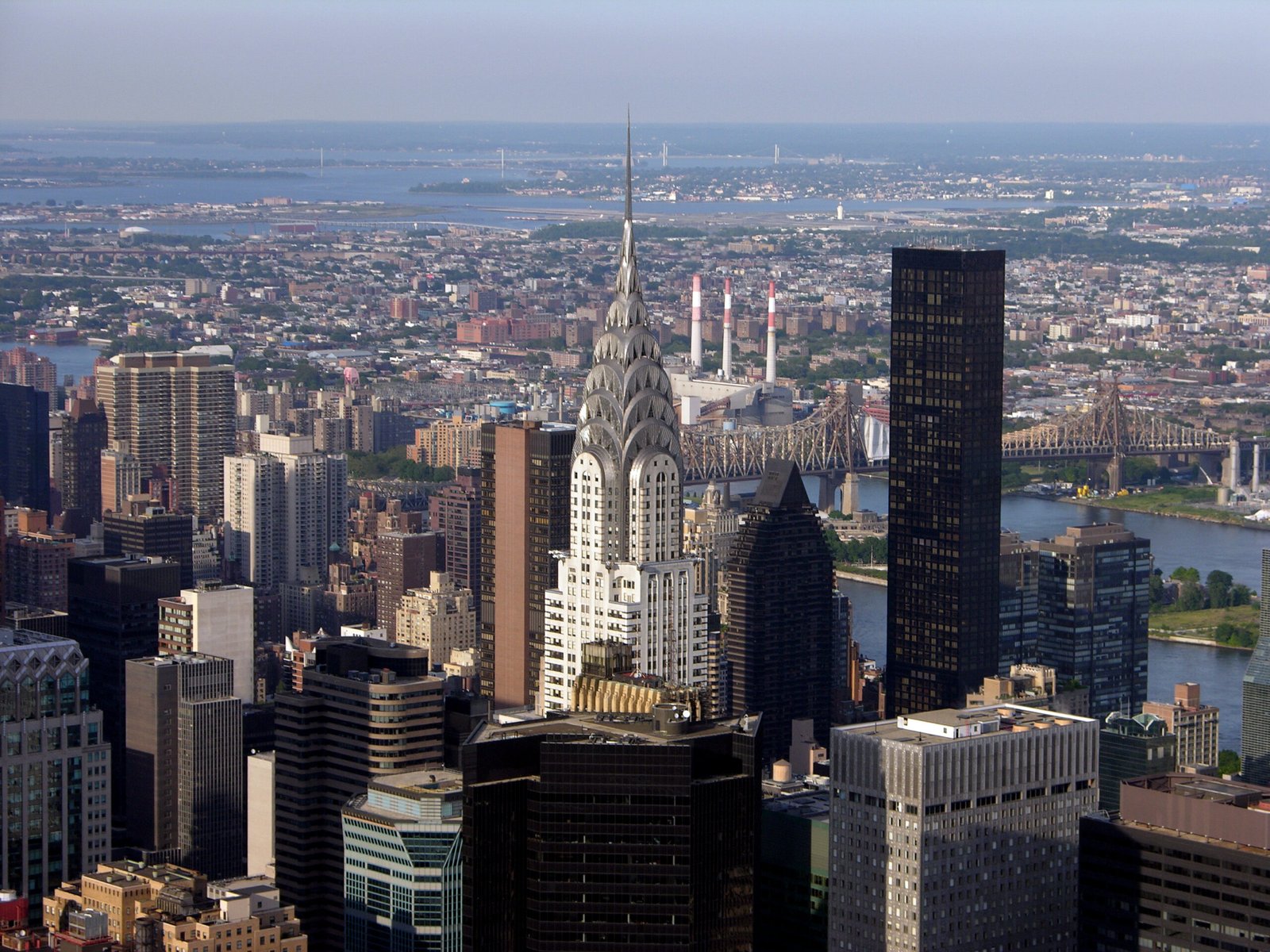
William Van Alen’s 1930 skyscraper held the title of world’s tallest for eleven months before losing it to the Empire State Building — but its stainless steel vertex and eagle gargoyles have never been surpassed for theatrical ambition.
At a glance
The Chrysler Building rises 319 metres from Lexington Avenue in Midtown Manhattan, its upper stories sheathed in Nirosta stainless steel that reflects the sky in silver arcs. Walter Chrysler commissioned the tower in 1928 as both headquarters and monument: the automobile magnate wanted a building that would stand as testimony to American industrial ambition in the most competitive skyline the world had yet seen. Architect William Van Alen delivered a structure that is quintessentially Art Déco in its celebration of speed, industry, and ornament — the eagle-head gargoyles at the sixty-first floor are direct adaptations of a 1929 Chrysler hood ornament, cast from stainless steel rather than chrome. The sunburst vertex, assembled in secret inside the building and raised through the roof in ninety minutes on 23 October 1929, added the final 38 metres that briefly made this the tallest structure on earth.
Key facts
- Completed: 1928–1930
- Architect: William Van Alen (1883–1954)
- Client: Walter P. Chrysler
- Height: 319 m (1,046 ft), 77 floors
- Style: Art Déco
- Address: 405 Lexington Avenue at 42nd Street, Midtown Manhattan, New York City
- GPS: 40.75143, -73.97572 — Open in Google Maps
- Status: Private office building; lobby open to public; no observation deck
History
William Van Alen had already built a reputation for theatrical facades when Walter Chrysler approached him in 1928, but the Chrysler Building project was complicated from the start. Van Alen’s former partner H. Craig Severance was simultaneously building the Bank of Manhattan Trust tower at 40 Wall Street, and both men knew the other’s plan. Van Alen responded by designing the secret spire — the seven-storey stainless-steel vertex that was assembled inside the topmost floors and raised through the roof as soon as the Bank of Manhattan was declared complete at 283 metres. The Chrysler Building opened at 319 metres, taking the record.
The building never paid Van Alen well. Walter Chrysler declined to pay his architect’s fee, accusing him of accepting kickbacks from contractors; the dispute was eventually settled, but Van Alen’s later career never matched the Chrysler Building’s scale or prominence. Walter Chrysler paid for the tower himself rather than through his company, so that his children would inherit it; the family sold it in 1953, and it has changed hands several times since. In 1976 the Chrysler Building was designated a National Historic Landmark and listed on the National Register of Historic Places; in 1978 it became a New York City landmark.
In 2019 a 90 percent stake in the building sold for a reported sum well below the previous owners’ purchase price — a reflection of Midtown’s changing office market. The building’s status as an architectural monument is, however, entirely undimmed.
What you see
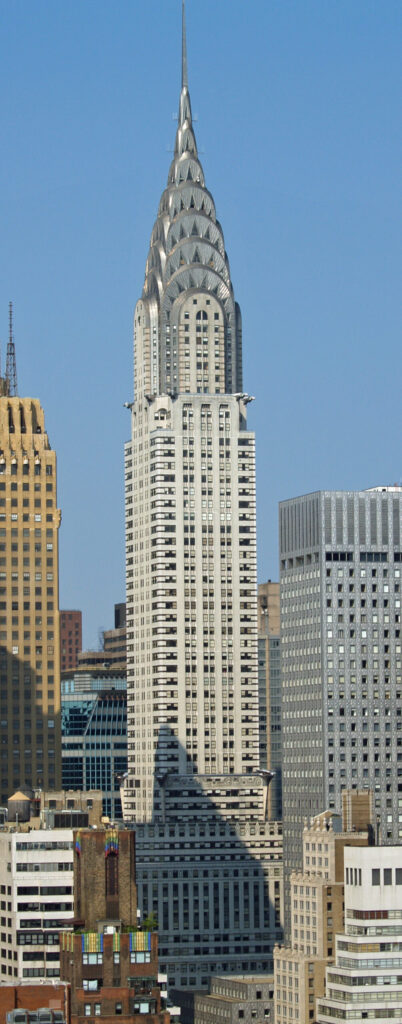
The tower steps back in seven tiers as it rises, each setback exposing another band of the white-brick and stainless-steel surface. The most dramatic feature is the vertex itself: a series of overlapping stainless arches framing triangular windows, stacked in diminishing stages to the needle point. The effect from street level is of a crown rather than a roof — or, as critics noted at the time, of a sunburst, a comet, an industrial machine set on top of a skyscraper.
At the sixty-first floor, four eagle gargoyles project from the corners — each is a Chrysler hood ornament enlarged to building scale and rendered in stainless steel. Below them, brick friezes display hubcap and mudguard motifs in terracotta. The lobby is one of New York’s most complete Art Déco interiors: floors and walls in African marble and Mexican onyx, ceiling mural by Edward Trumbull depicting transport and human industry, original elevator cabs in inlaid wood veneers.
Practical information
- Lobby access: Open to the public during office hours (typically Monday–Friday 08:00–18:00)
- Observation deck: None currently; the Cloud Club and former observation floor are not publicly accessible
- Best exterior viewing: From 42nd Street at Lexington Avenue, or from the East River (UN area) for the full silhouette
- Time needed: 20–30 minutes for the lobby; exterior viewing at any hour
- Photography: Lobby photography permitted without tripod; exterior freely
Getting there
The Chrysler Building is at the intersection of Lexington Avenue and 42nd Street in Midtown Manhattan. The nearest subway stations are Grand Central–42nd Street (4/5/6/7/S), a two-minute walk west along 42nd Street, and Lexington Avenue–51st Street (6) one block north. From JFK Airport, take the AirTrain to Jamaica and then the E train to 53rd Street–Lexington Avenue, two blocks north on foot. Radio City Music Hall is approximately a fifteen-minute walk west along 49th–50th Street, or three stops on the 6 train to 51st Street then a short walk.
Nearby
- Grand Central Terminal — Beaux-Arts transit hub (1913), two blocks west; ceiling constellation mural
- 30 Rockefeller Plaza — Art Déco tower at Rockefeller Center (1933), 15 min walk northwest, with Top of the Rock observation deck
- Radio City Music Hall — Art Déco theater (1932), 15 min walk northwest at 6th Avenue and 50th Street
Sources
- New York City Landmarks Preservation Commission: designation report for the Chrysler Building (1978)
- National Register of Historic Places and National Historic Landmark: listing for the Chrysler Building (1976)
- Museum of the City of New York: photographic and archival holdings on William Van Alen
- Chrysler Building official site and building management records
Gallery
Find it on the map
See this place and what’s around it →Record researched and written by Luigi De Marchi for Cultural Heritage Online, 2026.
📷 Become a Cultural Heritage Online photographer
Share your photos of places: they stay published under your name as the author. The more they're seen, the more you get noticed — and soon a contest will reward the most appreciated photos.
Log in or sign up free to add a photoIs this page about you?
This page is read by travellers and heritage enthusiasts who find it on Google. Tell us how you are connected to this place and we will take it from there.