

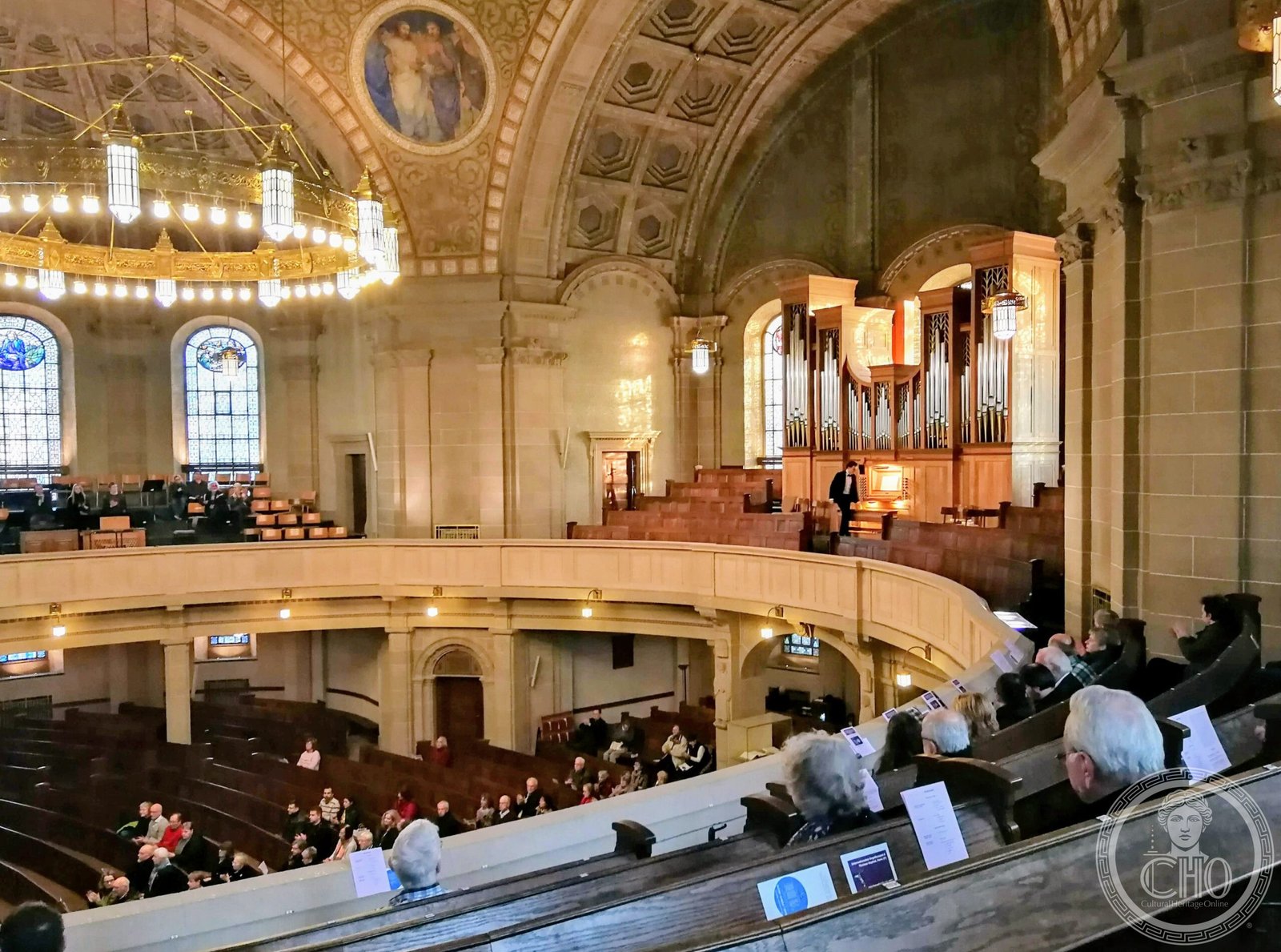
The Christuskirche in Mannheim is a Protestant church completed in 1911, rising prominently at Werderplatz in the city’s Oststadt district. Designed by Christian Schrade and consecrated under architect Theophil Frey’s competition-winning concept, the church stands 65 metres tall and represents the culmination of evangelical ecclesiastical construction in Mannheim during the late industrialisation era. Its massive sandstone dome, gilded angel crown, and eclectic blend of Neo-Baroque massing with Jugendstil ornamental detail make it one of the most recognisable skyline anchors in the Rhine-Neckar metropolitan area. The building survived the heavy Allied air raids of 1943–1944 largely intact, and remains an active place of worship as well as a beloved cultural monument.
At a glance
- Type
- Protestant parish church
- Period
- 1907–1911
- Style
- Neo-Baroque with Jugendstil elements
- Location
- Werderplatz, Oststadt, Mannheim, Baden-Württemberg, Germany
- Coordinates
- 49.4846° N, 8.4807° E
- Architect(s)
- Christian Schrade (design); Theophil Frey (competition); Emil Döring (technical supervision)
Overview
The Christuskirche occupies a commanding position at Werderplatz in Mannheim’s Oststadt, its 65-metre dome and gilded Archangel Michael figure visible from across the city. Built between 1907 and 1911 to serve a rapidly growing Protestant congregation during Mannheim’s industrial expansion, the church was consecrated on 1 October 1911. The construction cost exceeded 1.6 million marks — a substantial sum reflecting both the ambition of the commission and the elaborate craftsmanship of its sandstone facades, copper roofs, and mosaic interiors. Today it functions as an active evangelical parish church and is recognised as a landmark monument of Wilhelmine-era ecclesiastical architecture in southwest Germany.
History
Mannheim’s rapid industrialisation in the late nineteenth century drove significant population growth, creating an urgent need for new Protestant places of worship. An architectural competition was held, with Theophil Frey’s design ultimately selected and refined under the supervision of Christian Schrade. The foundation stone was laid on 9 September 1907 — chosen to coincide with the birthday of Grand Duke Friedrich I of Baden — and the finished church was inaugurated by Grand Duke Friedrich II in October 1911. During the Second World War, Mannheim suffered heavy bombing raids in 1943 and 1944, but the Christuskirche emerged largely unscathed. Subsequent restoration campaigns in the 1980s addressed weathering and structural maintenance, preserving the building’s original character.
Architecture & Design
The Christuskirche follows the principles of the Wiesbadener Programm, a late-nineteenth-century Protestant church model favouring a central, domed Kuppelbau plan where the altar and pulpit are visible from all seating. The plan comprises a circular vaulted nave with four cross arms, seated beneath a grand dome rising to 65 metres. The exterior is clad in yellow sandstone with green copper roofs, lending a warm, civic gravitas. Twelve statues of the apostles ring the tambour drum below the dome. Jugendstil decorative motifs appear in the stonework and interior ornament, softening the Neo-Baroque massing. The lantern is crowned by a gilded figure of Archangel Michael, a landmark that defines the Oststadt skyline. Interior capacity is approximately 1,700 persons.
Cultural significance
The Christuskirche is widely regarded as the finest Protestant church built in Mannheim during the Wilhelmine period, embodying the civic and ecclesiastical ambitions of a city at the height of its industrial prosperity. Its survival through the Second World War, when much of central Mannheim was destroyed, has given it an added resonance as a symbol of continuity. The building’s blend of Neo-Baroque monumentality and Jugendstil detail is characteristic of a transitional moment in German ecclesiastical architecture, bridging historicist tradition and early modernist ornament. It is a listed heritage monument (Kulturdenkmal) in Baden-Württemberg and continues to anchor public life in the Oststadt neighbourhood.
Visiting today
The Christuskirche is an active evangelical parish church and is open to visitors during regular church hours. Guided tours and musical events are organised periodically by the congregation; the building’s exceptional acoustics make it a venue for organ concerts and choral performances. The surrounding Werderplatz provides a pleasant setting to view the exterior facades. Visitors are asked to respect ongoing services and to dress modestly inside the church.
Getting there
The church is located in Mannheim’s Oststadt, a short walk from the city centre grid. It is accessible by Mannheim’s tram network — the nearest stops are on the lines serving Wasserturm and the Oststadt corridor. By car, Mannheim is served by the A6 and A67 motorways; parking is available in the surrounding streets and at nearby city car parks. Mannheim Hauptbahnhof connects the city to Frankfurt, Stuttgart, and Heidelberg by rail, with frequent regional and intercity services.
Sources & resources
Find it on the map
See this place and what’s around it →Record researched and written by Luigi De Marchi for Cultural Heritage Online, 2026.
📷 Become a Cultural Heritage Online photographer
Share your photos of places: they stay published under your name as the author. The more they're seen, the more you get noticed — and soon a contest will reward the most appreciated photos.
Log in or sign up free to add a photoIs this page about you?
This page is read by travellers and heritage enthusiasts who find it on Google. Tell us how you are connected to this place and we will take it from there.