
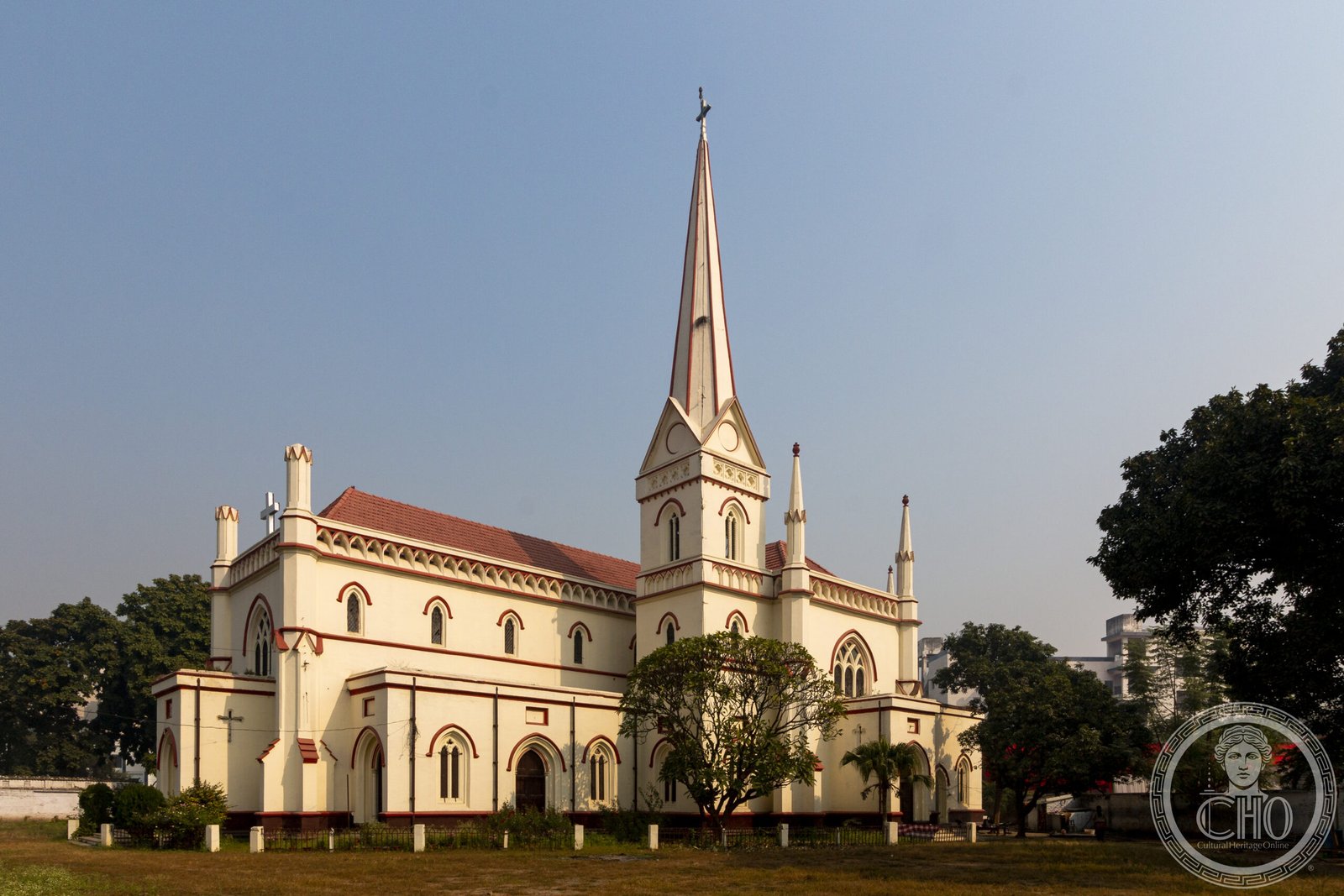
On Mahatma Gandhi Marg, in the Hazratganj district of Lucknow, in Uttar Pradesh, Christ Church, sometimes called the “Martyrs’ Memorial Church”, was built between 1858 and 1860 and consecrated on 26 November of that year by Bishop George Cotton. It is in Gothic style, on a cruciform plan, with about twenty spires and pinnacles, and was built by the Royal Engineers. The architect’s name, given by some tourist sources as an unspecified “General Hutchinson”, is not confirmed by a primary source. An earlier church had already been built in the Mariaon cantonment, with permission granted in 1837 and completion in 1842, holding ninety people, under the chaplain Henry Polehampton. That building was destroyed by the rebels in 1857, during the Indian uprising, and abandoned. A widespread inaccuracy online, repeated even by some encyclopedia entries, needs correcting: the present Christ Church, completed in 1860, was built three years after the siege of 1857 and therefore cannot be the building that endured it, as is sometimes wrongly reported. The building actually besieged, now in ruins, with a cemetery of about two thousand graves including that of Sir Henry Lawrence, is the separate church of St Mary’s, at the Lucknow Residency. The correct and verifiable link between Christ Church and the events of 1857 is therefore that of a memorial built afterwards in memory of the British dead of the uprising, as confirmed by the plaques and memorial tablets kept inside. Lucknow has no Anglican cathedral of its own: the seat of the diocese of the Church of North India that includes the city, All Saints Cathedral, is in Prayagraj (Allahabad). Today Christ Church is both an active church, with a capacity of about one hundred and thirty people, and the home of Christ Church College, a school affiliated to the CISCE founded in 1878 by H. McConoghey, which today has around two thousand five hundred students.
About the Church
Christ Church, on Mahatma Gandhi Marg in Lucknow’s Hazratganj district, was built 1858–1860 and consecrated as a memorial to those killed in the 1857 uprising — distinct from the actual besieged church at the Residency, St Mary’s, now a ruin nearby.
Key facts
- 1837/1842: an earlier church at Mariaon cantonment, destroyed by rebels during the 1857 uprising.
- 1858–1860: current Gothic-style Christ Church built as a memorial to the uprising’s British dead.
- 26 November 1860: consecrated by Bishop George Cotton.
- Not the church that endured the 1857 siege — that was St Mary’s, a separate, now-ruined church at the Residency.
- 1878: Christ Church College founded on the same site by H. McConoghey.
- Lucknow has no Anglican cathedral of its own; the diocesan cathedral, All Saints, is in Prayagraj.
History
Built in the years immediately following the 1857 uprising to honor British dead of the conflict, Christ Church is often mistakenly described in tourist and even some encyclopedic sources as the church that survived the siege itself — a role that actually belongs to the nearby, now-ruined St Mary’s Church at the Lucknow Residency. Christ Church’s own predecessor, at Mariaon cantonment, was destroyed during the uprising, but the building standing today was constructed only after the fighting ended, as a purpose-built memorial.
What you see
A cream-plastered Gothic Revival church with a tall spire and roughly twenty pinnacled turrets, its cruciform plan and arched windows built by Royal Engineers in the years following the 1857 uprising.
Practical information
- Opening hours: generally open outside services; check current hours before visiting, as the site also functions as an active school campus.
- Address: Christ Church College, Mahatma Gandhi Marg (Park Road), Hazratganj, Lucknow, Uttar Pradesh 226001, India.
Getting there
The church stands in Lucknow’s Hazratganj district. GPS: 26.8450°N, 80.9475°E.
Nearby
- The Residency, Lucknow — the ruined complex including St Mary’s Church, the building actually besieged in 1857, with its historic cemetery.
Sources
- Wikipedia — “Christ Church, Lucknow,” “The Residency, Lucknow,” “Diocese of Lucknow (Church of North India)”
- Tornos India — “Christian Community & Churches of Lucknow”
Find it on the map
See this place and what’s around it →📷 Become a Cultural Heritage Online photographer
Share your photos of places: they stay published under your name as the author. The more they're seen, the more you get noticed — and soon a contest will reward the most appreciated photos.
Log in or sign up free to add a photo