

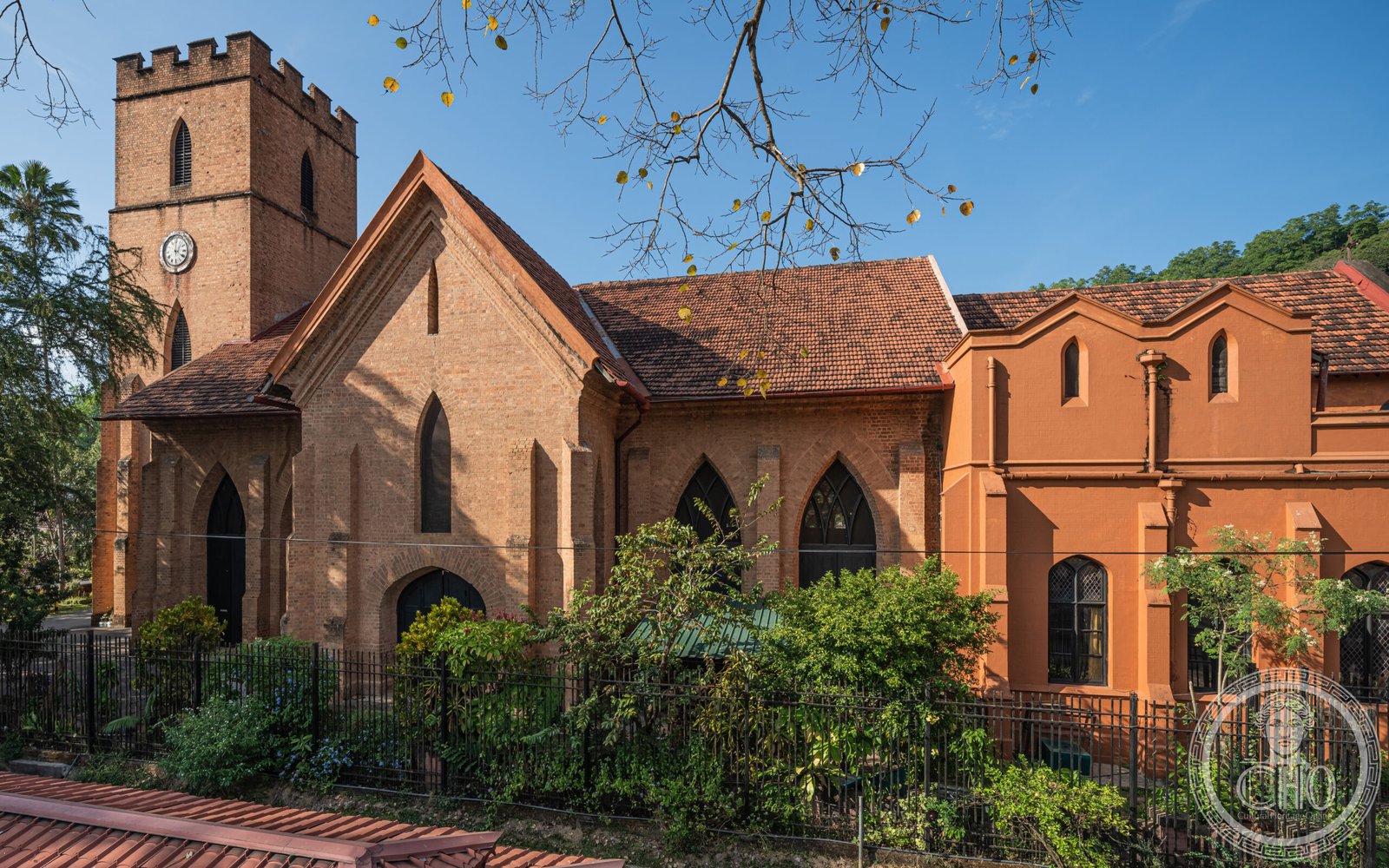
On Deva Veediya, in Kandy, Sri Lanka, St. Paul’s Anglican Church stands on a plot known as “Alakolamediththa”, crown land ceded by the British government in 1843, directly adjacent to the Temple of the Sacred Tooth and the old Audience Hall of the Kandyan royal palace. The origin of the project goes back, according to sources not fully confirmed by a primary source, to an 1825 visit by the Bishop of Calcutta, Reginald Heber, who is said to have attended Anglican services held in the very same royal Audience Hall. The foundation stone was laid on 16 March 1843 by the Bishop of Madras, George Spencer. The building was already in use for worship from 10 August 1846, though work continued, with a completion date not reconciled between sources, variously given as between 1848 and 1852. Consecration took place on 25 January 1853, the feast of the conversion of Saint Paul, by James Chapman, the first Bishop of Colombo. The name of the architect is not documented; the sources cite only the building firm, “Affleck and Gordon, Engineers”. The building, in neo-Gothic style, was built in terracotta bricks produced by government kilns. An 1878 extension added a chancel, vestry and organ chamber; between 1926 and 1928 the eastern section was rebuilt, with a fifty-seat chapel of Our Lady dedicated in August 1928. The present pipe organ, installed in 2009 and brought from Bradford, in England, is described, according to a source not found elsewhere, as perhaps the largest pipe organ still in regular use in Sri Lanka; an earlier organ had been donated in 1874. The church is the seat of a parish of the Anglican diocese of Kurunegala, not that of Colombo, and was declared a protected archaeological monument of Sri Lanka on 8 July 2005. Although its physical adjacency to the Temple of the Sacred Tooth complex is well documented — the church stands immediately west of the temple, next also to a Hindu shrine dedicated to Pattini, in what one source describes as an expression of religious harmony among Christians, Buddhists and Hindus in the same small quarter — the building’s actual inclusion within the inscribed perimeter of the UNESCO site “Sacred City of Kandy” is not confirmed, its official description appearing to refer to the eastern quadrant of the historic town core.
About the Church
St. Paul’s Church, on Deva Veediya in Kandy, Sri Lanka, is an Anglican parish church of the Diocese of Kurunegala, built on former royal Kandyan land ceded by the British in 1843, immediately adjacent to the Temple of the Sacred Tooth Relic. It was consecrated in 1853 and remains a protected archaeological monument.
Key facts
- 16 March 1843: foundation stone laid by George Spencer, Bishop of Madras, on former royal Kandyan palace land.
- 10 August 1846: first used for worship while construction continued.
- 25 January 1853: consecrated by James Chapman, first Bishop of Colombo.
- 1878 / 1926–1928: chancel, vestry and organ chamber added, followed by a rebuilt eastern section and Lady Chapel.
- 8 July 2005: declared a Protected Archaeological Monument of Sri Lanka.
- Belongs to the Anglican Diocese of Kurunegala, not Colombo.
History
Built on Crown land ceded from the former Kandyan royal palace complex, St. Paul’s rose immediately beside the Temple of the Sacred Tooth Relic in the 1840s and 1850s, its consecration in 1853 marking a settled Anglican presence in what had recently been the ceremonial heart of the Kandyan kingdom. Expanded in stages through 1928 and formally protected as a monument since 2005, it stands today as part of a small cluster of Christian, Buddhist and Hindu places of worship sharing the same historic ground.
What you see
A red-brick Neo-Gothic church with a castellated tower, built from government-produced terracotta bricks, its eastern end rebuilt in the 1920s to include a small Lady Chapel.
Practical information
- Opening hours: generally open daily outside services; check current hours before visiting.
- Address: Deva Veediya, Kandy 20000, Sri Lanka.
Getting there
The church stands on Deva Veediya in Kandy, immediately west of the Temple of the Sacred Tooth Relic. GPS: 7.2945°N, 80.6397°E.
Nearby
- Temple of the Sacred Tooth Relic — Kandy’s principal Buddhist shrine, immediately adjacent.
- Pattini Devalaya — a nearby Hindu shrine sharing the same historic precinct.
Sources
- Wikipedia — “St. Paul’s Church, Kandy”
- AmazingLanka.com and Lankapradeepa.com — church history and architectural detail.
- OpenStreetMap/Nominatim — location data.
Find it on the map
See this place and what’s around it →📷 Become a Cultural Heritage Online photographer
Share your photos of places: they stay published under your name as the author. The more they're seen, the more you get noticed — and soon a contest will reward the most appreciated photos.
Log in or sign up free to add a photo