
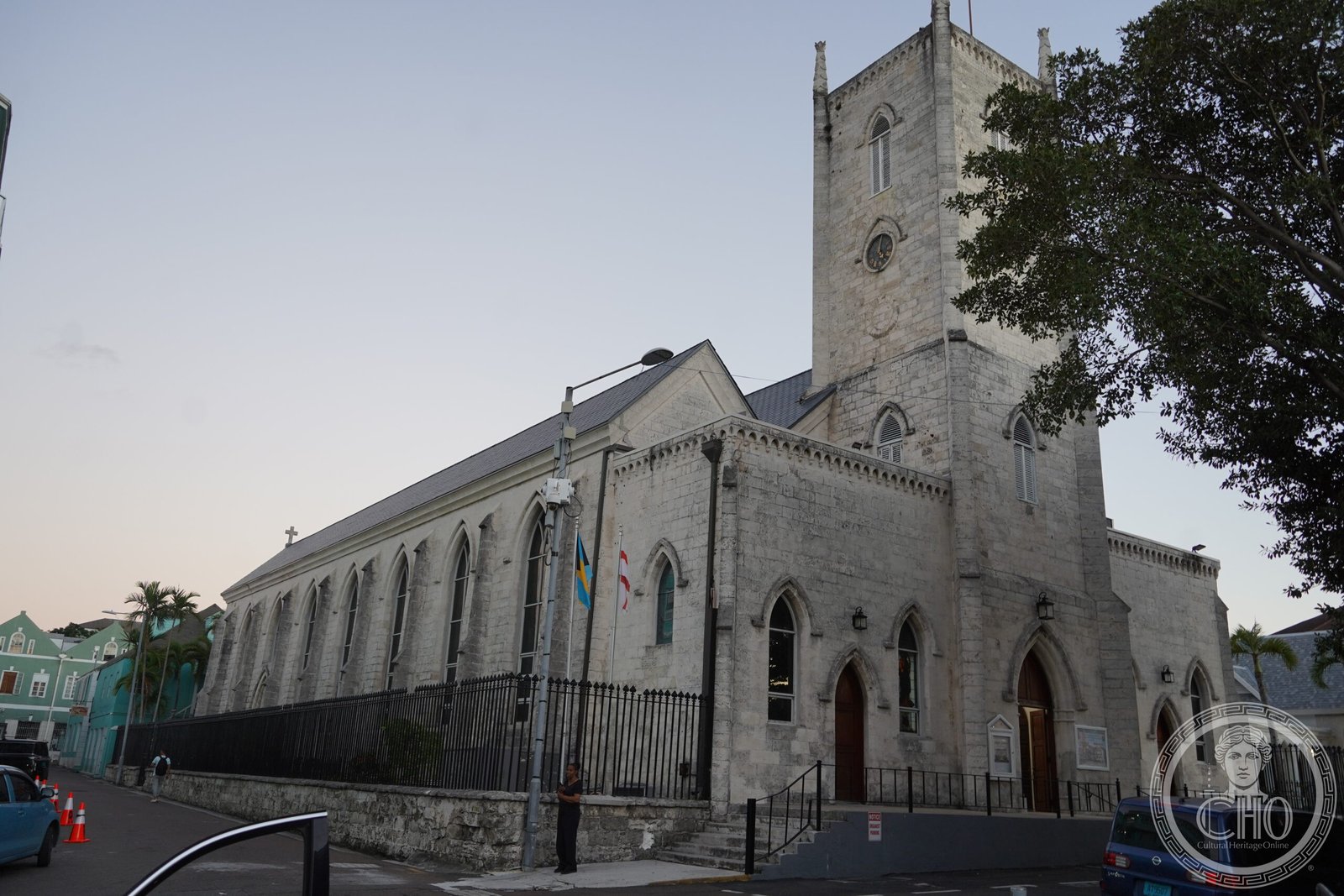
In Nassau, the capital of the Bahamas, the present cathedral is the fifth building to stand on the same site. The first, built between 1670 and 1684, was destroyed by the Spanish in 1684. The second, completed by 1695, was destroyed in 1703 during the Franco-Spanish raid on Nassau, a colonial military operation in the War of the Spanish Succession, not a pirate attack. No source attributes damage to the church during Nassau’s so-called “pirate republic” (roughly 1706-1718, the age of Blackbeard and the “Flying Gang”). On the contrary, the church was absent for the whole period, since the third building, in wood, was completed only in 1724, six years after Governor Woodes Rogers ended the era of piracy in 1718: the town of the most famous pirates in history literally had no church for its entire existence. The fourth building, in local limestone, was built in 1754, with a spire added in 1774 and replaced by a square tower in 1830 because of decay. The present, fifth building had its foundation stone laid in 1837 by Governor Sir Francis Cockburn, opened for worship in 1841 and was extended eastwards in 1861 to form the present chancel, the same year in which it became a cathedral, coinciding with Nassau’s elevation to a city. The first bishop, Charles Caulfield, was however consecrated at Lambeth Palace, in London, on 24 November 1861, not in the cathedral itself. Nor is any specific link documented between the building and the Loyalists who arrived after the American Revolution, although such a link is well documented for the nearby, and different, St. Matthew’s Church. In Gothic style, with blocks of local limestone held together mainly by their own weight rather than by mortar, and a vaulted mahogany ceiling with beams worked by shipbuilders, the cathedral lost its original stained glass in a fire in 1942. The replacements, the work of M. Fassi-Cadet of Nice, were donated in 1949 by Charles Munroe in memory of his son, Lieutenant Logan Munroe, who fell in the Second World War. The present organ, built by the German firm Gebr. Oberlinger, was installed in 1986, with three manuals, 64 stops and about 3,200 pipes. The tower clock, made by the London firm Thwaites and Reed in 1926, replaced earlier mechanisms of 1796 and 1865 that once regulated the hours for selling alcohol in town. Despite circulating promotional claims that the British royal family always visits the cathedral on its trips to the Bahamas, no primary source confirms a specific, dated visit to the building, nor is any hurricane damage to this specific structure documented, despite the devastation suffered by Nassau’s churches in the cyclones of 1926 and 1929. The Anglican diocese of Nassau was established on 4 November 1861; the present bishop is the Right Reverend Laish Z. Boyd Sr., in office since 2009.
About Christ Church Cathedral
In Nassau, the Bahamas, the current cathedral is the fifth building on this site. The first, built 1670-1684, was destroyed by the Spanish in 1684; the second, completed by 1695, was destroyed in the 1703 Franco-Spanish raid on Nassau, a colonial military operation during the War of the Spanish Succession, not a pirate attack. No source attributes any damage to the church during Nassau’s “pirate republic” era (roughly 1706-1718, the time of Blackbeard and the “Flying Gang”) — in fact, the church stood absent for that entire period, since the third building, made of wood, was only completed in 1724, six years after Governor Woodes Rogers ended the age of piracy in 1718.
Key facts
- 1703-1724: no church stands on the site — spanning the entire pirate republic era.
- 1837-1841: the current, fifth building constructed under Governor Sir Francis Cockburn.
- 1861: extended and elevated to cathedral status as Nassau becomes a city.
- 1942: a fire destroys the original stained glass, replaced in 1949.
- 1986: a German-built Oberlinger organ, 64 ranks and roughly 3,200 pipes, installed.
- No documented royal visit or hurricane damage specific to this building, despite popular claims.
History
The fifth church to stand on this site, Christ Church Cathedral was literally absent from Nassau during the town’s most famous historical episode — the pirate republic of Blackbeard and the Flying Gang, which ran its course entirely in the gap between the church’s 1703 destruction and its 1724 rebuilding. Elevated to cathedral status in 1861 as Nassau became a city, it has weathered a 1942 fire and centuries of Bahamian hurricanes, though no documented storm damage or verified royal visit ties specifically to this building despite what tourism accounts sometimes claim.
What you see
A Gothic structure of locally quarried limestone, its blocks held together largely by weight rather than mortar, rises beneath a vaulted mahogany ceiling with beams shaped by shipbuilders. Its tower clock, installed in 1926, once regulated the town’s liquor-sale hours, while its stained glass, replaced after a 1942 fire, memorializes a local family’s son lost in the Second World War.
Practical information
- Opening hours: generally open daily outside services; check current hours before visiting.
- Address: corner of George Street and King Street, Nassau, New Providence, Bahamas.
Getting there
The cathedral stands at the corner of George Street and King Street in downtown Nassau. GPS: 25°04′38″N, 77°20′39″W.
Nearby
- St. Matthew’s Anglican Church — Nassau’s other historic Anglican church, with a genuinely documented Loyalist-era connection.
Sources
- christchurchbahamas.org — official cathedral history pages (“About” and “Our Cathedral”).
- Anglican Diocese of The Bahamas and The Turks and Caicos Islands — official site (bahtcianglican.org).
- Wikipedia — “Raid on Nassau” and “Flying Gang”
- Wikipedia — “1926 Nassau hurricane” and “1929 Bahamas hurricane”
Find it on the map
See this place and what’s around it →📷 Become a Cultural Heritage Online photographer
Share your photos of places: they stay published under your name as the author. The more they're seen, the more you get noticed — and soon a contest will reward the most appreciated photos.
Log in or sign up free to add a photo