
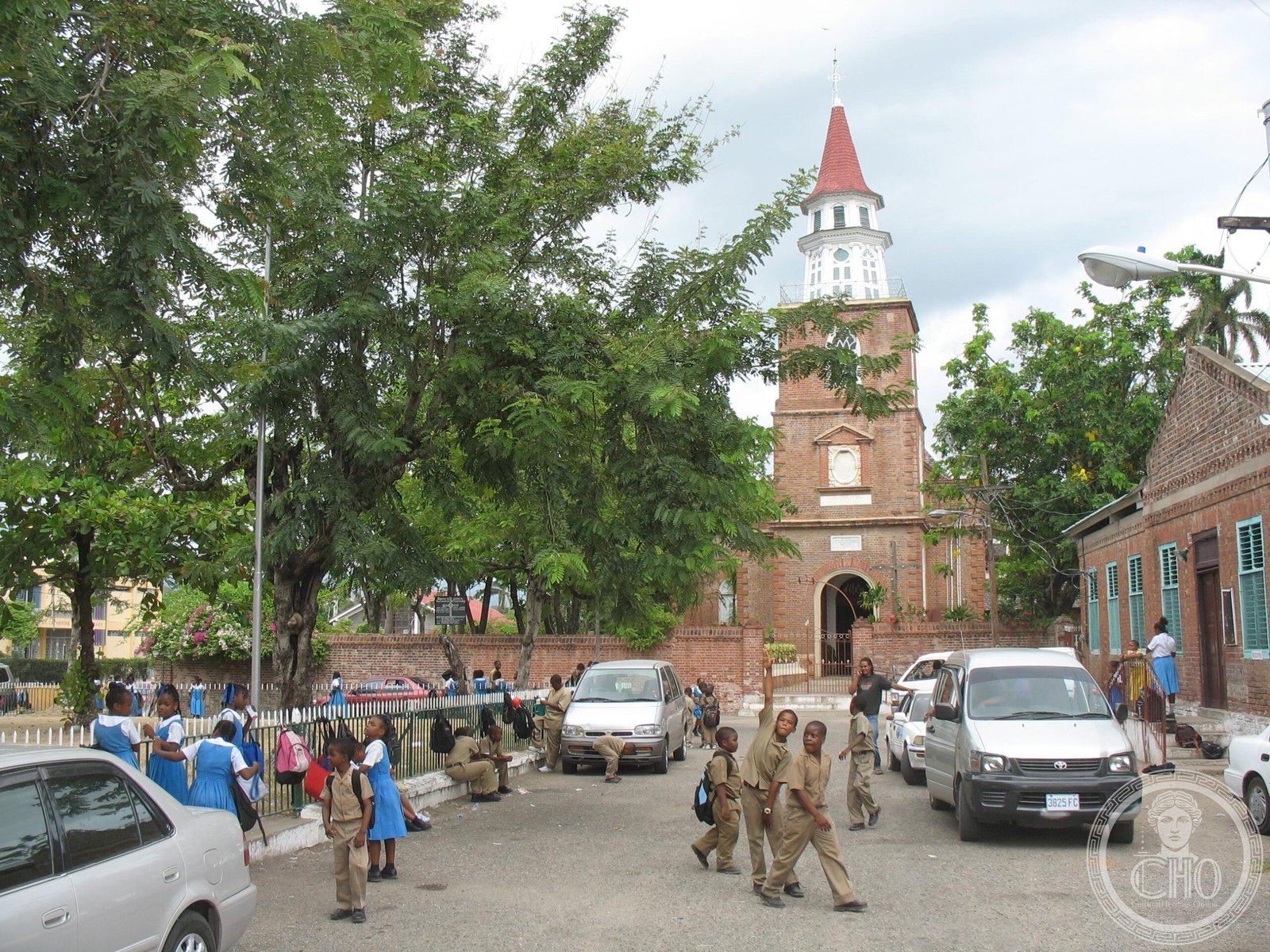
In Spanish Town, then the capital of Jamaica, a Spanish Catholic church known as the chapel or church of the «Red Cross» stood on the site at least from the Twenties or Thirties of the sixteenth century, according to sources that vary between 1525 and 1538. After the English conquest of Jamaica in 1655 the Spanish building was destroyed, and an Anglican church was built on its ruins between 1661 and 1664, according to the Anglican diocese of Jamaica. Some sources give a destruction in 1665 instead, probably a transcription error for 1655. That first English church was in turn destroyed by a hurricane in 1712, and the building standing today, with nave and transept in the Romanesque style and round arches, was rebuilt and dedicated in 1714, in the reign of Queen Anne. A single government source wrongly speaks of an earthquake in 1714, against the other sources, which agree on the hurricane of 1712. A bell tower was added in 1817, one of the few spired towers in the Caribbean, while the choir was rebuilt in the Gothic style, with pointed arches, in 1848, creating the contrast between the two building campaigns that can be seen today. The cathedral is often described, by the Anglican diocese itself, as the oldest Anglican cathedral outside the British Isles, although the diocese uses the word «perhaps» for the related claim that it holds the oldest site of continuous Christian worship in the hemisphere. The building became a cathedral only in 1843, under Bishop Aubrey Spencer, while the Anglican diocese of Jamaica had been established on 24 July 1824 by letters patent of King George IV, covering at that time the Bahamas and British Honduras as well. Spanish Town, founded as Villa de la Vega around 1534, remained the capital of Spanish Jamaica until 1655 and then of English Jamaica until 1872, when the capital was moved to Kingston. Inside, many monuments commemorate governors and colonial figures, among them, according to sources that would deserve further cross-checking, Governor Thomas Howard, Earl of Effingham, with a monument by the celebrated English sculptor John Bacon, who made three works in the cathedral. No specific event of restoration or recent damage to the building is documented in the sources consulted, nor is it possible to confirm with certainty the name of the present bishop of the diocese, given the conflicting sources on this point.
About St. Jago de la Vega Cathedral
In Spanish Town, then the capital of Jamaica, a Spanish Catholic church known as the Chapel or Church of the Red Cross stood on this site at least since the 1520s or 1530s, sources disagreeing on the exact year. After the English conquest of Jamaica in 1655, the Spanish building was destroyed and an Anglican church was built on its ruins between 1661 and 1664, per the Anglican Diocese of Jamaica; some sources instead cite a destruction in 1665, likely a transcription error for 1655.
Key facts
- 1655: the Spanish Catholic church destroyed following the English conquest of Jamaica.
- 1714: the current building constructed after a 1712 hurricane destroyed its predecessor.
- 1817: a bell tower added, one of the few steeples found in the Caribbean.
- 1848: the chancel rebuilt in Gothic style, contrasting with the 1714 Romanesque nave.
- 1843: designated a cathedral under Bishop Aubrey Spencer.
- Widely described, including by the diocese itself, as the oldest Anglican cathedral outside the British Isles.
History
Built on the ruins of a Spanish Catholic church destroyed by the English themselves after their 1655 conquest of Jamaica, this cathedral’s current form dates only to 1714, after a hurricane destroyed the first Anglican-era building. Only designated a cathedral in 1843, it nonetheless carries a claim, repeated even by its own diocese, to being the oldest Anglican cathedral outside the British Isles — a claim about its institutional seniority as a cathedral, distinct from separate claims about the world’s oldest surviving Anglican church buildings elsewhere in the Caribbean and Atlantic.
What you see
A Romanesque nave and transept from 1714, with rounded arches and classical quoins, meets a Gothic chancel rebuilt in 1848 with pointed arches — a visible seam between two building campaigns more than a century apart. A 1817 steeple tower, rare in the Caribbean, rises above an interior filled with marble memorials to colonial governors and notables, including work by the English sculptor John Bacon.
Practical information
- Opening hours: generally open daily outside services; check current hours before visiting.
- Address: Barrett Street, Spanish Town, Saint Catherine Parish, Jamaica.
Getting there
The cathedral stands on Barrett Street in Spanish Town, Jamaica’s former colonial capital. GPS: 17°59′40″N, 76°57′07″W.
Nearby
- Spanish Town’s main square — home to a separate statue of Admiral George Rodney by sculptor John Bacon, whose other work appears inside the cathedral.
Sources
- Anglican Diocese of Jamaica and the Cayman Islands — official history page (anglicandioceseja.org).
- Jamaica National Heritage Trust — heritage listing for St. Jago de la Vega Cathedral.
- Wikipedia — “Spanish Town” (en.wikipedia.org).
- jamaica55.gov.jm — Jamaican government commemorative heritage page.
Find it on the map
See this place and what’s around it →📷 Become a Cultural Heritage Online photographer
Share your photos of places: they stay published under your name as the author. The more they're seen, the more you get noticed — and soon a contest will reward the most appreciated photos.
Log in or sign up free to add a photo