
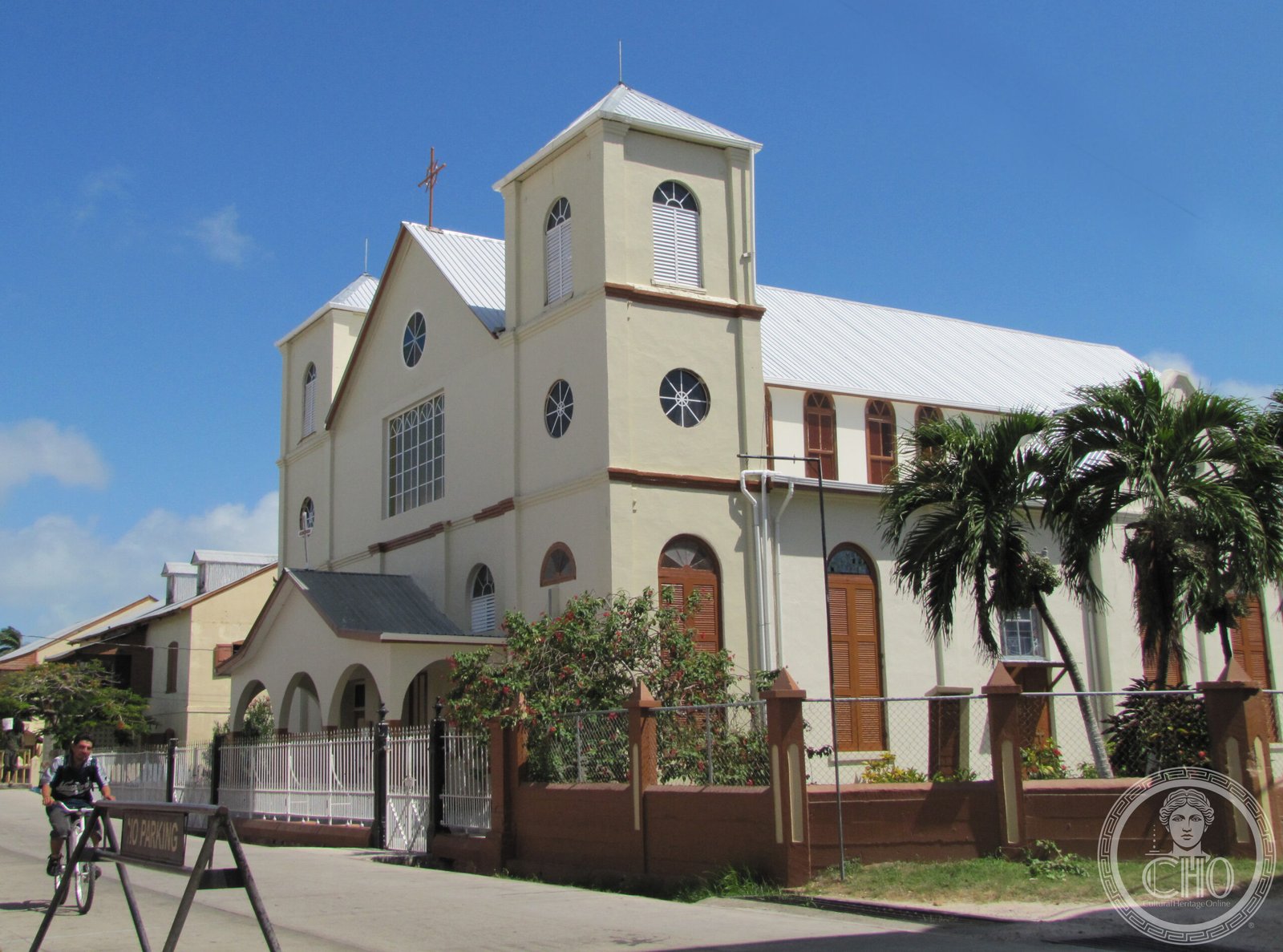
In Belize City, the Jesuit mission in British Honduras was established in 1851, with Father Eustace du Peyron, S.J., arriving from Jamaica as the first resident Jesuit, charged with having a church, a rectory and a school built: this is the origin of the parish of the Holy Redeemer. A first church, built in 1853, was destroyed on 17 July 1856 by the «Great Northside Fire» that swept the northern quarter of the city. Work on the present building began in 1857 on the same site and the new church was blessed in 1858, built of brick recovered largely from the ballast of the sailing ships that carried logwood and mahogany to England, with interior elements of local mahogany. The two original towers were crowned by onion domes in Byzantine style, replaced by pyramidal spires in the early years of the twentieth century. Side chapels and altars were added in 1862, a clerestory in 1888, and a major building campaign ran between 1924 and 1929 under Bishop Murphy, with Father Tenk, S.J., as builder. The sanctuary was enlarged in 1893 in view of cathedral status, and the church was consecrated as a cathedral, dedicated to the Holy Redeemer, in 1894. The ecclesiastical circumscription was erected as the apostolic prefecture of British Honduras on 10 June 1888, raised to an apostolic vicariate in 1893, renamed apostolic vicariate of Belize on 15 December 1925, raised to the diocese of Belize on 29 February 1956 with David Francis Hickey, S.J., as first bishop, renamed diocese of Belize City and Belmopan in 1970, after Belmopan became the capital, and finally diocese of Belize City-Belmopan on 31 December 1983. The church of Our Lady of Guadalupe in Belmopan became a co-cathedral in 1970, while Holy Redeemer remains the principal seat of the diocese. The see is vacant today: Bishop Lawrence Sydney Nicasio led the diocese from 26 January 2017 until his death on 1 January 2024, and no successor has been appointed. Hurricane Hattie, which on 31 October 1961 devastated Belize City as a category 4 storm, damaging about 70 per cent of the buildings in the city and leaving more than 10,000 people homeless, and leading to the decision to move the capital to the new city of Belmopan, also destroyed the wooden floor of the cathedral, later replaced with concrete and tiles, along with numerous stained-glass windows and a monument to the first bishop of the diocese. No structural damage to walls, roof or towers is documented. No specific documented link exists between the building and the colonial history of British Honduras, the independence of Belize in 1981, or the territorial dispute with Guatemala. Pope John Paul II visited Belize in 1983, the first papal visit to the country, an event associated with the cathedral in the chronology kept by the parish itself, although the specific details of his presence in the building are not confirmed. In April 2001 Bishop Osmond Peter Martin opened the Monsignor Facundo Castillo Diocesan Centre, next to the cathedral, alongside a restoration campaign whose exact extent is not documented.
About Holy Redeemer Cathedral
In Belize City, the Jesuit mission in British Honduras was established in 1851, with Fr. Eustace du Peyron, S.J., arriving from Jamaica as the first resident Jesuit, tasked with getting a church, rectory, and school built — the origin of Holy Redeemer parish. A first church, built in 1853, was destroyed on 17 July 1856 by the “Great Northside Fire” that swept through the north of the city; construction of the present building began in 1857 on the same site, and the new church was blessed in 1858, built of brick largely salvaged from the ballast of sailing ships that carried logwood and mahogany back to England, with mahogany used for interior elements.
Key facts
- 1857-1858: the current cathedral built, its brick recovered from ship ballast.
- Early 1900s: original Byzantine onion domes replaced with pyramidal steeples.
- 1894: consecrated as a cathedral, dedicated to the Most Holy Redeemer.
- 31 October 1961: Hurricane Hattie destroys the flooring and stained glass, though not the structure.
- 1983: Pope John Paul II visits Belize, the country’s first-ever papal visit.
- The see has been vacant since Bishop Lawrence Sydney Nicasio’s death on 1 January 2024.
History
Rebuilt in 1858 after fire destroyed its predecessor, this cathedral was literally constructed from the ballast bricks of ships that once carried Belizean mahogany and logwood to England — a material history tying the building directly to the colony’s timber trade. Hurricane Hattie’s catastrophic 1961 landfall, which devastated Belize City and prompted the capital’s relocation to Belmopan, damaged the cathedral’s floors and windows but left its structure standing, a survival that let it remain the senior seat of a diocese now sharing cathedral status with Belmopan’s own church since 1970.
What you see
Twin towers, originally crowned with Byzantine-style onion domes, were rebuilt with plainer pyramidal steeples in the early 1900s, framing a brick facade whose material once weighed down sailing ships. Inside, mahogany woodwork and a clerestory added in 1888 reflect a building campaign that continued in phases into the 1920s.
Practical information
- Opening hours: generally open daily outside services; check current hours before visiting.
- Address: North Front Street, Belize City, Belize.
Getting there
The cathedral stands on North Front Street in central Belize City. GPS: 17°29′46″N, 88°11′13″W.
Nearby
- St. John’s Cathedral — Belize City’s separate Anglican cathedral, a different building nearby.
Sources
- Wikipedia — “Holy Redeemer Cathedral”
- Diocese of Belize City-Belmopan — official diocesan history (catholicdiocesebelize.org).
- Holy Redeemer Cathedral — parish history page (holyredeemer.tonyrath.com).
- Catholic-Hierarchy.org and GCatholic.org — Diocese of Belize City-Belmopan listings.
Find it on the map
See this place and what’s around it →📷 Become a Cultural Heritage Online photographer
Share your photos of places: they stay published under your name as the author. The more they're seen, the more you get noticed — and soon a contest will reward the most appreciated photos.
Log in or sign up free to add a photo