
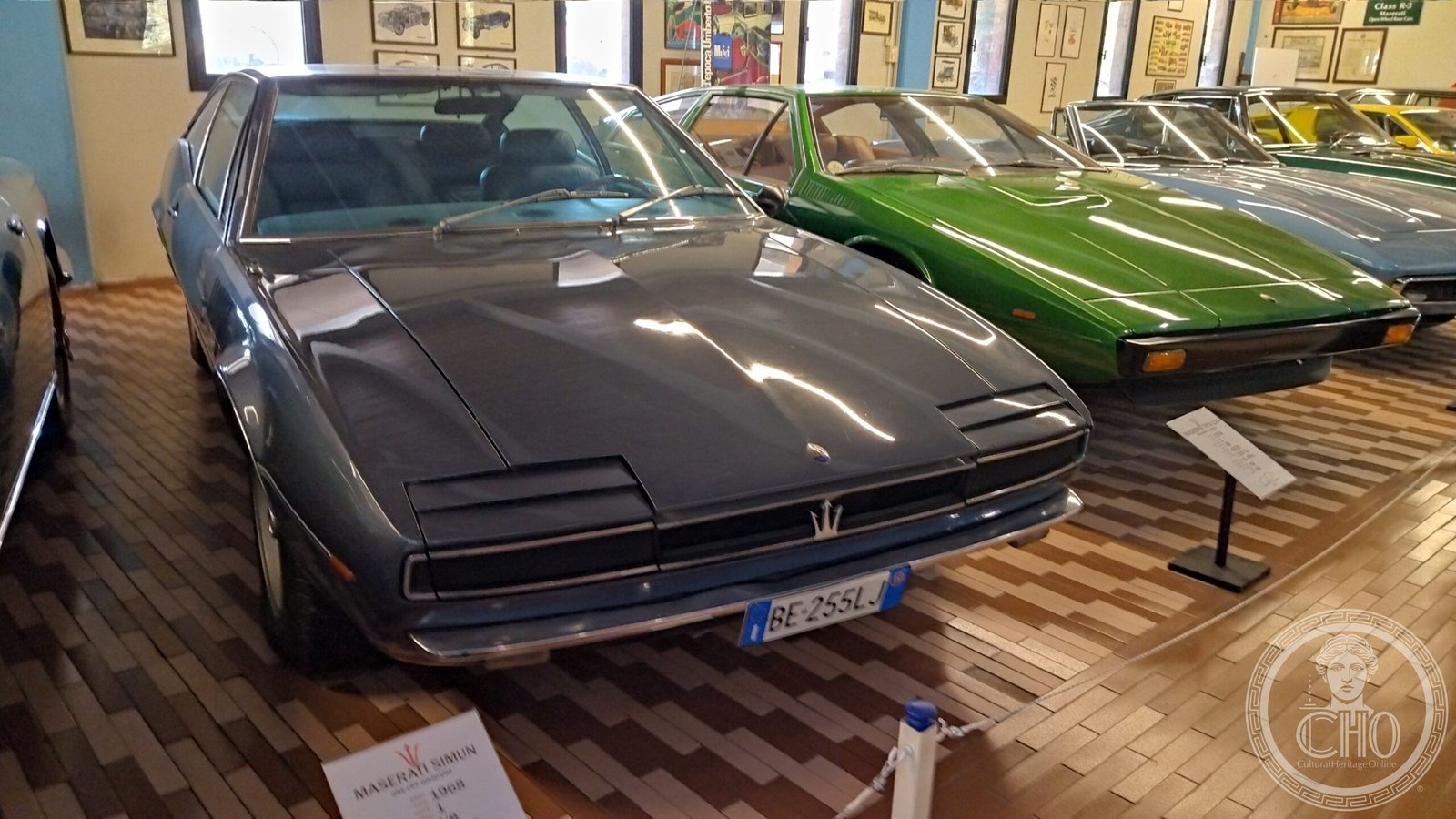

Modena gave Italy the trident: Maserati was born here in 1914, its twin-cam engine tested on the Viale Ciro Menotti circuit by Alfieri Maserati before the First World War was over. The city's motor heritage includes the Casa Natale Enzo Ferrari, the Enzo Ferrari Museum by Future Systems, and a cluster of private collections where historic Maserati, De Tomaso, and Bugatti machinery survives.
At a glance
Modena is the capital of what Italians call the Motor Valley — the 80-kilometre strip of the Via Emilia from Modena to Bologna where Ferrari, Lamborghini, Ducati, Pagani, and Maserati all have or had their main facilities. Maserati was founded in Bologna in 1914 by Alfieri Maserati and moved to Modena in 1937, where its factory on Viale Ciro Menotti operated until 1993. The official Maserati Heritage programme and the brand's historic vehicles are today managed by the company in collaboration with the Enzo Ferrari Museum in Modena; the Museo Panini in the Hombre farm at Lesignana holds one of Europe's most significant private collections of Maserati road and racing cars. The Casa Natale Enzo Ferrari (Corso Canalchiaro 85) is open to visitors as an independent museum.
Key facts
- Maserati founded: 1 December 1914, Bologna; moved to Modena 1937
- Maserati symbol: Trident of Neptune, from the Piazza Maggiore fountain in Bologna
- Enzo Ferrari Museum address: Via Paolo Ferrari 85, 41121 Modena
- GPS (Enzo Ferrari Museum): 44.6487, 10.9162
- Museo Panini (Hombre): Via Corletto Sud, Lesignana, 41123 Modena
- Reference: Enzo Ferrari Museum, Modena
History
The Maserati brothers — Alfieri, Bindo, Carlo, Ettore, and Ernesto — came from Voghera in Lombardy; Carlo had raced for Bianchi at the 1908 Coppa Florio, and the brothers had worked for the Isotta Fraschini racing team before founding their own firm. The founding product in 1914 was a racing car built around a twin-cam four-cylinder engine of Alfieri's design. Alfieri won the Targa Florio in 1926 in a Maserati 26 — the first significant international victory for an Italian car not named Fiat or Alfa Romeo. He died in 1932, aged 44, of complications from a racing injury; the brothers continued under the control of the Bolognese industrialist Adolfo Orsi, who bought the company in 1937 and moved production to Modena.
The Maserati 250F — the open-wheel Formula 1 car raced between 1954 and 1960 — is the machine on which Juan Manuel Fangio won his fifth world championship title in 1957, driving a memorably improvisational race at the Nürburgring in which he overcame a 50-second pit stop deficit to win by 3.5 seconds. The 250F is generally considered one of the most beautiful racing car designs ever made. After financial difficulties ended Maserati's factory racing programme in 1957, the company pivoted to road cars with the 3500 GT, the Mistral, the Ghibli, and the Quattroporte — establishing a character distinct from Ferrari: grand touring rather than pure sports, power combined with four-seat comfort.
Maserati passed through Citroën ownership (1968–75), near-liquidation, Alejandro De Tomaso's ownership (1975–93), and then through Fiat, Ferrari, and finally Stellantis. Production returned to Modena in 2021 with the MC20 supercar, assembled in the historic factory on Viale Ciro Menotti. The Museo Panini at the Hombre farm holds 70+ historic vehicles including the largest surviving collection of pre-war Maserati racing cars outside the company's own storage.
The Modena motor heritage sites
The Enzo Ferrari Museum, designed by Future Systems (now Capricorn) and completed in 2012, is one of the few significant pieces of contemporary architecture in Emilia-Romagna: a yellow aluminium roof of undulating form shelters the exhibition hall, its curvature an allusion to the aerodynamic forms of the racing cars displayed within. The museum traces Ferrari's Modena origins and history alongside rotating displays of historic vehicles, and connects directly to the Casa Natale — the house where Enzo Ferrari was born in 1898 — via an enclosed passage.
The Museo Panini is a different experience: a private farm collection in a rural setting 8 kilometres from Modena's historic centre, where the Panini family — founders of the Panini sticker albums — assembled over a lifetime a collection of 70+ vehicles, predominantly Italian and predominantly pre-war. The Maserati group — racing cars from the 1920s and 1930s, many in running condition — is the core of the collection, but the Bugattis, Alfas, and Lancia D23s make it one of the most significant private collections in Europe.
Practical information
- Enzo Ferrari Museum, Modena: Open daily 9:30–18:00 (seasonal variation); ticketed; museomaranello.ferrari.com
- Museo Panini (Hombre Farm): Visits by appointment; Via Corletto Sud, Lesignana; contact via hombre.it
- Time needed: Enzo Ferrari Museum = 1.5 hours; Museo Panini = 2 hours
- Motor Valley day route: Modena (Ferrari Museum) → Maranello (Galleria Ferrari, 20 km) → Sant'Agata Bolognese (Lamborghini, 30 km) → Bologna (Ducati, 40 km)
Getting there
Modena is on the Bologna–Milan high-speed rail line (Bologna: 25 minutes; Milan: 55 minutes). From Modena railway station: the Enzo Ferrari Museum is 10 minutes on foot across the historic centre. By car: A1 autostrada Milan–Bologna, exit Modena Nord or Modena Sud. Museo Panini is 8 km south-east of Modena centre, accessible only by car (no public transport to Lesignana).
Nearby
- Galleria Ferrari, Maranello — 20 km south, the Scuderia Ferrari museum with F1 championship cars
- Duomo di Modena — 500 m, Romanesque cathedral (UNESCO) with Wiligelmo's Genesis reliefs (c. 1099)
- MUDETEC Lamborghini, Sant'Agata Bolognese — 30 km north, Lamborghini's complete historic collection
- Acetaia Villa San Donnino — 3 km, Modena's traditional balsamic vinegar (DOP) production and museum
Sources
- Wikipedia (English): Maserati
- Enzo Ferrari Museum: museomaranello.ferrari.com
- Wikipedia (Italian): Museo Casa Enzo Ferrari
- Wikimedia Commons: File:Maserati Simun museopanini.jpg, CC0 Public Domain
- Nominatim / OpenStreetMap: GPS 44.6487, 10.9162 (Enzo Ferrari Museum, Modena)
Find it on the map
See this place and what’s around it →📷 Become a Cultural Heritage Online photographer
Share your photos of places: they stay published under your name as the author. The more they're seen, the more you get noticed — and soon a contest will reward the most appreciated photos.
Log in or sign up free to add a photoIs this page about you?
This page is read by travellers and heritage enthusiasts who find it on Google. Tell us how you are connected to this place and we will take it from there.