
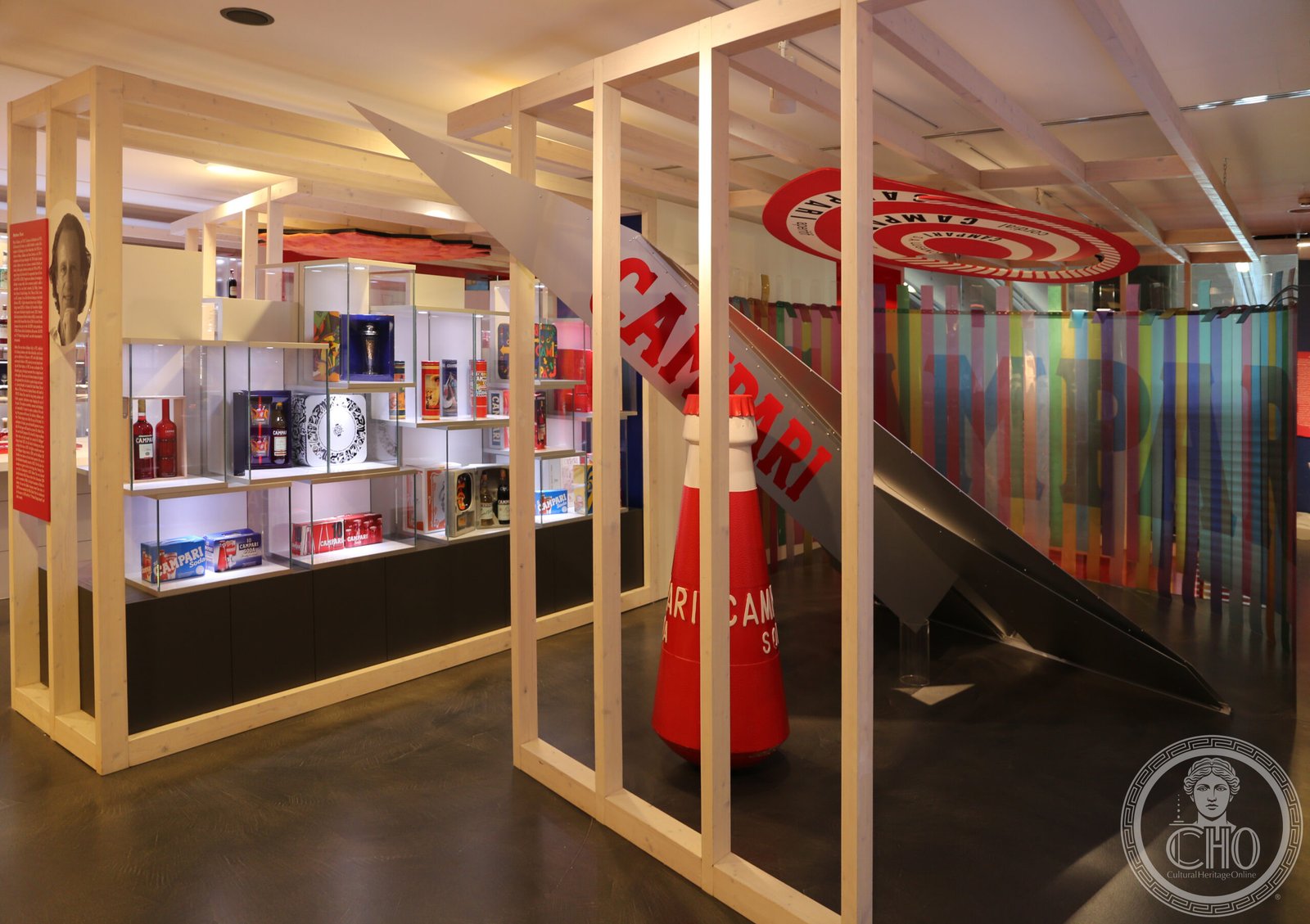

In the former Campari factory on the edge of Milan, the Galleria Campari tells the story of the bitter red aperitivo that Gaspare Campari invented in Novara in 1860 and that became one of the most recognisable Italian brand identities of the twentieth century — through its bottles, its posters, and the artists it commissioned.
At a glance
The Galleria Campari opened in 2010 in the historic Campari Group headquarters at Viale Antonio Gramsci 161 in Sesto San Giovanni, a town immediately north of Milan that was the centre of Italian heavy industry for most of the twentieth century. The museum holds the company's archive of advertising materials, limited-edition bottles, original artworks, and objects related to the production history of Campari and its affiliated brands, including Aperol, Cynar, and Cinzano. At its core is the collection of poster art commissioned by Campari from the major Italian futurists and commercial artists of the early twentieth century: Fortunato Depero, Leonetto Cappiello, Franz Laskoff — work that made Campari a patron of the visual avant-garde at a moment when Italian advertising was developing its visual language.
Key facts
- Opened: 2010
- Address: Viale Antonio Gramsci 161, 20099 Sesto San Giovanni (MI)
- GPS: 45.5391, 9.2355
- Brand origin: 1860, Gaspare Campari, Novara
- Key art commissions: Fortunato Depero (1932 Futurist bottle); Leonetto Cappiello (1921 poster)
- Website: campari.com/galleria
History
Gaspare Campari invented his bittersweet red aperitivo — the exact recipe remains a trade secret, containing between 20 and 60 ingredients including the bark of different trees, plants, herbs, and aromatic roots — around 1860 in Novara, where he worked as a distiller. He moved to Milan in 1862, opening the Bar Campari in the Galleria Vittorio Emanuele II, the glass-vaulted arcade just completed in the city's centre. The bar became a fixture of Milanese intellectual life: the poet and playwright Carlo Porta frequented it, and the Campari Soda (Campari pre-mixed with soda, served in the distinctive cone-shaped single-serve bottle) was invented for the bar's aperitivo hour. Campari reached beyond national borders in the 1890s and became one of the first Italian food and drink brands to have a global distribution in the early twentieth century.
The company commissioned advertising from some of the most inventive Italian graphic artists of the period. Fortunato Depero, the Futurist artist who later designed the famous “Campari Soda” conical bottle in 1932 (one of the first examples of a branded vessel designed as a work of art), created a series of posters and advertisements for Campari in the late 1920s. Leonetto Cappiello's 1921 poster — a clown astride a galloping horse, red overcoat against blue night — was among the most reproduced Italian advertising images of the twentieth century. The Campari archives, now held in Sesto San Giovanni, contain the originals of this material alongside the company's full production and marketing history.
The Campari Group transferred its headquarters and production facilities to Sesto San Giovanni in the early twentieth century, consolidating production on the site where the Galleria now stands. The company moved its official headquarters to Sesto Calende in 2014, but the Sesto San Giovanni building retains the historic archive and the museum space.
What you see
The Galleria is housed in the original Campari factory complex: a rationalist industrial building from the Fascist period, with the characteristic horizontal banding and angular details of Italian industrial architecture of the 1930s. The interior has been adapted for museum use while retaining the spatial character of the factory: high ceilings, large windows, the scale of a production building rather than a gallery.
The displays combine the company's product history — bottle designs from the 1860s to the present, including the iconic Depero cone bottle — with the advertising art collection: original poster paintings, film-strip animations, packaging design, and the sequence of limited editions commissioned by the company for the cocktail market. A separate section covers the Negroni — the cocktail that made Campari the defining Italian bitter internationally, invented in Florence in 1919 when Count Camillo Negroni asked the bartender to strengthen his Americano cocktail by replacing soda with gin.
Practical information
- Visits: By appointment; contact via campari.com/galleria
- Time needed: 1–1.5 hours
- Highlights: Depero “Camparisoda” bottle (1932); Cappiello 1921 poster; Campari Soda original bottle; Negroni cocktail archive; Futurist advertising collection
Getting there
Sesto San Giovanni is immediately north of Milan, accessible by Metro Line 1 (red) from the city centre: Sesto Marelli or Sesto San Giovanni stations are a short walk from the Campari building. By car: Tangenziale Nord from Milan (A4/A8 motorway ring), exit Sesto San Giovanni. The Campari building is on Viale Gramsci, the main commercial avenue of Sesto San Giovanni.
Nearby
- Parco Nord Milano — 1 km west, 640-hectare urban forest on former industrial land
- Ex Falck steelworks (Sesto San Giovanni) — 500 m, the largest industrial brownfield redevelopment in Italy; hosts cultural events
- Fondazione Prada, Milan — 8 km south-west, contemporary art and design institution in a former distillery
- Museo Storico Alfa Romeo, Arese — 20 km north-west, 256 vehicles from 1910 to present in the original Alfa Romeo factory
Sources
- Wikipedia (Italian): Campari
- Campari Group official: campari.com/galleria
- Wikipedia (English): Campari
- Wikimedia Commons: File:Sesto san giovanni, museo campari, 04.jpg, Sailko, CC BY 3.0
- Nominatim / OpenStreetMap: GPS 45.5391, 9.2355
Find it on the map
See this place and what’s around it →📷 Become a Cultural Heritage Online photographer
Share your photos of places: they stay published under your name as the author. The more they're seen, the more you get noticed — and soon a contest will reward the most appreciated photos.
Log in or sign up free to add a photoIs this page about you?
This page is read by travellers and heritage enthusiasts who find it on Google. Tell us how you are connected to this place and we will take it from there.