
_-_2022-08-31_-_4.jpg)
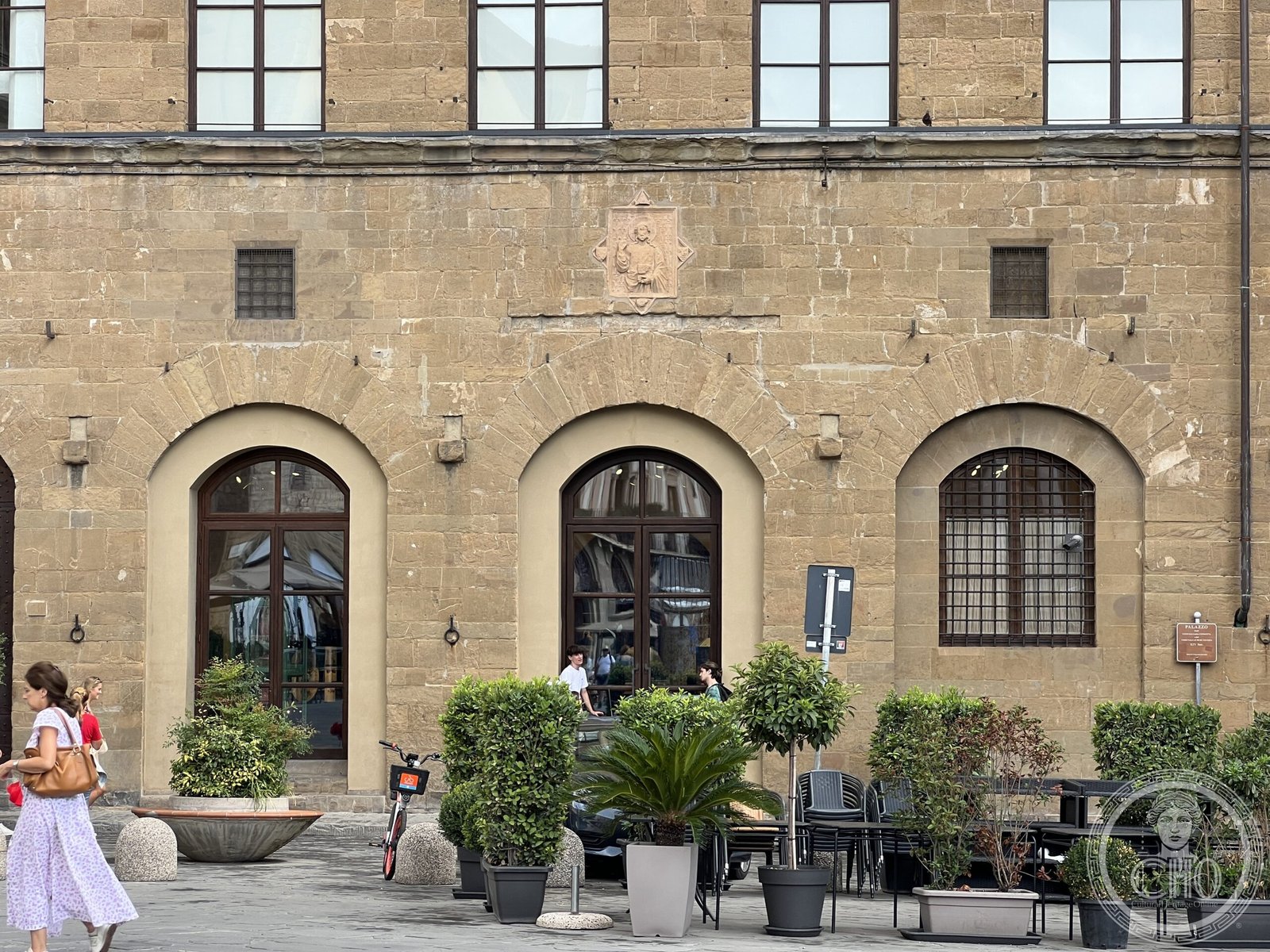
In the thirteenth-century Palazzo della Mercanzia overlooking Piazza della Signoria, the Gucci Garden occupies the building where Florentine merchants once settled their disputes — a fitting location for a brand whose aesthetic was built on the tension between Florentine craft tradition and international luxury commerce.
At a glance
The Gucci Garden opened in 2011 in Palazzo della Mercanzia, the seat of the Florentine merchants' tribunal from 1359, at Piazza della Signoria 10. The museum — known as the Gucci Museo since its opening and rebranded as the Gucci Garden in 2018 — occupies three floors of the medieval palazzo, tracing the history of the house from Guccio Gucci's 1921 leather goods shop in Via della Vigna Nuova to the contemporary creative direction of Sabato De Sarno. The permanent collection holds garments, accessories, archival advertising, and original designs from nine decades of production; the building also contains a restaurant and a boutique. Admission includes access to the collection and to the frescoed medieval interior of the Mercanzia.
Key facts
- Opened: 2011 (as Gucci Museo); rebranded Gucci Garden 2018
- Building: Palazzo della Mercanzia (1359), Piazza della Signoria 10
- GPS: 43.7697, 11.2568
- Floors: 3 floors of permanent collection
- Founded by: Guccio Gucci in Florence, 1921 (luggage and leather goods)
- Website: gucci.com/garden
History
Guccio Gucci opened his first shop in Florence in 1921, selling leather luggage and equestrian accessories to a clientele that was just beginning to discover the organised tourism of the grand hotel era. The business was built on the reputation of Florentine leather craftsmanship and on Gucci's own experience as a hotel worker in London, where he had observed the travelling habits of the wealthy at the Savoy. The bamboo handle (introduced in 1947 when Italian leather was scarce due to post-war sanctions), the double-G logo (introduced in the 1960s as a tribute to Guccio), and the red and green stripe derived from the saddlery tradition are among the visual elements that made Gucci identifiable across markets and decades.
The brand expanded internationally through the 1950s and 1960s, opening stores in New York, Paris, London, and Tokyo; its customers included Jacqueline Kennedy (whose association with the Jackie O bag gave one of the house's most famous designs its colloquial name), Audrey Hepburn, and Grace Kelly. After a troubled period in the 1980s and early 1990s — family conflicts, near-bankruptcy, the murder of Maurizio Gucci — the brand was revived under Tom Ford's creative direction from 1994, and became part of the French luxury conglomerate Kering in 1999. The Gucci Garden was established to anchor the brand's Florentine identity against the Paris-headquartered conglomerate context.
The Palazzo della Mercanzia was chosen as the museum location because of its historical role as the institutional home of Florentine merchant capitalism — the institution that Gucci's craft tradition had grown within. The building's interior retains its medieval ceiling paintings and heraldic decorations alongside the brand's display design.
What you see
The permanent collection is organised thematically rather than chronologically, moving through the house's archive of garments, accessories, shoes, and luggage in rooms that pair different historical moments around recurring motifs: the horse-bit, the flora print, the bamboo, the double-G. This approach reveals the extent to which Gucci's visual language has been worked and reworked over decades — not a linear stylistic evolution but a set of elements in constant reinterpretation.
The medieval frescoes of the Mercanzia rooms — heraldic panels, guild symbols, ceiling paintings in tempera on wood — remain visible above and around the fashion display, creating a historical frame that is either appropriate or ironic depending on the visitor's perspective. Gucci's restaurant on the ground floor, designed with the house's visual codes applied to a dining context, has its own reputation. The building's Gothic façade on Piazza della Signoria is one of the most prominent in the square; the sign “Gucci Garden” is, depending on your view of this, a statement about contemporary luxury and Florentine civic identity.
Practical information
- Opening hours: Check gucci.com/garden (typically Tuesday–Sunday 10:00–20:00)
- Admission: Ticketed; booking recommended
- Time needed: 1–1.5 hours for the collection
- Highlights: Jackie O bag (1950s), bamboo-handle bags (1947 onwards), Tom Ford archive, Alessandro Michele era pieces, horse-bit loafers
Getting there
Palazzo della Mercanzia is directly on Piazza della Signoria at number 10 — the square that contains the Palazzo Vecchio, the Loggia dei Lanzi, and the replica of Michelangelo's David. From Florence SMN station: 15 minutes on foot via Via dei Cerretani and Via Calimala. From the Duomo: 5 minutes on foot through Via dei Calzaiuoli. The ZTL restricted zone covers Piazza della Signoria; park outside the centre and approach on foot.
Nearby
- Palazzo Vecchio — 30 m, medieval civic palace of the Florentine Republic; frescoed halls, Michelangelo's David (copy)
- Loggia dei Lanzi — 50 m, open-air sculpture gallery: Cellini's Perseus, Giambologna's Rape of the Sabine Women
- Uffizi Gallery — 200 m, the world's greatest collection of Italian Renaissance painting
- Museo Salvatore Ferragamo — 500 m, Palazzo Spini Feroni, 14,000 shoe models from 1920 to present
Sources
- Wikipedia (English): Gucci
- Gucci Garden official: gucci.com/garden
- Wikipedia (Italian): Palazzo della Mercanzia
- Wikimedia Commons: File:Musée Gucci Florence 2022, Chabe01, CC BY-SA 4.0
- Nominatim / OpenStreetMap: GPS 43.7697, 11.2568
Find it on the map
See this place and what’s around it →📷 Become a Cultural Heritage Online photographer
Share your photos of places: they stay published under your name as the author. The more they're seen, the more you get noticed — and soon a contest will reward the most appreciated photos.
Log in or sign up free to add a photoIs this page about you?
This page is read by travellers and heritage enthusiasts who find it on Google. Tell us how you are connected to this place and we will take it from there.